Scientists have finally confirmed a universal law of growth in two dimensions. They used a quantum system of tiny light-matter particles. This discovery supports the idea that many different processes, from crystals forming to living systems growing, might follow the same hidden rules.
Why Growth Is Hard to Predict
Understanding how surfaces grow has been a big challenge in physics. In 1986, researchers created the Kardar-Parisi-Zhang (KPZ) equation. This theory describes growth in many systems. It has been used for crystal growth, how populations change, how flames spread, and even in machine learning. The main idea is that very different systems can follow the same basic rules as they grow.
Now, scientists at the University of Würzburg have made a big step forward. They first confirmed the KPZ theory in one-dimensional systems in 2022. Now, they have shown it also works in two dimensions. This is a major achievement, proving how widely this model applies.
We're a new kind of news feed.
Regular news is designed to drain you. We're a non-profit built to restore you. Every story we publish is scored for impact, progress, and hope.
Start Your News DetoxSiddhartha Dam, a researcher at the University of Würzburg, explained that growing surfaces are always complex and random. He noted that these systems are "out of equilibrium" in physics. It is very hard to measure how such a process changes in both space and time, especially because these changes happen very quickly. This is why it took so long to prove the KPZ model in two dimensions. The team managed to control a quantum system in the lab, which has only recently become possible with new technology.
Building a Quantum Experiment
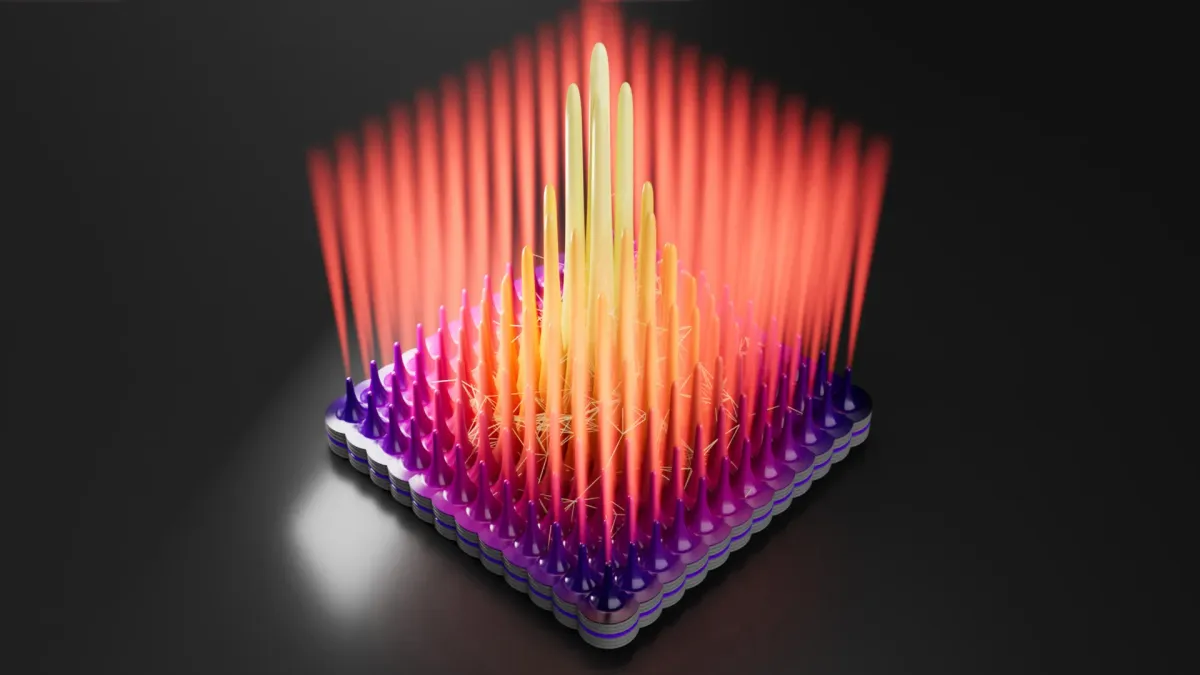
To test the theory, the researchers built a very precise quantum setup. They cooled a semiconductor made of gallium arsenide (GaAs) to an extremely cold temperature of -269.15°C. Then, they continuously shined a laser on it. This created unusual particles called polaritons inside the material.
Polaritons are a mix of light and matter. They combine photons (light particles) with excitons (electron-hole pairs). They only exist for a very short time and only when the system is out of equilibrium. The laser creates them, and they disappear within a few picoseconds. This makes them perfect for studying fast growth processes.
Dam explained that they could accurately track the polaritons' locations. When the system was pumped with light, polaritons were created, meaning they "grew." Using advanced methods, the team measured how this quantum system grew in both space and time. They found that it followed the KPZ model.
From Idea to Proof
The idea to test KPZ behavior in such a system came from Sebastian Diehl, a professor at the University of Cologne and part of the research team. His group developed the theory in 2015.
In 2022, researchers in Paris confirmed KPZ predictions experimentally, but only in one dimension. Expanding this to two dimensions was much harder. The new results from Würzburg provide this missing proof.
Diehl said that showing KPZ universality in two-dimensional materials proves how fundamental this equation is for real systems that are out of equilibrium.
Precision Engineering Made It Possible
A key part of this breakthrough was the ability to carefully design the material. The team created a complex structure. Mirror layers trapped photons inside a central "quantum film." In this layer, photons interacted with excitons in the gallium arsenide. This formed polaritons, which the scientists could then observe as they developed.
Simon Widmann, a doctoral researcher who worked on the experiments, explained how they precisely controlled the thickness of each material layer. They used a method called molecular beam epitaxy to create highly reflective mirrors under ultra-high vacuum. This allowed them to control how the material grew atom by atom and fine-tune all experimental settings, like the laser, which had to excite the sample with extreme precision. This level of control was crucial for successfully showing KPZ universality.