A new study shows that how a cell fails to divide after copying its DNA can change its future. This discovery comes from research into whole genome duplication.
Cell division is a basic process for all life. Thousands of molecules in human cells work together very quickly and precisely. But sometimes, errors happen.
Before a cell splits into two, it must make an exact copy of its DNA. This ensures each new cell gets a full set. Sometimes, the DNA copies correctly, but the cell doesn't finish dividing. When this happens, the cell ends up with two full sets of DNA. This state is called whole genome duplication (WGD).
We're a new kind of news feed.
Regular news is designed to drain you. We're a non-profit built to restore you. Every story we publish is scored for impact, progress, and hope.
Start Your News DetoxThink of it like making two photocopies of a document. Instead of putting each copy in a separate folder, both copies end up in the same folder.
Whole genome duplication is a serious error. It can affect whether a cell keeps working, becomes inactive, or dies. It can also change a cell's role, lead to age-related damage, or contribute to diseases like cancer.
Researchers at Hokkaido University looked at two main ways cells fail to divide and enter this duplicated state: cytokinesis failure and mitotic slippage.
Two Ways Cells Fail to Divide
In cytokinesis failure, the cell completes most of its division steps. However, it doesn't physically split due to a problem in its cytoplasm. In mitotic slippage, the cell starts dividing but stops too early, without properly separating its chromosomes.
Associate Professor Ryota Uehara, the study's lead author, noted that it was unclear if these different routes affected the resulting cells.
Even though both routes create cells with duplicated genomes, their outcomes are very different.
The researchers used live cell imaging to track cells after duplication. Cells formed through cytokinesis failure were more stable and survived better. In contrast, cells from mitotic slippage had uneven chromosome distribution and were less likely to survive.
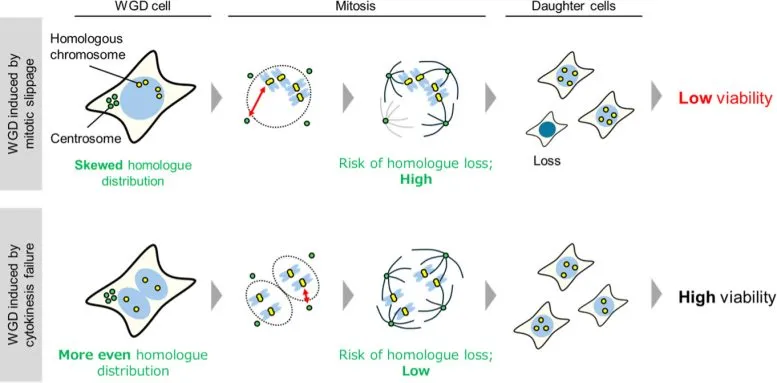 Different ways cells fail to divide lead to different chromosome distributions and survival outcomes. Credit: Ryota Uehara
This difference is linked to how chromosomes are arranged during division. Mitotic slippage often causes uneven chromosome separation, which lowers cell survival. Cytokinesis failure tends to keep a more balanced distribution, helping cells survive.
When researchers improved chromosome separation in cells undergoing mitotic slippage, those cells survived much better.
What This Means for Cancer
These findings are important for cancer research. Whole genome duplication is common in cancer cells. Some cancer treatments might even cause it. Cells that survive after duplication can keep growing and might lead to cancer returning.
The study suggests that targeting the mechanisms of chromosome separation could help reduce the survival of these abnormal cells.
Uehara explained that the different ways whole genome duplication can happen have largely been overlooked. He added that their study challenged this idea by comparing cells formed through different methods. They found these differences can affect cell behavior over time.
Deep Dive & References
Sister chromatid separation determines the proliferative properties upon whole-genome duplication via homologous chromosome arrangement - Proceedings of the National Academy of Sciences, 2026