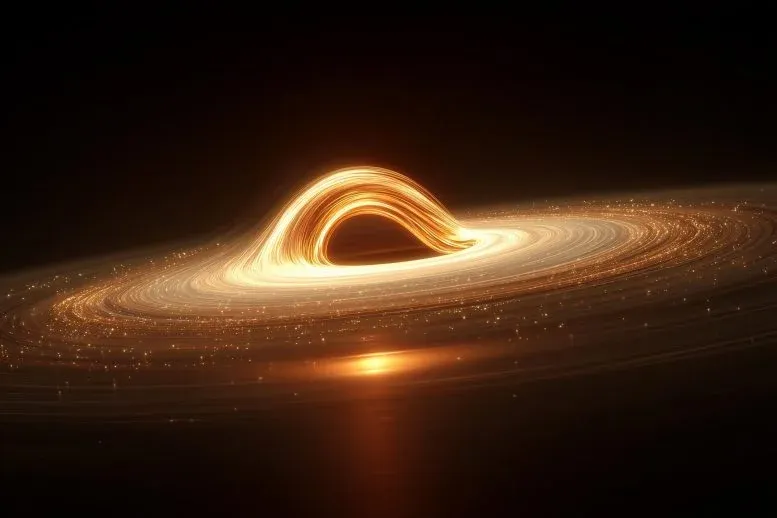
For over a century, Einstein's equations predicted something wild: that a spinning black hole should drag spacetime around itself like water spiraling down a drain. Now astronomers have actually seen it happen.
The evidence came from watching a star get shredded. As the doomed star's debris spiraled into a black hole, it formed a rapidly rotating disk of glowing material. At the same time, powerful jets of gas shot outward at nearly the speed of light. Both the disk and the jets wobbled in sync, completing one full cycle every 20 days—a repeating pattern that could only be explained by spacetime itself being twisted and dragged by the black hole's spin.
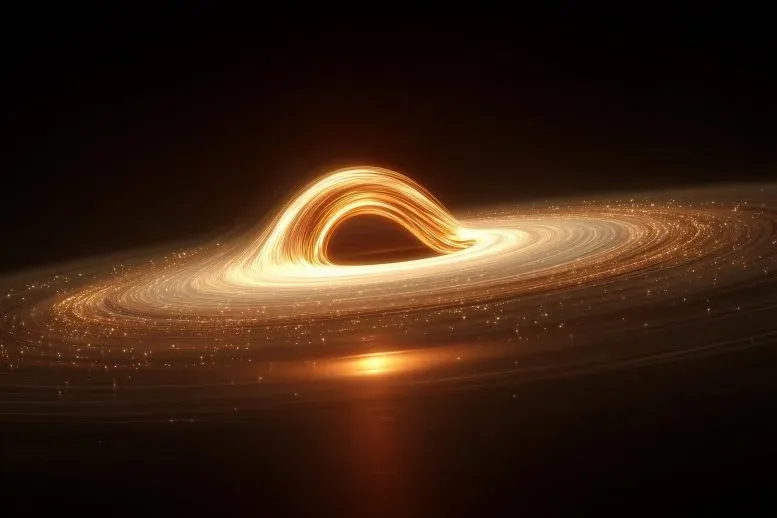 Astronomers have finally caught a spinning black hole in the act of twisting the fabric of spacetime itself. The discovery came from watching a distant star get torn apart, forming a glowing disk and powerful jets that began to wobble together in a steady rhythm. (Artist's concept.) Credit: SciTechDaily.com
We're a new kind of news feed.
Regular news is designed to drain you. We're a non-profit built to restore you. Every story we publish is scored for impact, progress, and hope.
Start Your News DetoxA prediction finally made real
Einstein proposed the basic idea in 1913. Two Austrian physicists, Josef Lense and Hans Thirring, worked out the mathematics in 1918. They called it frame-dragging—the idea that rotating mass doesn't just sit there; it actually warps the space and time around it, pulling nearby objects along for the ride. It's one of general relativity's stranger predictions, the kind of thing that sounded theoretically sound but almost impossible to verify in the real universe.
That's where this discovery matters. Researchers analyzed X-ray data from NASA's Neil Gehrels Swift Observatory and radio observations from the Karl G. Jansky Very Large Array. By combining these signals with detailed analysis of the material's behavior, they found the smoking gun: that synchronized wobble, repeating with clockwork precision.
"By showing that a black hole can drag spacetime and create this frame-dragging effect, we are also beginning to understand the mechanics of the process," said Dr. Cosimo Inserra, a co-author of the study. The finding doesn't just tick a box on Einstein's to-do list. It gives astronomers a new tool to measure black hole spin, understand how matter actually falls into black holes, and figure out how those jets get launched at such extreme speeds.
For anyone who's ever wondered whether the universe really works the way physicists claim, this is the answer: yes, and we can finally prove it.