

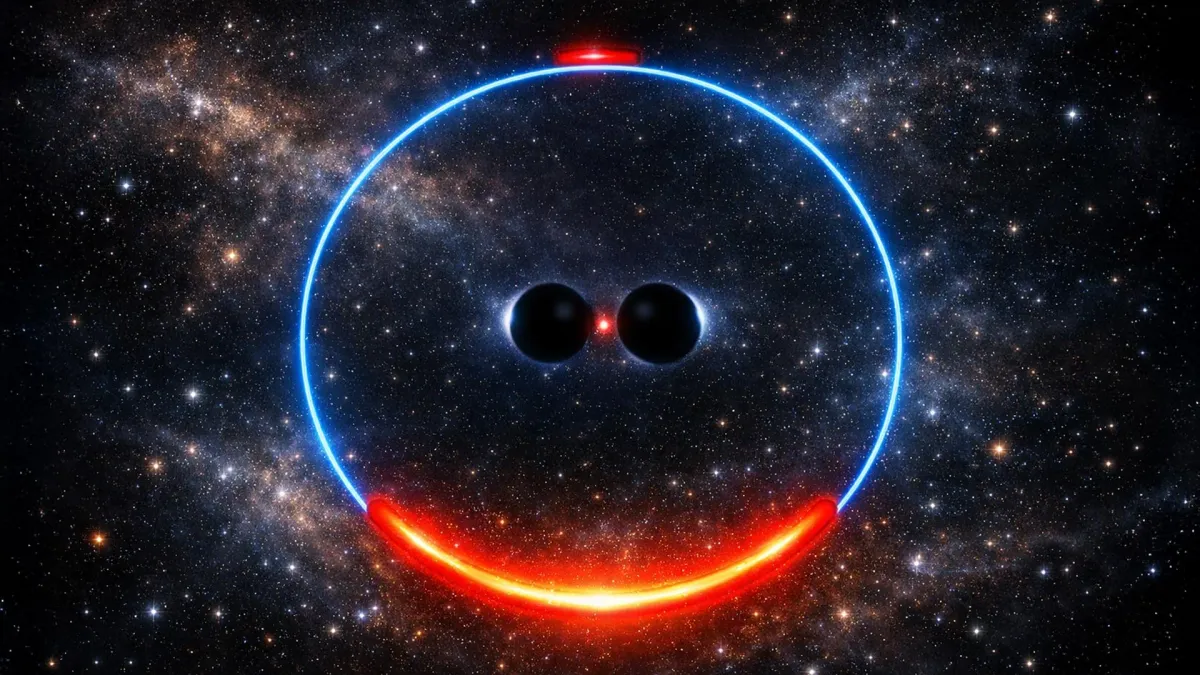
Astronomers have a new way to find pairs of supermassive black holes that are very close together. These pairs are hard to spot. They form when galaxies merge.
Scientists from the University of Oxford and the Max Planck Institute for Gravitational Physics developed this method. They look for stars that flash brightly again and again. This happens because the black holes' gravity magnifies the starlight.
How Black Hole Pairs Create Flashes
Most galaxies have a supermassive black hole at their center. When two galaxies collide, their black holes can become linked. This forms a supermassive black hole binary.
We're a new kind of news feed.
Regular news is designed to drain you. We're a non-profit built to restore you. Every story we publish is scored for impact, progress, and hope.
Start Your News DetoxThese systems are key to understanding how galaxies grow. They also create the strongest gravitational waves in the universe.
Future space telescopes will detect these waves directly. But this new research suggests we might not have to wait. Current and upcoming sky surveys could find these black holes using visible light.
Dr. Miguel Zumalacárregui explained that supermassive black holes act like natural telescopes. Their huge mass and small size bend light strongly. This can focus starlight into very bright images, a process called gravitational lensing.
The Unique Signal of Binary Black Holes
A single black hole can magnify a star, but only if the alignment is perfect. A binary system is different. Two black holes together create a much larger area where light can be magnified.
This area forms a diamond shape called a caustic curve. Stars that pass through this curve appear much brighter.
Professor Bence Kocsis noted that the chances of starlight being greatly amplified are much higher for a binary system.
Unlike a single black hole, a binary black hole system is always changing. The two black holes orbit each other. They slowly lose energy by sending out gravitational waves. This makes them move closer and orbit faster.
Hanxi Wang, who led the study, explained that as the binary moves, the caustic curve rotates and changes shape. It sweeps across many stars behind it. If a bright star is in this region, it can produce a very bright flash each time the curve passes over it. This creates repeated bursts of starlight. These bursts are a clear sign of a supermassive black hole binary.
The flashes would happen again and again. This creates a pattern that astronomers can look for.
Learning from the Flashes
The team found that the timing and brightness of these flashes are not random. They follow predictable trends.
As gravitational waves shrink the orbit, they change the caustic curve's shape and movement. These changes leave clues in the flashes' brightness and frequency.
By studying these patterns, researchers can learn about the binary system. They can estimate the black holes' masses and details of their orbits.
New observatories like the Vera C. Rubin Observatory and the Nancy Grace Roman Space Telescope will help in this search.
Professor Kocsis is excited about finding these black hole binaries years before gravitational wave detectors are ready. He said it will allow new ways to study gravity and black holes.
Deep Dive & References
- Black Holes as Telescopes: Discovering Supermassive Binaries through Quasiperiodic Lensed Starlight - Physical Review Letters, 2026





