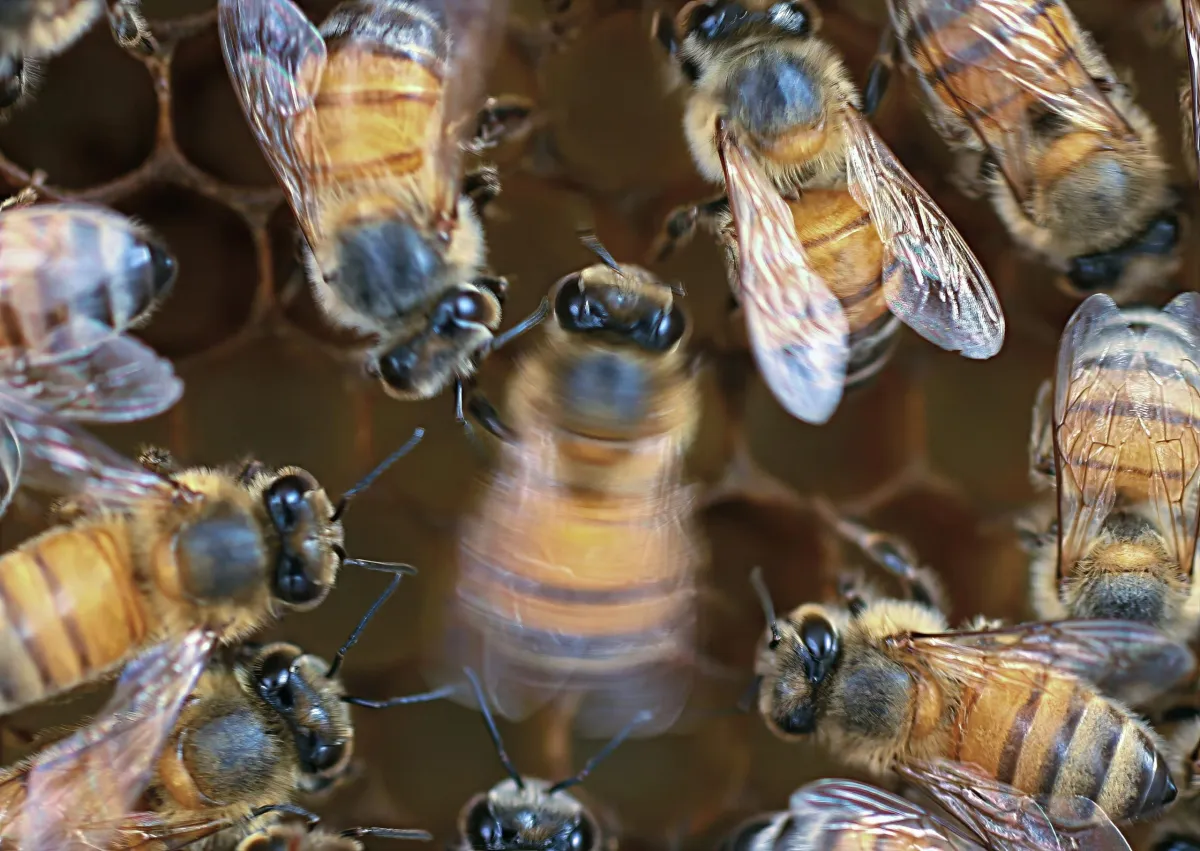
Get this: honey bees, those tiny masters of communication, actually perform their famous "waggle dance" way better when they have a big audience. Seriously, if fewer bees are paying attention, their dance gets sloppy.
It's like they're little street performers, and audience size totally changes their act.
The Bee's Secret Language
When a foraging bee finds a sweet spot with food, it rushes back to the hive. Then, it launches into this wild, wiggly dance. Other bees crowd around, watching every move.
We're a new kind of news feed.
Regular news is designed to drain you. We're a non-profit built to restore you. Every story we publish is scored for impact, progress, and hope.
Start Your News DetoxThe bee shakes its body forward, then loops back. The angle of that straight run tells everyone the direction of the food, using the sun as a compass. The longer the dance, the farther away the snacks are. It's a super efficient GPS system for the whole colony.
But here's the twist: Professor James Nieh from UC San Diego says it's just like a human performer. If a street dancer has a huge crowd, they can really focus. But if only a few people are watching, they might move around more, trying to grab attention. That makes their performance less sharp.
Bees do the same thing. Fewer followers means the dancer moves more, trying to find an audience. All that extra movement makes it harder to keep the dance precise. So, the directions get less accurate.
Social Feedback Makes a Difference
Nieh and his team, working with folks from the Chinese Academy of Sciences and Queen Mary University of London, set up controlled hives. They messed with the number of bees watching the dance.
What they found was pretty nuts: Dance quality went down when the audience was smaller. Even when they kept the total number of bees the same but added younger bees (who usually don't care about dances), the results were the same. Dancers were less accurate when their audience wasn't engaged.
Ken Tan, a senior author on the study, pointed out that people used to think the waggle dance was just a one-way message. But this new data shows the audience actually shapes the signal. The dancer isn't just broadcasting; it's reacting to the vibe in the hive.
How Bees Know You're Watching
So, how do the bees know if they have an audience? It turns out, watching bees often touch the dancer with their antennae and bodies. These little bumps and taps probably tell the dancing bee how many and what kind of followers are around.
Lars Chittka, another researcher, summed it up perfectly: Humans aren't the only ones who perform better under the spotlight. Honey bees literally dance better when they know someone is watching. When the crowd's thin, the dancer searches for listeners, and their message gets fuzzy.
It just goes to show you: even for insects, communication is a seriously social game. And that's a pretty cool thing to know.