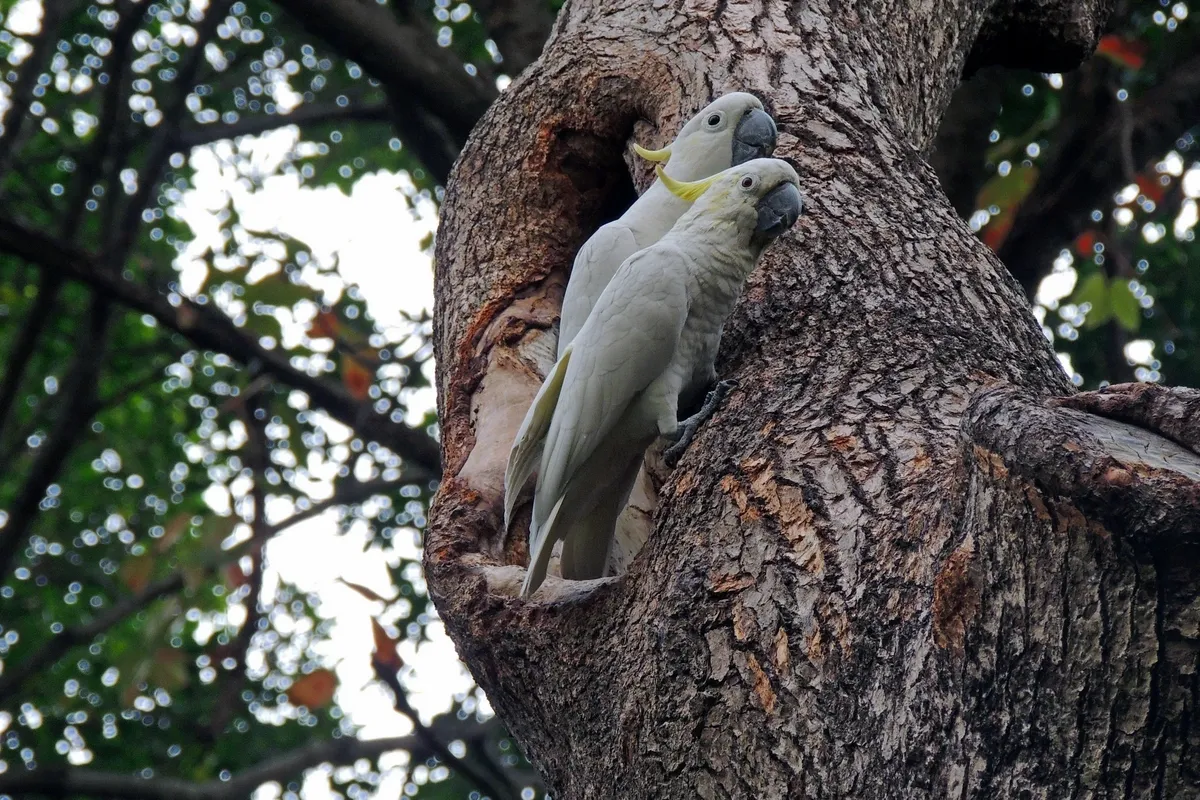
Turns out, those famously loud yellow-crested cockatoos squawking around Hong Kong's skyscrapers aren't just a local quirky landmark. They might actually be a genetic lifeline for their critically endangered relatives back in Indonesia.
These urban birds, whose ancestors were mostly escaped pets, have been thriving in one of the densest cities on Earth. And now, a new study suggests they've been doing more than just perfecting their street smarts; they've been building up a genetic treasure trove.

Down in their native Indonesia and Timor-Leste, fewer than 2,000 yellow-crested cockatoos (Cacatua sulphurea) are left in the wild. Habitat loss and the relentless illegal pet trade have pushed them to the brink. It's a grim picture for such a vibrant, intelligent bird.
We're a new kind of news feed.
Regular news is designed to drain you. We're a non-profit built to restore you. Every story we publish is scored for impact, progress, and hope.
Start Your News DetoxEnter Hong Kong, a city that's home to roughly 200 of these parrots. That's about 10% of the entire global population. Researchers took a deep dive into the DNA of these city slickers and found something genuinely surprising: they possess remarkably high genetic diversity. We're talking diversity on par with established wild parrot populations.
Lead author Astrid Andersson from Hong Kong University called these introduced urban populations a "Biodiversity Ark." She argues they shouldn't be dismissed but embraced as a potential solution to prevent extinction. Which, if you think about it, is both impressive and slightly terrifying that a bustling metropolis could become such a vital genetic repository.

The researchers even compared the Hong Kong birds' DNA to museum specimens representing all four known subspecies. The verdict? Hong Kong's cockatoos are a genetic melting pot, carrying markers from every single one. More than half the birds sampled were linked to a lineage from Lombok, an Indonesian island where the species is now believed to be locally extinct. So, the genetic ghosts of Lombok are apparently living their best city life, 1,600 miles away.
It’s a peculiar twist of fate: the very pet trade that imperiled these birds in the first place might have inadvertently created an escape hatch for their species, all thanks to a few avian jailbreaks in Hong Kong.