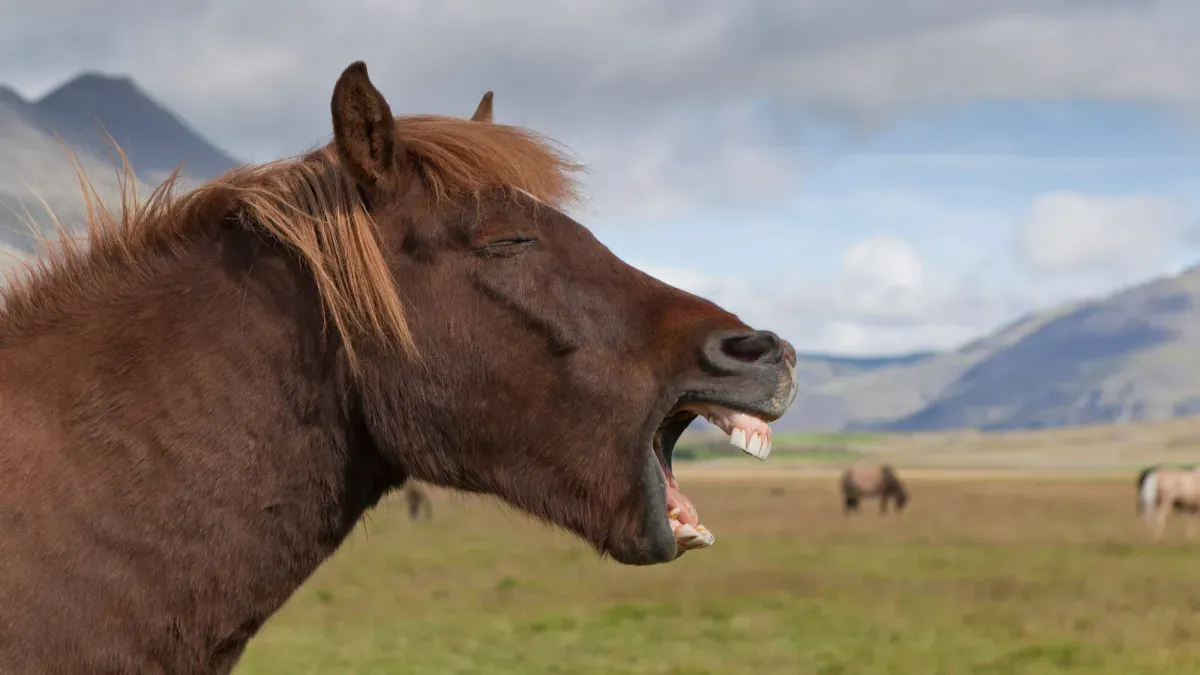
You've heard a horse whinny a thousand times—that iconic, unmistakable sound. But here's what researchers only figured out recently: horses are doing something biomechanically impossible. They're producing two completely different pitches at the same time, and one of them shouldn't exist at all.
A horse's body is huge. By the laws of physics, large animals produce low-frequency sounds. A horse's vocal folds vibrate the way ours do, creating that low rumble. But embedded in the same whinny is a high-frequency whistle so sharp it's more like what you'd expect from a bird. For decades, scientists couldn't explain where it came from.
Elodie Floriane Mandel-Briefer, a biologist at Copenhagen University who studies animal communication, puts it plainly: "Although humans have been co-existing and co-evolving with horses for 4,000 years, we still understand their communication imperfectly." Ten years ago, her team discovered the whinny contained two overlapping pitches—a phenomenon called biphonation. But knowing it existed and knowing how it worked were two different problems.
We're a new kind of news feed.
Regular news is designed to drain you. We're a non-profit built to restore you. Every story we publish is scored for impact, progress, and hope.
Start Your News DetoxThe Laryngeal Whistle
The breakthrough came through an unconventional experiment. Mandel-Briefer and her colleagues obtained horse larynges from a meat supplier and literally blew air through them. "Initially they only got the low component, but with some playing around they were able to obtain the high frequency component as well," she explains. This showed both sounds came from the larynx itself, not from the lips or any other part of the vocal tract.
To confirm the high-frequency part was actually a whistle—not vibrating tissue—the team ran a clever test. They blew two different gases through the larynges: regular air and helium. Helium shifts whistle frequencies upward because of its different physical properties. Tissue vibrations, by contrast, stay the same regardless of the gas. The shift proved it: horses were producing a laryngeal whistle alongside their normal vocal fold vibrations. This work, published recently in Current Biology, is the first time scientists have mechanically explained how horses pull off this feat.
As far as researchers can tell, horses are the only animals that combine these two sound-production methods simultaneously. Przewalski's horses, their close relatives, also do it. But zebras and donkeys—more distant cousins—don't produce that high-frequency component at all. This suggests the ability evolved specifically in the horse lineage, probably because it gave them a communication advantage.
The why matters as much as the how. In a 2015 study, Mandel-Briefer found that the high-frequency whistle carries emotional information—pleasant or unpleasant—while the low-frequency rumble conveys intensity. A horse can essentially send two messages at once: "I'm mildly happy" or "I'm intensely distressed." The high component also travels farther, so horses can communicate emotional nuance across greater distances. It's a richer communication system than most mammals possess, encoded in a single sound.
Understanding how animals communicate reveals something deeper about how they think and feel. Every time a horse whinnies, it's running a biomechanical trick that took humans 4,000 years of living alongside them to finally understand. The next time you hear one, you're listening to a small miracle of animal engineering—two voices in one.