Thomas Edison and Henry Ford spent winters in Fort Myers, Florida, taking joyrides through swamps in Model Ts that regularly flooded—much to the alarm of Clara Ford, who had a healthy fear of snakes. But between the chaos of those early 1900s road trips, the two inventors hatched an ambition that would consume the rest of Edison's life: find a way to grow rubber on American soil.
At the time, the U.S. depended almost entirely on natural rubber from British and Dutch colonies in Southeast Asia. The arrangement worked fine until it didn't—the moment a foreign power decided to cut off supply, American industry would grind to a halt. Edison, then in his sixties, saw the vulnerability and couldn't let it go.
The Laboratory Takes Root
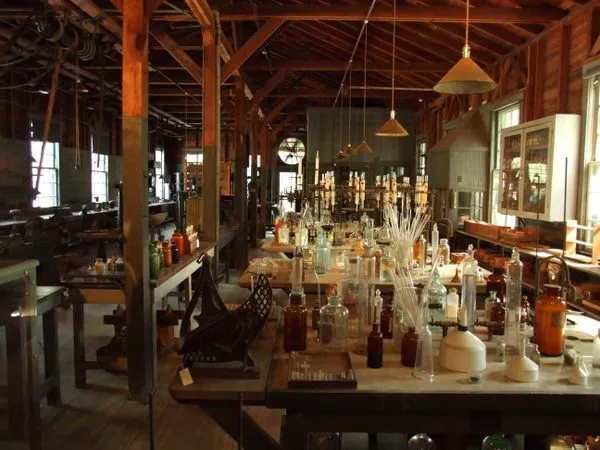
Edison had fallen in love with Fort Myers three decades earlier, after his first wife's death and a bout of burnout from perfecting the incandescent bulb. His doctor told him to rest in the South. He bought property along the Caloosahatchee River, drawn to the wild bamboo growing there, and eventually shipped down an entire laboratory from New Jersey. What started as a winter escape became something far more ambitious.
We're a new kind of news feed.
Regular news is designed to drain you. We're a non-profit built to restore you. Every story we publish is scored for impact, progress, and hope.
Start Your News DetoxWith Ford's encouragement and resources, Edison transformed the property into something between a botanical garden and an industrial research facility. Over 17,000 plant species were brought to the laboratory. Botanists, volunteers, and even the Union Pacific Railroad joined the effort, turning the grounds into a latex distilling operation. Edison was no longer just tinkering—he was running a full-scale agricultural experiment.
He cycled through candidates: tropical plants, a massive banyan tree (still standing today), and dozens of others. Then, in 1928, he found it. Goldenrod—a fast-growing weed that most people ignore—produced latex. It was the answer. Edison ripped out Mina's carefully tended citrus trees to plant rows of goldenrod. His wife watched her garden disappear into his obsession, and she worried. He was old now, consumed by this work in a way that frightened her.
The Legacy That Lived On
Edison died in 1931, and the botanical lab limped along until 1934, when the Department of Agriculture took it over. His goldenrod rubber never became a commercial success—the yield was never quite enough, the process never quite efficient enough.
But Edison's instinct about vulnerability proved prophetic. When Japan seized Southeast Asia during World War II, the U.S. suddenly had no natural rubber. The country pivoted to synthetic rubber, building directly on the foundation Edison's experiments had laid. The research that seemed to fail in peacetime became essential during war.
Today, the Edison and Ford Winter Estates in Fort Myers draws visitors who walk the grounds where two inventors once chased an impossible solution. The banyan tree still grows. The botanical laboratory still stands. And goldenrod still grows wild—a reminder that sometimes the answer to a problem is hiding in plain sight, waiting for someone stubborn enough to look.