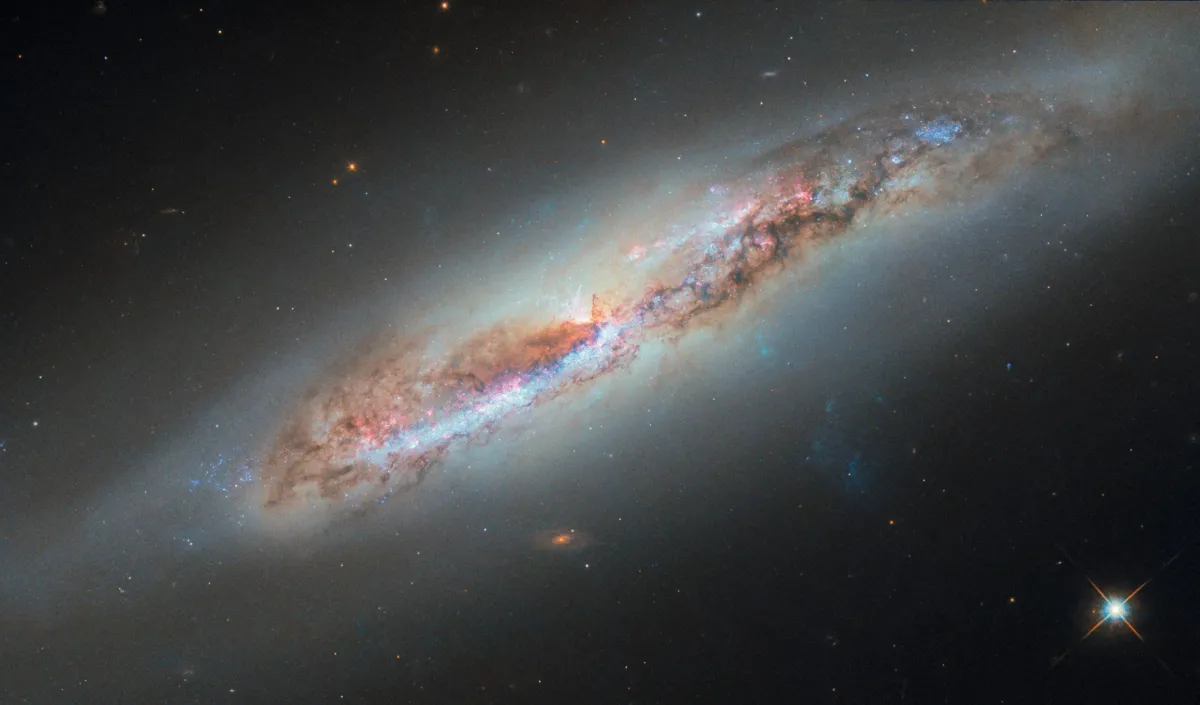
A spiral galaxy 60 million light-years away is being torn apart in real time, leaving a ghostly trail of glowing gas in its wake.
NGC 4388, spotted by the Hubble Space Telescope in the constellation Virgo, is moving through one of the densest neighborhoods in the universe — a galaxy cluster so crowded and hot that it's actively reshaping everything passing through it. The galaxy appears almost edge-on from Earth, which is why astronomers can see something they missed in earlier images: a plume of gas being stripped away like a comet's tail.
The Pressure of Proximity
Inside a galaxy cluster, the space between galaxies isn't empty. It's filled with an extremely thin but searingly hot gas called the intracluster medium — think of it as the cluster's atmosphere. As NGC 4388 plows through this environment at tremendous speed, the pressure is literally peeling gas away from the galaxy's disc, pulling it backward into a long, luminous stream.
We're a new kind of news feed.
Regular news is designed to drain you. We're a non-profit built to restore you. Every story we publish is scored for impact, progress, and hope.
Start Your News DetoxIt's a violent process, but it's also surprisingly common. Galaxies living in dense clusters face this fate regularly. What makes NGC 4388 special is that we're catching it mid-transformation, and the new Hubble observations — combining data across multiple wavelengths of light — finally show the full structure of what's being lost.
The glow itself comes from two sources. Closest to the galaxy's core, radiation from a supermassive black hole (which is actively feeding and heating surrounding material) energizes the nearest strands of gas. Farther out, shock waves created by the collision between the stripped gas and the intracluster medium cause more distant material to shine. It's a two-stage light show, powered by the galaxy's own violent heart and the cluster's crushing environment.
This kind of transformation doesn't happen overnight. Over millions of years, NGC 4388 will lose more and more of its gas, eventually becoming a smaller, gas-poor galaxy — if it survives the cluster's gravity at all. What we're seeing is a snapshot of galactic evolution in action, a reminder that even the largest structures in the universe are constantly being reshaped by their surroundings.