160,000 light-years away, the Hubble Space Telescope has caught something rarely seen in such crisp detail: the moment stars are born and immediately start remaking their world.
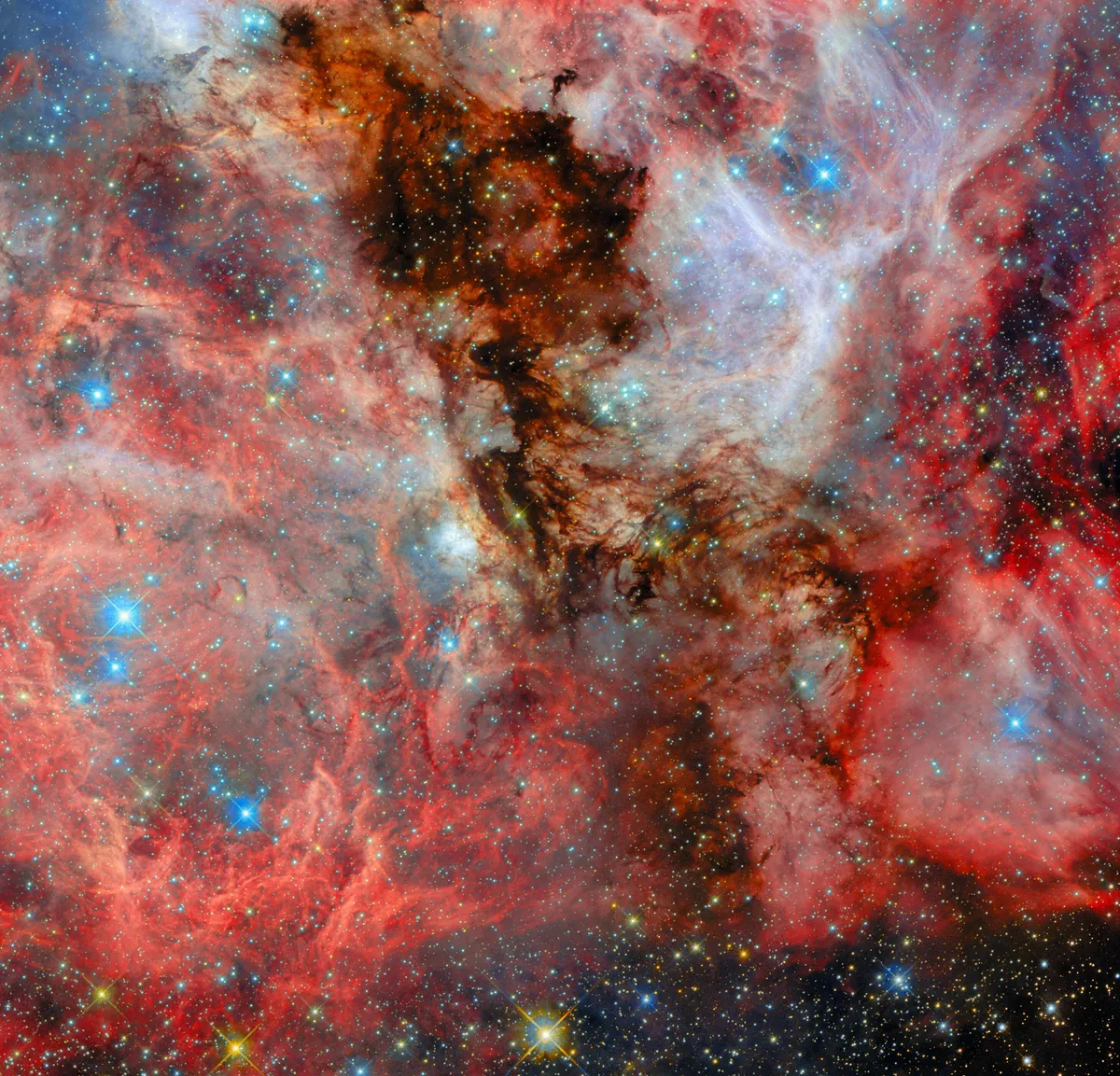
The image shows a corner of N159, one of the most prolific star-forming regions in the Large Magellanic Cloud, our galaxy's largest satellite. What you're looking at is mostly hydrogen gas—the raw material of stars—twisted into ridges and hollows by the sheer force of stellar creation. The red glow isn't decoration. It's hydrogen being energized by radiation from newly formed stars, lighting up like a neon sign to trace the invisible architecture of the gas clouds.
The Conversation Between Stars and Gas
This is where the image gets genuinely interesting. The brightest spots are clusters of young, massive stars—the kind that burn through their fuel in a cosmic blink. These newborns don't just sit quietly in their nursery. They blast outward with intense radiation and stellar winds, carving rounded bubbles and hollow pockets into the surrounding gas. It's a feedback loop: stars form from gas, then immediately begin reshaping the gas that made them possible.
We're a new kind of news feed.
Regular news is designed to drain you. We're a non-profit built to restore you. Every story we publish is scored for impact, progress, and hope.
Start Your News DetoxIn the foreground, you can see darker clouds silhouetted against the glow—they're being lit from behind by stars emerging from within them. This layering of light and shadow reveals the depth of the process, the way star formation isn't a single moment but an ongoing conversation between stellar energy and raw material.
The full N159 complex spans more than 150 light-years, making it one of the most massive star-forming clouds in the Large Magellanic Cloud. This image captures only a fragment of that vast region, yet even this small section contains enough stellar activity to reshape our understanding of how galaxies build their stars. As these young stars age and move outward, they'll eventually trigger new rounds of star formation in neighboring gas clouds—a cascade that echoes across millions of years.