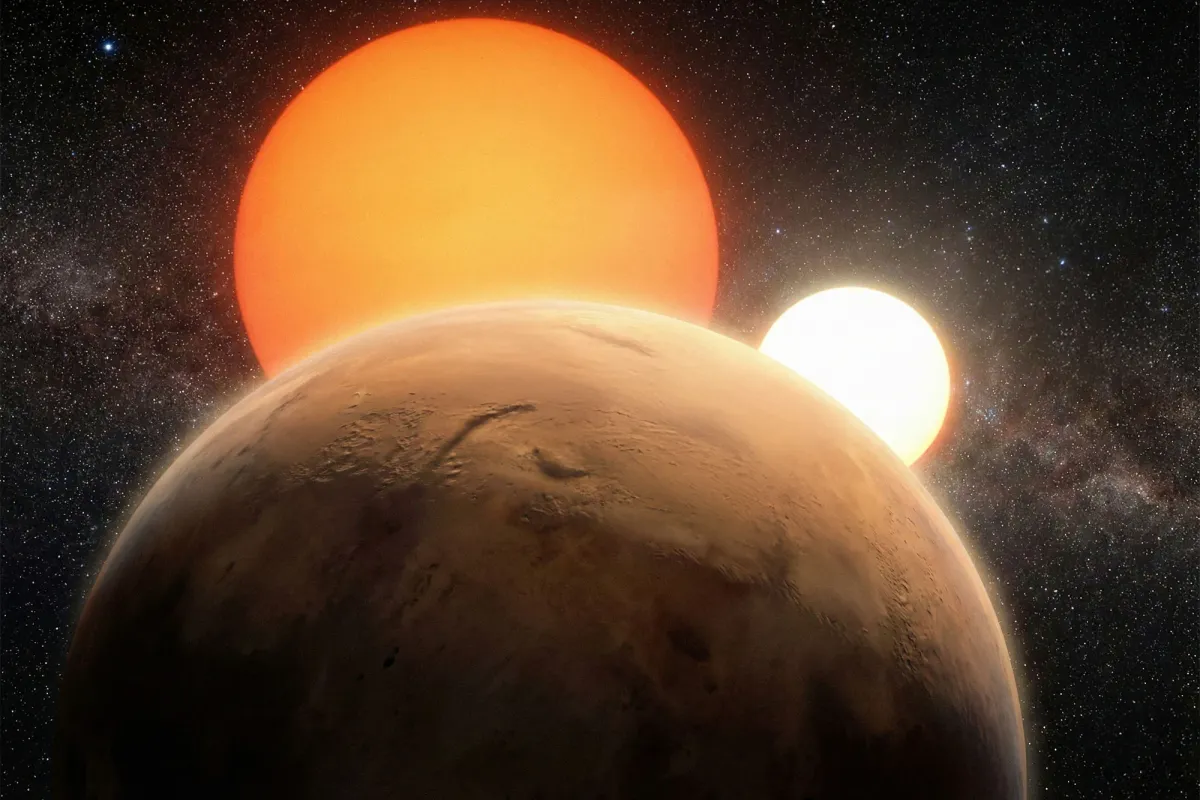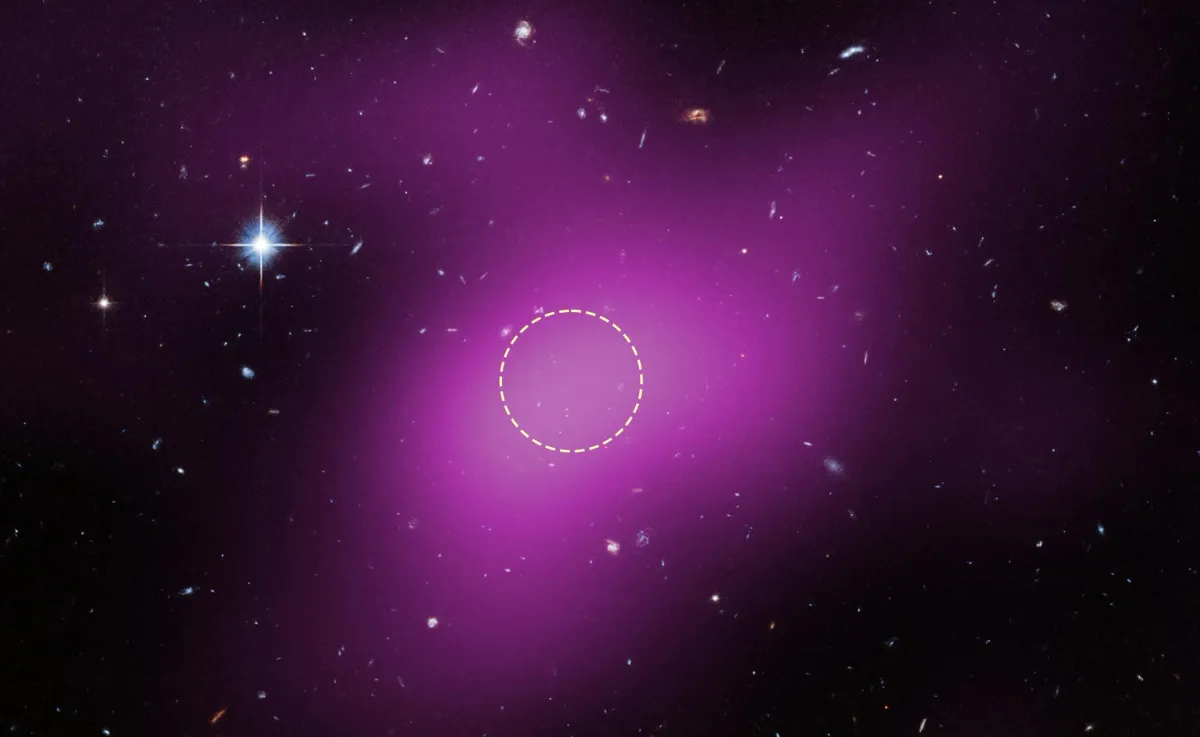
Astronomers have spotted something the Universe shouldn't have: a cloud of gas the size of a small galaxy, held together by dark matter, with not a single star inside it.
The object, called Cloud-9, was first picked up by radio telescopes in China three years ago but required Hubble's precision to confirm what seemed impossible — that here was a primordial building block of a galaxy that simply never became one. It's the first confirmed discovery of its kind, and it's forcing scientists to rethink what they thought they knew about how galaxies form.
"This is a tale of a failed galaxy," said Alejandro Benitez-Llambay, the principal investigator at Milano-Bicocca University in Milan. "In science, we usually learn more from the failures than from the successes. Seeing no stars is what proves the theory right."
We're a new kind of news feed.
Regular news is designed to drain you. We're a non-profit built to restore you. Every story we publish is scored for impact, progress, and hope.
Start Your News DetoxA window into what's hidden
Cloud-9 belongs to a class of objects astronomers had predicted for decades but never directly observed: Reionization-Limited H I Clouds, or RELHICs. These are clouds of neutral hydrogen born in the early Universe that never accumulated enough material to ignite star formation. For years, scientists could only theorize about them. Ground-based telescopes couldn't see deep enough to rule out faint stars hiding in the darkness. Hubble's Advanced Camera for Surveys finally could.
"With Hubble, we're able to nail down that there's nothing there," explained Gagandeep Anand, lead author of the study at the Space Telescope Science Institute in Baltimore.
What makes Cloud-9 remarkable is what it reveals about the invisible Universe. The cloud's central region spans roughly 4,900 light-years across and contains neutral hydrogen with a mass about 1 million times that of our Sun. But here's the crucial part: the gas alone can't account for the gravitational pull holding the cloud together. The math only works if dark matter — the invisible substance that makes up most of the Universe's mass — dominates Cloud-9's structure. Astronomers estimate the total mass at roughly 5 billion solar masses, with dark matter providing the gravitational glue.
"This cloud is a window into the dark Universe," said Andrew Fox of the European Space Agency. "We know from theory that most of the mass in the Universe is expected to be dark matter, but it's difficult to detect this dark material because it doesn't emit light. Cloud-9 gives us a rare look at a dark-matter-dominated cloud."
Why these invisible objects matter
Cloud-9 sits near the spiral galaxy Messier 94, and subtle distortions in its gas suggest the two are interacting gravitationally. The cloud exists in a narrow sweet spot — large enough that its gas hasn't dispersed into space, but small enough that gravity hasn't yet crushed it into stars. This precarious balance is precisely what makes it so scientifically valuable. By studying a system where dark matter dominates and starlight doesn't interfere, astronomers can understand dark matter's behavior in ways that aren't possible near bright galaxies.
Finding these failed galaxies is genuinely difficult. Bright nearby objects drown out their faint signals. Environmental forces, like ram-pressure stripping (gas being torn away as a cloud moves through space), can destroy them. This rarity explains why Cloud-9 stood out when radio surveys finally had the sensitivity to detect it.
The discovery deepens our understanding of galaxy formation in the early Universe and suggests that many more of these dark relics may exist, scattered throughout the cosmos. As telescopes improve and surveys deepen, astronomers expect to find more — each one another piece of the puzzle of how the Universe assembled itself from invisible matter into the bright structures we see today.