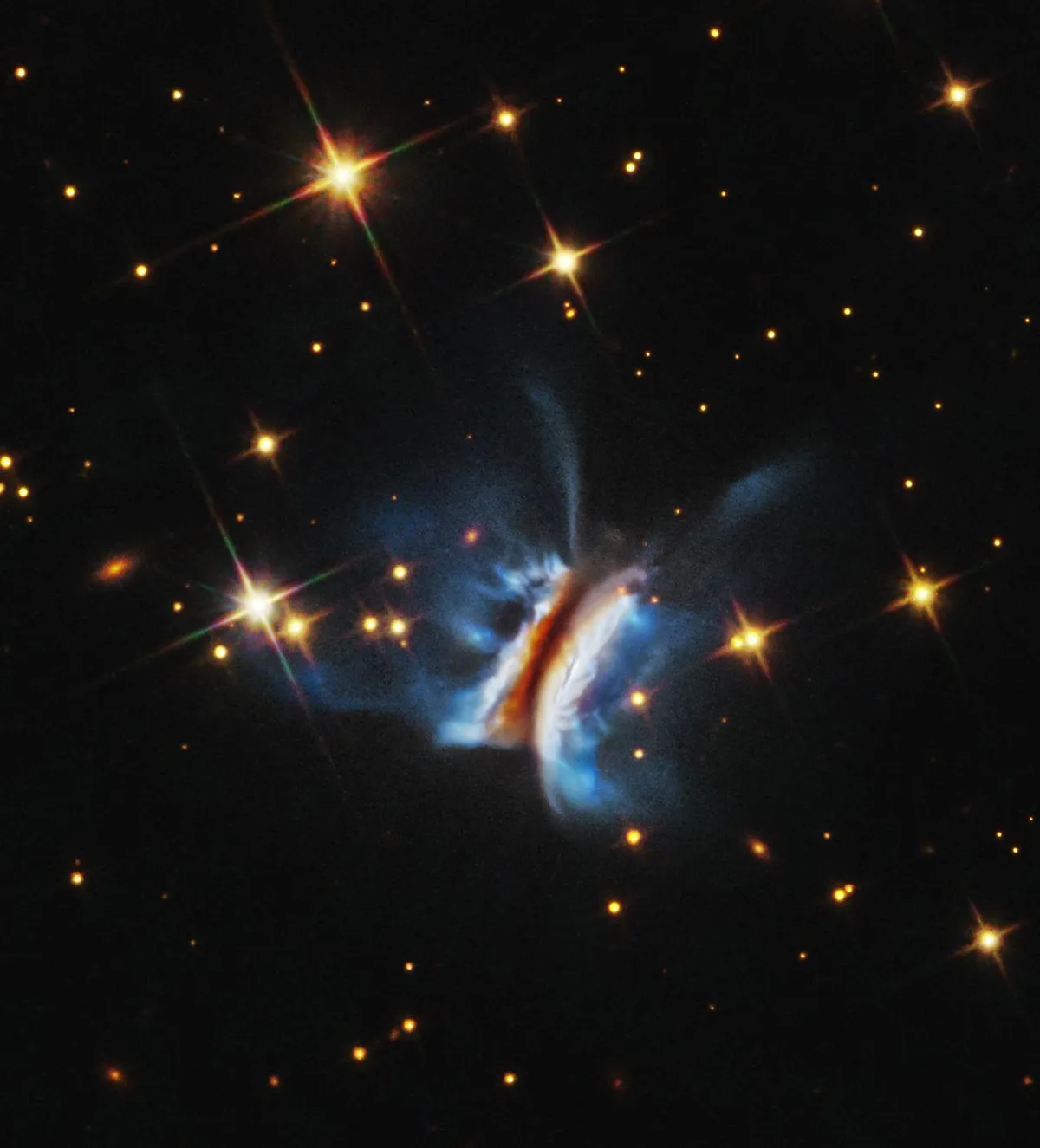
A thousand light-years away, astronomers have spotted something that shouldn't exist — at least not at this scale. The Hubble Space Telescope has captured images of the largest protoplanetary disk ever observed: a swirling nursery of dust and gas so vast it stretches nearly 400 billion miles across, dwarfing our entire solar system by a factor of 40.
The disk, catalogued as IRAS 23077+6707 but nicknamed "Dracula's Chivito," is so dense and sprawling that it completely obscures the young star at its center. Astronomers believe that star—or possibly a tight pair of them—is still forming, buried beneath the weight of planetary material.
A lopsided planet factory
What makes this discovery genuinely strange is the disk's architecture. High-resolution Hubble images reveal that one side of the disk erupts with towering filament-like structures, while the other side presents a sharp, clean edge with no visible features at all. This dramatic asymmetry caught the research team off guard.
We're a new kind of news feed.
Regular news is designed to drain you. We're a non-profit built to restore you. Every story we publish is scored for impact, progress, and hope.
Start Your News Detox"We were stunned to see how asymmetric this disk is," said Joshua Bennett Lovell, an astronomer at the Center for Astrophysics | Harvard & Smithsonian. The lopsidedness suggests the disk is actively being shaped by dynamic processes—perhaps recent infalls of dust and gas, or gravitational interactions with nearby material—happening in real time.
Kristina Monsch, the lead researcher, notes that this level of detail in protoplanetary disk imaging is rare. "These new Hubble images show that planet nurseries can be much more active and chaotic than we expected," she said. What astronomers thought would be relatively orderly systems are turning out to be far messier, more violent places where planets are born.
A scaled-up solar system
The disk contains an estimated 10 to 30 times the mass of Jupiter—enough raw material to form multiple gas giants and potentially an entire planetary system. This makes IRAS 23077+6707 a kind of magnified version of what our own solar system might have looked like 4.6 billion years ago, but vastly larger.
Monsch sees the discovery as a window into planetary formation itself. "In theory, IRAS 23077+6707 could host a vast planetary system," she explained. "While planet formation may differ in such massive environments, the underlying processes are likely similar." The catch: astronomers don't yet fully understand those underlying processes. This disk, and others like it, now offer a chance to watch them unfold.
The images raise more questions than they answer—which is precisely why they matter. As telescopes get sharper and our ability to observe distant stellar nurseries improves, the messy reality of planet birth is becoming visible in ways it never was before.