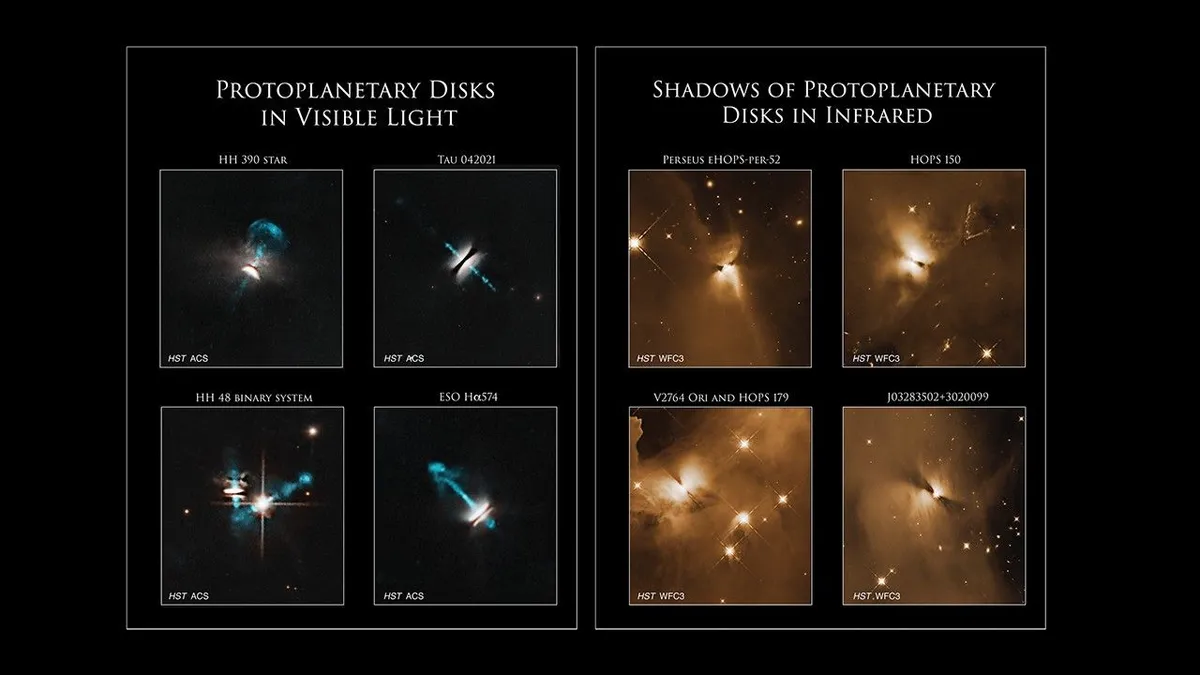
Imagine watching a planet being born. Not in time-lapse, not in simulation — in actual photographs taken by one of humanity's most powerful telescopes. That's what NASA's Hubble Space Telescope has just given us: a rare album of protoplanetary disks, the chaotic swirling clouds of gas and dust where stars are still forming and planets are just beginning to coalesce.
These images reveal something that doesn't make it into most textbooks: planet formation is violent, asymmetrical, and oddly beautiful. The disks themselves are hidden in visible light, shrouded in dust so thick that ordinary cameras see only darkness. But Hubble captured them in both visible and infrared wavelengths, piecing together a portrait of stellar nurseries scattered across our galaxy — some 450 light-years away in the Taurus Molecular Cloud, others nearly 1,500 light-years distant in Perseus.
What makes these images scientifically valuable is what they reveal about the process itself. When a star is born, it doesn't simply collapse quietly into existence. Jets of superheated gas shoot outward from the star's magnetic poles at roughly 93 miles per second — fast enough to cross the continental United States in less than a minute. These jets serve a crucial purpose: they carry away rotational momentum, allowing the forming star to spin slowly enough that material can accumulate around it rather than flying off into space.
We're a new kind of news feed.
Regular news is designed to drain you. We're a non-profit built to restore you. Every story we publish is scored for impact, progress, and hope.
Start Your News DetoxThe visible-light images show dark silhouettes of protoplanetary disks ringed by glowing reflection nebulae — the surrounding dust and gas lit up by the young star's light. When the jets collide with surrounding material, they create shock waves that cause the gas to glow in distinctive patterns. The infrared images tell a different story. In infrared, the central protostars become visible through the dust that would otherwise hide them, revealing thick, edge-on disks casting shadows across the surrounding cloud. These shadow patterns are so pronounced they look like the disks themselves are enormous — though they're actually optical illusions created by the dust envelope that still clings to the forming star.
One of the most intriguing findings comes from a broader Hubble survey of the Orion star-forming region. Astronomers discovered that in denser stellar neighborhoods, young stars are more likely to have companions — binary systems where two protostars orbit each other. The survey also found something unexpected: young stars have roughly the same rate of companions as mature, hydrogen-fusing stars. This suggests that whether a star ends up alone or paired is largely decided early, during those first chaotic moments captured in these images.
Why does this matter beyond the sheer wonder of seeing planets-in-the-making? Understanding how planets form in different environments — crowded star clusters versus isolated regions — helps us grasp why our own solar system looks the way it does. It also shapes how we search for planets around distant stars and what kinds of planetary systems we might expect to find.
These images represent just one snapshot in an ongoing survey. As Hubble continues its observations and as newer telescopes like the James Webb Space Telescope peer even deeper into dust clouds, our understanding of this formative stage will only deepen. For now, these photographs stand as a reminder that the universe's most fundamental creative process is still largely hidden from us — visible only when we look in the right wavelengths and ask the right questions.