For decades, physicists have been stuck in the middle of a problem they couldn't quite model. Dark matter — the invisible stuff that makes up most of the universe — might be able to collide with itself in ways that cause its densest regions to heat up and collapse dramatically. But the math to simulate this process fell into a gap between two existing approaches, each good at one extreme but useless in the middle.
Now researchers at the Perimeter Institute have built a bridge across that gap. They've created new simulation software called KISS-SIDM that can model self-interacting dark matter accurately and — crucially — fast enough to run on a laptop.
The Gravity Paradox
Most of us think of gravity as something that pulls things together and makes them hotter through compression. But gravity has a counterintuitive trick: systems held together by gravity can actually get hotter as they lose energy, not cooler. It's backwards from what everyday physics teaches us.
We're a new kind of news feed.
Regular news is designed to drain you. We're a non-profit built to restore you. Every story we publish is scored for impact, progress, and hope.
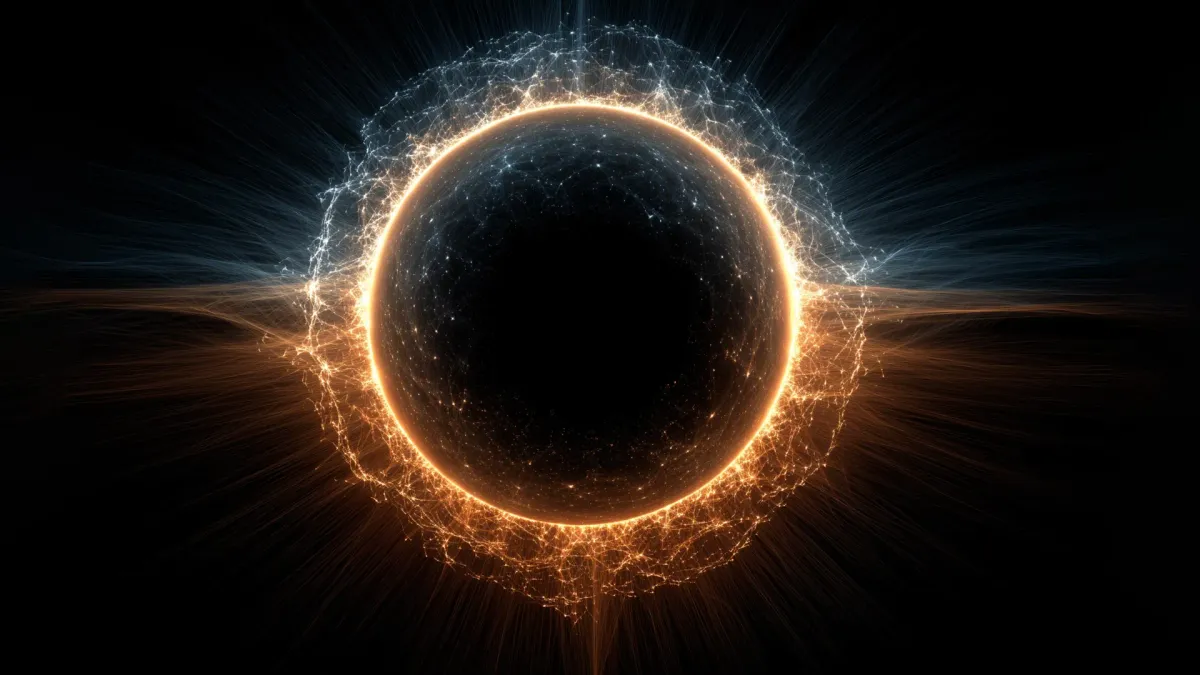
Start Your News DetoxThis quirk becomes dramatic when dark matter particles can collide with each other. These collisions shuffle energy around within dark matter halos — the massive, invisible scaffolds that surround galaxies and shape how they evolve. As energy gets transported outward, the core becomes increasingly dense and hot. Over time, this process, called gravothermal collapse, can push the core toward something extreme: possibly even a black hole.
"You have this self-interacting dark matter which transports energy outwards," explains James Gurian, a postdoctoral fellow at Perimeter who led the work. "This leads to the inner core getting really hot and dense as energy is transported outwards."
The Missing Middle
The challenge wasn't whether this could happen — the theory said it could. The problem was simulating it accurately. Existing methods worked beautifully in two scenarios: when dark matter was sparse and collisions rare (N-body simulations), or when it was extremely dense and collisions frequent (fluid simulations). But the realistic middle ground, where density and collision rates were both moderate, had no reliable tool.
"For the in-between, there wasn't a good method," Gurian says. "You need an intermediate range approach to correctly go between the low-density and high-density parts. That was the origin of this project."
Gurian and collaborator Simon May, now an ERC Preparative Fellow at Bielefeld University, developed KISS-SIDM to fill that gap. The code is faster, more accurate, and — unlike older approaches that required expensive computing clusters — it runs on standard laptops. They've made it publicly available for other researchers.
Why This Matters Now
Interest in self-interacting dark matter has grown recently because some real galaxies show features that don't quite fit our standard models of how dark matter should behave. If dark matter can interact with itself in the ways KISS-SIDM can now simulate, it might explain those puzzling observations.
More intriguingly, the collapse of dark matter cores could leave observable signatures — possibly even connections to black hole formation. But that's still an open question. What exactly happens when a dark matter core collapses completely? That's what researchers want to study next.
By making it possible to explore these extreme conditions in detail, the new tool represents a step toward answering some of the deepest questions about dark matter and the structure of the universe itself.