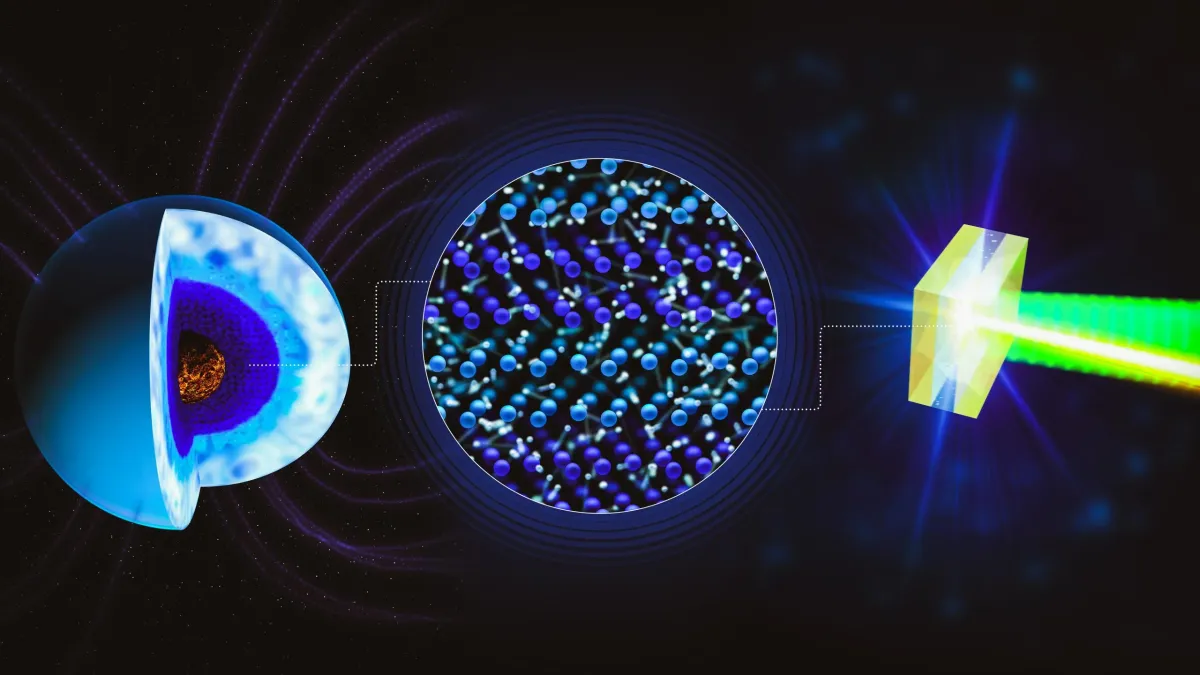
Deep inside Uranus and Neptune, water doesn't behave like water anymore. Under pressures millions of times greater than Earth's atmosphere and temperatures hot enough to melt rock, it transforms into something called superionic water—a solid that conducts electricity like metal.
For decades, scientists knew this exotic state existed. They'd created it in labs, watched it form in computer simulations. But they couldn't quite see its internal structure clearly enough to understand what was actually happening at the atomic level.
A new study using some of the world's most powerful X-ray lasers has finally revealed the answer, and it's messier than anyone expected.
We're a new kind of news feed.
Regular news is designed to drain you. We're a non-profit built to restore you. Every story we publish is scored for impact, progress, and hope.
Start Your News DetoxThe Structure Nobody Predicted
Earlier research suggested superionic water's oxygen atoms would arrange themselves into one of two neat, orderly patterns—either body-centered cubic or face-centered cubic. Clean geometry. Predictable. Wrong.
Instead, researchers found something far more chaotic. The oxygen atoms form a hybrid mix of face-centered cubic regions interspersed with hexagonal close-packed layers. Where these different arrangements meet, structural irregularities ripple through the material. It's less like a perfectly laid brick wall and more like one where the bricklayer kept changing their mind about which pattern to use.
This discovery matters because it changes how we understand what's happening inside ice giants. If superionic water can exist in multiple forms simultaneously, that affects how it conducts heat and electricity—and those properties directly shape a planet's magnetic field and internal evolution.
How They Saw the Invisible
To catch superionic water in its true form, scientists needed equipment that could simultaneously recreate planetary conditions and photograph atomic structure in real time. Two facilities did exactly that: the Matter in Extreme Conditions instrument at LCLS in California and the HED-HIBEF instrument at European XFEL in Germany.
They compressed water beyond 1.5 million atmospheres, heated it to thousands of degrees Celsius, and captured X-ray snapshots of its atomic arrangement in trillionths of a second. The precision required was extraordinary—like photographing a moving target the size of an atom while the room is on fire.
What they found matched the most advanced computer simulations, suggesting the models were on the right track, even if the actual structure was more intricate than anticipated.
Why This Matters Beyond the Lab
Superioni water might be the most common form of water in our solar system. Uranus and Neptune are thought to contain vast amounts of it in their deep interiors. Understanding its actual structure helps scientists refine models of how these planets formed, evolved, and continue to change—knowledge that becomes especially relevant as we discover ice giants orbiting distant stars.
Water, it turns out, is far from simple. Even when we think we understand it, extreme conditions reveal hidden complexity.