A frozen wanderer that drifted between stars for millions of years just gave us our first proof that alien planetary systems contain the same building blocks as ours.
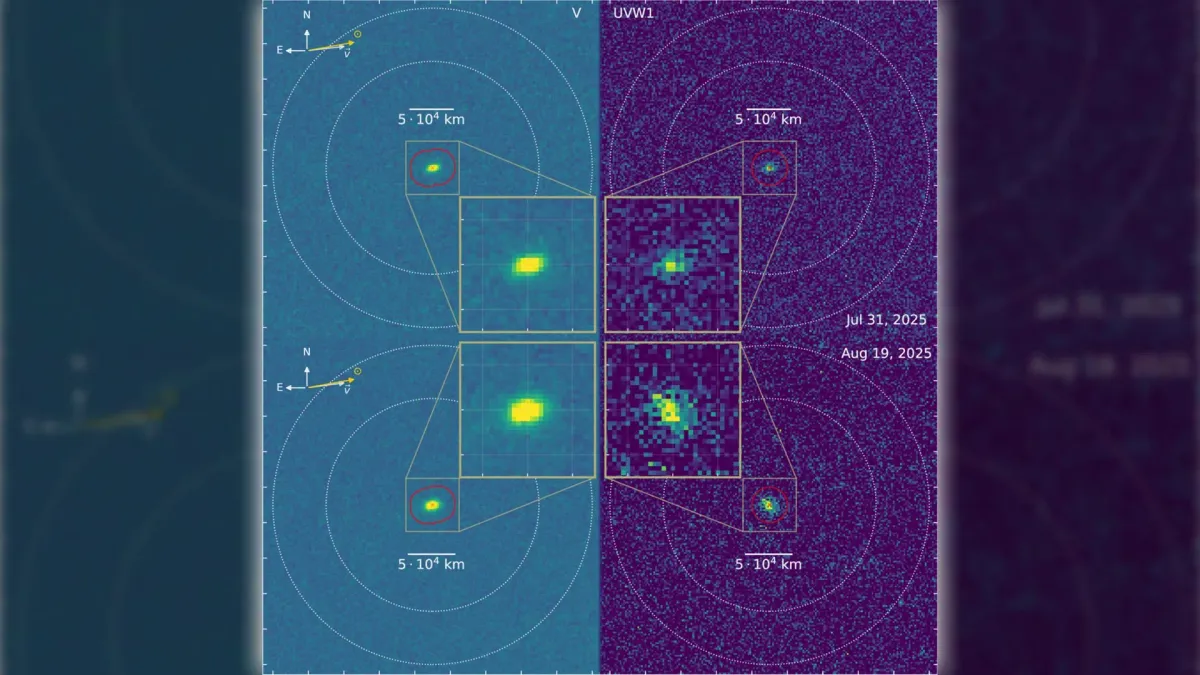
When 3I/ATLAS slipped into our solar system—only the third interstellar comet ever spotted—NASA's Swift Observatory caught something remarkable: a faint ultraviolet glow of hydroxyl gas, the telltale signature of water. It's the first time scientists have detected water from an object born around a different star.
Reading a Message From Another World
This matters more than it might sound. For decades, astronomers have used water as their measuring stick for how comets behave. It tells them how sunlight triggers the release of other gases, what frozen materials lurk inside a comet's core, how active it becomes as it approaches the Sun. Now they can apply that same framework to an object from an entirely different planetary system.
We're a new kind of news feed.
Regular news is designed to drain you. We're a non-profit built to restore you. Every story we publish is scored for impact, progress, and hope.
Start Your News DetoxWhat makes 3I/ATLAS especially strange is where the water was detected. Swift found it when the comet was nearly three times farther from the Sun than Earth is—so far out that surface ice should stay frozen. Yet the comet was losing water at about 40 kilograms per second, equivalent to a fully opened fire hose blasting into the vacuum.
Most comets born in our own solar system stay quiet at that distance. The strong ultraviolet signal suggests something unexpected is happening: sunlight may be warming tiny icy particles that broke away from the nucleus, causing them to release vapor and feed the surrounding cloud of gas. Only a handful of distant comets have shown this kind of extended water source, and it hints at layered ices that could preserve memories of where and how the object originally formed.
Each Visitor Rewrites the Rules
The three interstellar comets discovered so far have each been a surprise. 'Oumuamua arrived bone dry. Borisov was rich in carbon monoxide. Now ATLAS is spraying water from farther out than anyone expected. Together, they're revealing that the volatile ices that build comets vary wildly from one star system to another—shaped by temperature, radiation, and chemistry in ways we're only beginning to understand.
That variation matters because comets seed planets. The differences in composition from system to system suggest that the ingredients available for planet formation—and potentially for life—take on different flavors across the galaxy. We're reading postcards from other worlds, and they're telling us that life's chemistry isn't unique to Earth.
Detecting that faint ultraviolet signal was also a technical feat. NASA's Swift Observatory carries only a 30-centimeter telescope, but from orbit it can observe ultraviolet wavelengths that Earth's atmosphere blocks. The Auburn team managed to catch 3I/ATLAS within weeks of its discovery, before it dimmed too much or drifted too close to the Sun for safe observation.
3I/ATLAS has since faded from view, but it's expected to return to visibility after mid-November, giving astronomers another window to watch how its activity shifts as it swings closer to the Sun. Each observation adds another data point to a growing picture: the ingredients that build worlds aren't locked away in our corner of space. They're scattered across the galaxy, waiting to be found.