Scientists at the University of Tokyo have figured out why certain molecules cluster together in liquid droplets — and it comes down to invisible charges playing matchmaker.
When two polymer solutions mix and then separate into distinct liquid phases, something unexpected happens: ions don't distribute evenly. Instead, positively charged ions pile up in whichever phase has a slightly negative charge, like opposite ends of a magnet pulling toward each other. This creates a sorting mechanism that acts like a molecular bouncer, deciding which molecules get into which droplet.
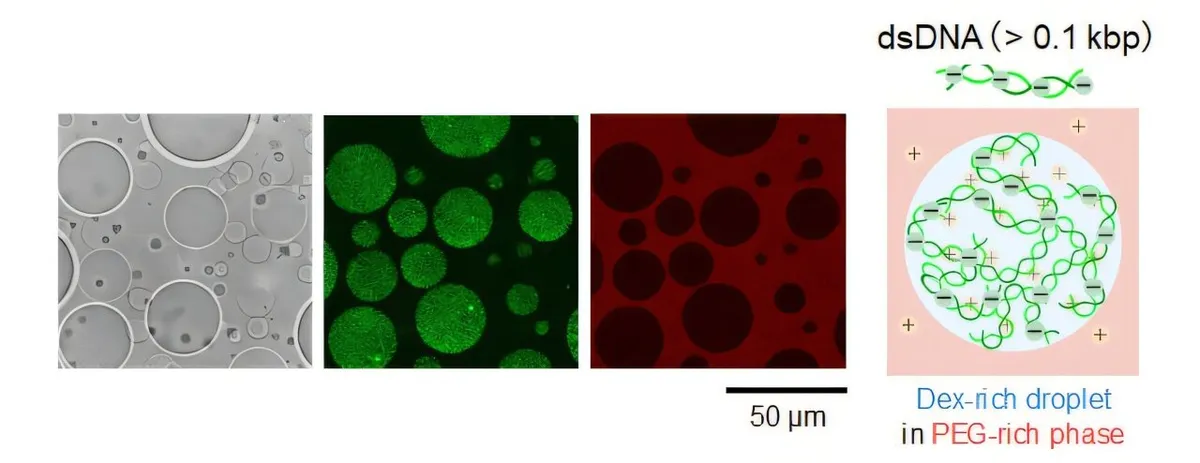
The researchers tested this using a simple two-phase system made from polyethylene glycol (PEG) and dextran (Dex). They found that the Dex phase carries a slightly negative charge, so positively charged ions accumulate there. Once those ions gather, they neutralize the negative charge of DNA molecules, allowing the DNA to slip into the Dex droplets instead of staying scattered in the PEG phase.
We're a new kind of news feed.
Regular news is designed to drain you. We're a non-profit built to restore you. Every story we publish is scored for impact, progress, and hope.
Start Your News DetoxDiagram showing how DNA and cations localize in Dex droplets within a PEG aqueous solution, and how the electrical charge difference between the phases drives this separation.
What makes this discovery significant is that it's the first time researchers have directly measured and quantified this ion-sorting behavior in liquid-liquid phase separation. The mechanism they've identified — called Donnan-type ion partitioning — was previously thought to work mainly in gels and membranes, not in freely flowing liquid phases.
The team used ion-sensitive fluorescent probes to track exactly where the charged particles ended up, revealing that salt concentration dramatically affects how the phases behave. Higher salt levels shift the balance, changing which molecules go where.
This matters because similar phase separation happens constantly inside living cells. Proteins cluster into droplet-like structures without any membrane surrounding them, and those structures are crucial for how cells function. Understanding the electrical forces that drive this sorting could eventually help scientists design better drug delivery systems or develop new ways to separate and purify biological molecules in the lab.
The next step is exploring whether this ion-partitioning principle applies to other phase-separation systems, both in cells and in biotechnology applications.