For decades, astronomers assumed small, scorched planets couldn't hold atmospheres. TOI-561 b just shattered that assumption.
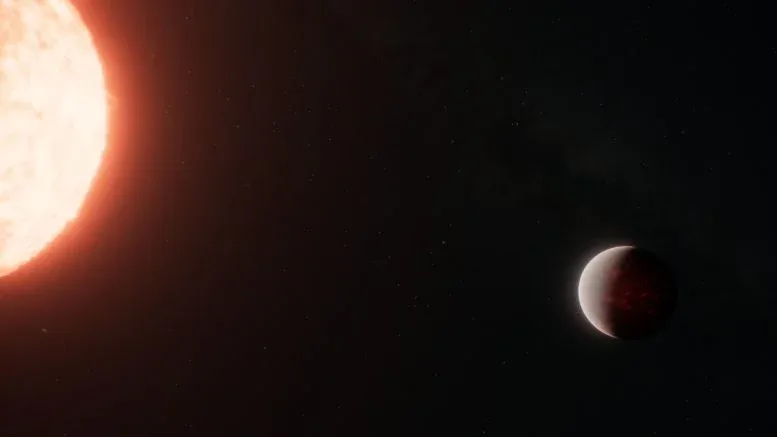
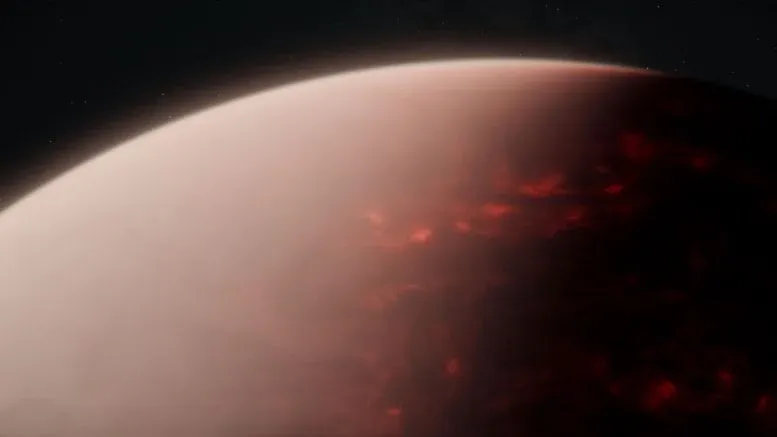
The James Webb Space Telescope has detected the clearest evidence yet of an atmosphere around a rocky exoplanet—and it's orbiting one of the most hostile worlds we know. TOI-561 b is a super-Earth about twice our planet's mass, locked in an impossibly tight orbit around its star. One year there lasts just 10.56 hours. Its surface? A global ocean of molten rock, heated to around 3,200°F (1,800°C).
By every rule astronomers thought they understood, this planet shouldn't have an atmosphere. Small planets lose their gases. Hot planets lose them faster. Ancient planets—and TOI-561 b is billions of years old—should have lost theirs long ago. Yet there it is.
We're a new kind of news feed.
Regular news is designed to drain you. We're a non-profit built to restore you. Every story we publish is scored for impact, progress, and hope.
Start Your News DetoxHow We Know It's There
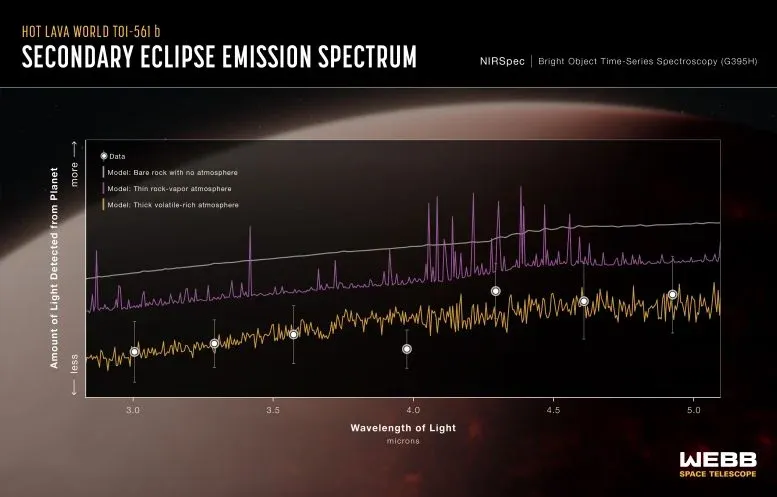
The Carnegie Institution team, led by astronomer Johanna Teske, used Webb's infrared spectrograph to take the planet's temperature across its dayside. If TOI-561 b were bare rock with no atmosphere, the side facing its star should be blistering at nearly 4,900°F (2,700°C). Instead, it measured closer to 3,200°F—significantly cooler. The difference tells a story: winds in a thick atmosphere are carrying heat around to the nightside, tempering the extreme temperature swings.
"We really need a thick volatile-rich atmosphere to explain all the observations," said co-author Anjali Piette. Water vapor and other gases in that atmosphere absorb infrared radiation before it escapes to space, a fingerprint Webb's instruments can read.
The team spent more than 37 hours continuously observing the system—long enough to watch TOI-561 b complete nearly four full orbits. They're still analyzing the full dataset, working to map temperatures across the entire planet and narrow down what gases fill that improbable sky.
The Puzzle of Survival
The real mystery isn't that the atmosphere exists—it's how. A small, intensely irradiated planet should hemorrhage its gases into space. Yet TOI-561 b appears to maintain equilibrium: the molten magma ocean beneath continuously releases new gases, feeding the atmosphere even as radiation tries to strip it away. Researcher Tim Lichtenberg from the University of Groningen described it simply: "It's really like a wet lava ball."
This discovery rewrites what we thought possible for exoplanet atmospheres. It suggests that rocky worlds in extreme conditions might retain their gases far longer—and in far greater abundance—than theory predicted. As Teske noted, the new data "is opening up even more questions than it's answering." The next phase of analysis could reveal the atmospheric composition in detail, offering clues about how planets survive in conditions we once thought uninhabitable.