January 2026 is shaping up to be a month where the night sky does most of the work for you. Three major celestial events are clustering together in the first two weeks, each one positioned perfectly for viewing from Earth — a rare alignment of opportunity that won't happen quite the same way again for years.
The month kicks off on January 2 with asteroid 40 Harmonia reaching opposition, the moment when it sits directly opposite the sun in our sky. This means it's fully lit and as close to Earth as it gets. Harmonia is genuinely massive — nearly 70 miles across, placing it in the top 1% of all known asteroids. You'll need a decent telescope to find it, and midnight on January 2 is your window, aiming toward the southern horizon.
A supermoon, then the meteor shower problem
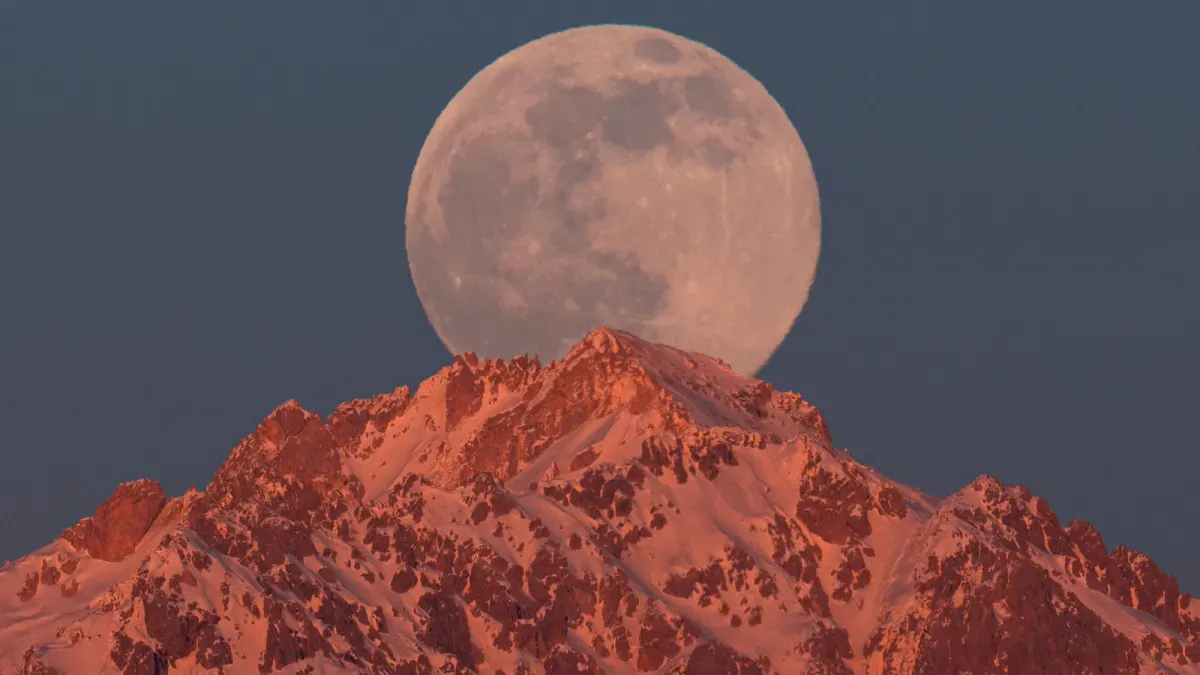
One night later, the Wolf Moon arrives as a supermoon — the fourth consecutive one of this lunar cycle. It reaches full illumination at 5:03 AM EST on January 3, which means the entire night before will glow with its light. This is where things get complicated.
We're a new kind of news feed.
Regular news is designed to drain you. We're a non-profit built to restore you. Every story we publish is scored for impact, progress, and hope.
Start Your News DetoxThe Quadrantids meteor shower peaks on the night of January 3 into the early hours of January 4, and in most years it's genuinely worth staying up for — brief but intense, with sharp fireballs streaking across the northeastern sky. But this year, the supermoon's brightness will wash out most of the fainter meteors. You might still catch a few of the brightest ones if you get far from city lights and give your eyes time to adjust, but it won't be the show it could have been.
This is the trade-off of a supermoon month: the moon itself becomes the main event, but it also steals the supporting acts.
Jupiter takes center stage
A week later, on January 10, Jupiter reaches opposition. The largest planet in our solar system will rise in the east as the sun sets and hang highest in the sky around midnight. Even basic binoculars will show you something Galileo saw through his primitive telescope in 1610 — the four largest moons orbiting Jupiter (Io, Europa, Ganymede, and Callisto), tiny points of light arranged around a banded disk.
The opposition is the sweet spot for Jupiter viewing. It's fully illuminated, closest to Earth, and visible all night long. A small telescope transforms it from a bright point into a world, with cloud bands and storms visible across its surface.
For any of these events, the same rules apply: get away from streetlights and city glow, let your eyes spend at least 20 minutes adjusting to darkness, and check local weather forecasts beforehand. January nights are long and cold, but they're also dark — the season when the night sky actually has a chance to shine.