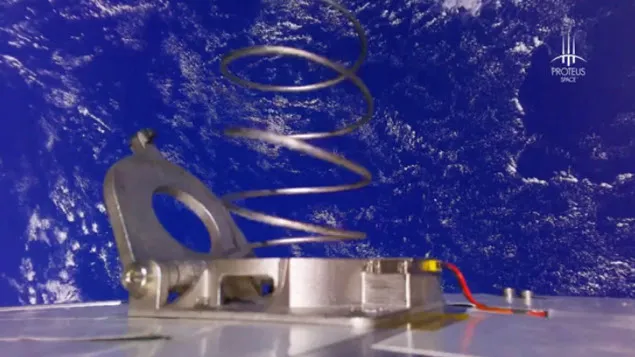
A titanium spring the size of a deck of cards just proved that 3D printing could transform how we build spacecraft. In February 2026, as a commercial satellite passed over the Pacific, an onboard camera captured the moment the JPL Additive Compliant Canister—JACC—popped open like a jack-in-the-box, extending from the size of a matchbox to about the length of a pencil.
It's a small moment with outsized implications. JACC is a deployment mechanism for satellite antennas, and it works. More importantly, it was built in a way that traditional space hardware manufacturers said was impossible: entirely 3D-printed, from a single piece of titanium, with three times fewer components than the conventional version.
Why this matters for space exploration
Space hardware is usually built like it's going to be handled by astronauts in a spacesuit—over-engineered, with redundancy piled on redundancy. That caution makes sense when a launch costs hundreds of millions of dollars. But it also makes spacecraft heavier, more complex, and more expensive to build. JACC challenges that assumption. By consolidating what would normally be five separate parts—hinges, panels, springs—into one 3D-printed component, engineers reduced both weight and failure points. At just over one pound, it's light enough that the savings compound across an entire satellite.
We're a new kind of news feed.
Regular news is designed to drain you. We're a non-profit built to restore you. Every story we publish is scored for impact, progress, and hope.
Start Your News DetoxThe spring deployed aboard Mercury One, a commercial spacecraft launched in November 2025 as part of SpaceX's Transporter-15 mission. It shared the flight with a second experimental antenna system called SUM (Solid Underconstrained Multi-Frequency Deployable Antenna), both operating under the collective name PANDORASBox. Together, both systems were designed, built, tested, and delivered for flight by JPL in less than a year on minimal budgets—the kind of constraint that usually forces innovation.
What makes this moment significant is that it's no longer theoretical. 3D printing in aerospace has been discussed for years, but most demonstrations happened in labs or simulations. JACC actually deployed in orbit, where vacuum, temperature swings, and radiation create conditions no Earth-based test can fully replicate. The camera footage proves it worked.
The broader implication is cost and speed. If future satellite antennas can be printed rather than traditionally machined, manufacturers could cut lead times from months to weeks and reduce per-unit costs substantially. For space agencies and commercial operators launching constellations of dozens or hundreds of satellites, that compounds quickly.
JPL's internal research funds and NASA's Earth Science Technology Office backed the project—the kind of modest investment that often yields the most practical breakthroughs. The next step is integration: taking what worked on Mercury One and moving it into designs for operational satellites. That's where the real test begins.