Jupiter's four largest moons—Europa, Ganymede, Callisto, and Io—might have arrived in the solar system already stocked with the molecular ingredients for life. A team of international researchers modeled how complex organic molecules could have formed in the swirling disk around the young Sun and then traveled into Jupiter's own moon-forming region, arriving largely intact. The simulations suggest that up to half of the icy material that built these moons may have carried freshly made organic compounds, never chemically destroyed in transit.
This matters because Europa, Ganymede, and Callisto are believed to harbor vast subsurface oceans beneath their icy crusts. If those oceans exist—and upcoming spacecraft missions will help confirm it—then having organic molecules already embedded in the moons' material from birth means the chemistry for life might have been waiting there for billions of years.
The Journey of Molecules Across Space
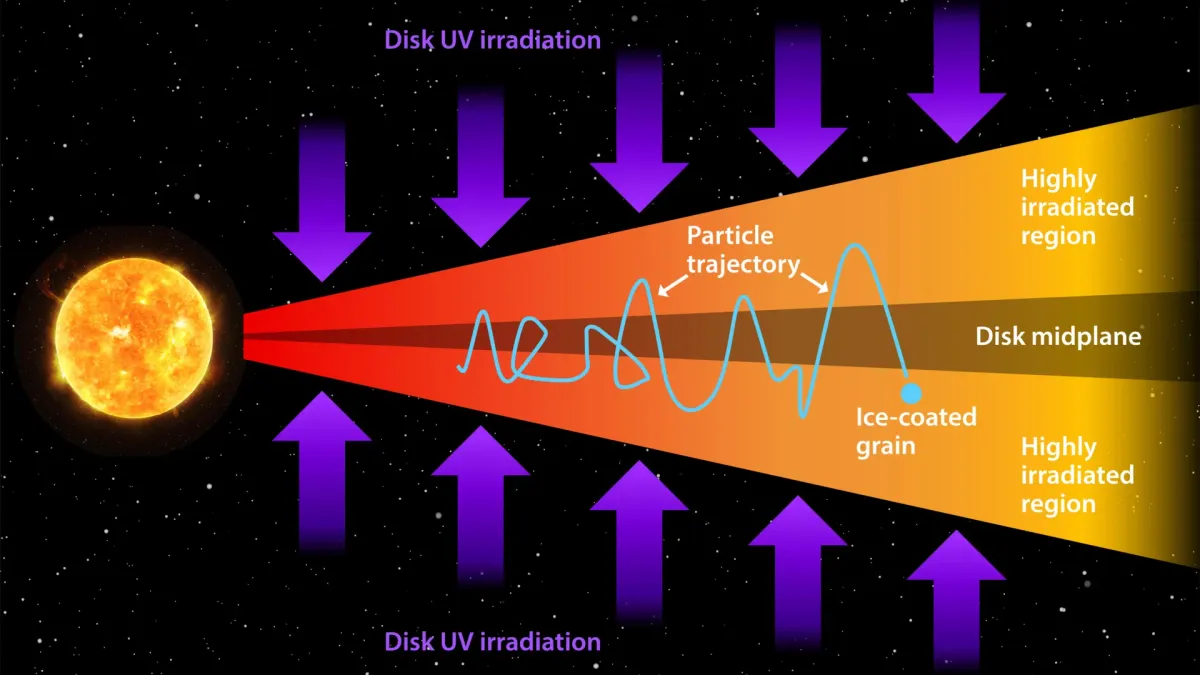
Complex organic molecules (COMs) are carbon-based compounds containing oxygen and nitrogen—the exact elements living systems depend on. In laboratories, scientists have shown these molecules can form when icy dust grains containing methanol or mixtures of carbon dioxide and ammonia get hit with ultraviolet light or gentle heating. Those conditions were everywhere in the protoplanetary disk—the spinning cloud of gas and dust that surrounded our young Sun and eventually became planets and moons.
We're a new kind of news feed.
Regular news is designed to drain you. We're a non-profit built to restore you. Every story we publish is scored for impact, progress, and hope.
Start Your News DetoxResearchers from Southwest Research Institute, Aix-Marseille University, and the Institute for Advanced Studies combined models of how disks evolve over time with simulations tracking individual icy particles. This let them calculate the exact radiation levels and temperatures those grains experienced as they drifted through space.
"By combining disk evolution with particle transport models, we could precisely quantify the radiation and thermal conditions the icy grains experienced," said Dr. Olivier Mousis, who led one of the studies. "Then we directly compared our simulations with laboratory experiments that produce COMs under realistic astrophysical conditions. The results showed that COM formation is possible in both the protosolar nebula environment and Jupiter's circumplanetary disk."
The team built detailed simulations of both the original solar nebula and Jupiter's circumplanetary disk—the structure of gas and dust that surrounded young Jupiter and eventually assembled its moons. By tracking where icy particles went, they could reconstruct the physical and chemical history of the material that became Europa, Ganymede, Callisto, and Io.
The simulations revealed something striking: a substantial fraction of icy grains likely formed COMs and carried them into the region where Jupiter's moons were assembling. In certain scenarios, nearly half of the modeled particles transported newly created organic molecules from the broader solar nebula into Jupiter's disk, where they were incorporated into the growing moons with little chemical change. Some COMs may have also formed closer to Jupiter itself—parts of its circumplanetary disk appear to have reached temperatures high enough to drive the chemical reactions needed to create these molecules.
This means Jupiter's moons may have inherited organic material from two sources: the wider solar nebula and local chemical activity within Jupiter's own disk billions of years ago. It's a redundancy that increases the odds of habitability.
What makes this finding significant is what it implies about planetary formation more broadly. We've long known that the ingredients for life exist in space—we find organic molecules in meteorites, in comets, in the interstellar medium. But this research shows a plausible mechanism for how those ingredients got incorporated into the solid worlds themselves, from the moment they formed. It's not something that arrived later via asteroid impacts; it was baked in from the start.
"Our findings suggest that Jupiter's moons did not form as chemically pristine worlds," Mousis said. "Instead, they may have accreted a significant inventory of COMs at birth, providing a chemical foundation that could later interact with the liquid water in their interiors."
Europa, Ganymede, and Callisto are thought to harbor subsurface oceans beneath their icy crusts. Liquid water combined with internal energy sources—heat from radioactive decay or tidal friction—makes these moons compelling targets in the search for life. If COMs were embedded in their building materials from the start, then these worlds may also contain the molecular ingredients needed for prebiotic chemistry, including the formation of amino acids and nucleotides—the building blocks of proteins and DNA.
NASA's Europa Clipper mission and the European Space Agency's Juice spacecraft are currently on their way to the Jovian system to investigate the structure, composition, and habitability of these moons. The new research provides a framework for interpreting what those missions will find when they arrive.
"Establishing credible pathways for COMs formation and delivery provides scientists with a critical framework for interpreting upcoming measurements of Jupiter's surface and subsurface chemistry," Mousis said. "By linking laboratory chemistry, disk physics and particle transport models, our work may highlight how habitable conditions are rooted in the earliest stages of planetary formation."
The findings suggest that the conditions for life—or at least its chemical precursors—may be far more common in the universe than we assumed. If organic molecules routinely get incorporated into moons and planets during formation, then countless worlds might carry the molecular seeds of biology.