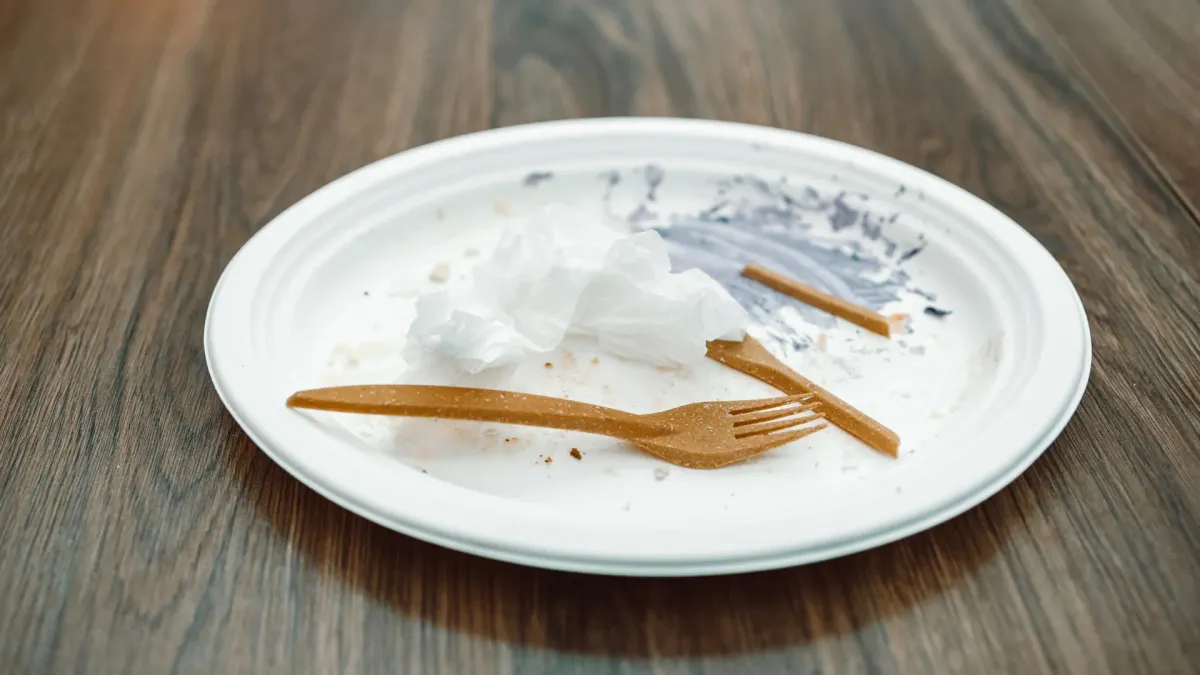
A team of researchers at Flinders University has created a packaging film from milk protein that vanishes in about three months — a tangible step toward replacing the single-use plastics that now clog landfills and oceans worldwide.
The material sounds like chemistry class, but the ingredients are reassuringly ordinary: calcium caseinate (a protein extracted from milk), modified starch, bentonite clay, and a few additives to improve flexibility. When buried in soil, the film fully degraded in 13 weeks — fast enough to matter, stable enough to actually protect food.
This matters because the plastic problem has become undeniable. Around 60% of all plastics are used once and discarded. Only 10% get recycled. Global plastic production has jumped from 2 million tonnes in 1950 to 475 million tonnes by 2022 — roughly the weight of 250 million cars. Without intervention, the OECD warns production could spike another 70% by 2040.
We're a new kind of news feed.
Regular news is designed to drain you. We're a non-profit built to restore you. Every story we publish is scored for impact, progress, and hope.
Start Your News DetoxWhat makes this particular solution compelling isn't just that it works, but how it works. The researchers deliberately chose cheap, abundant, biodegradable ingredients. The bentonite clay strengthens the film and improves its barrier properties — meaning it can actually keep food fresh, not just look the part. Microbial testing showed the material posed no toxicity concerns. Professor Youhong Tang, who leads the nanomaterials research at Flinders, notes that further antibacterial testing would strengthen the case, but the early evidence is solid.
Where This Fits In
The milk-based approach reveals something important about the biodegradable plastics race: you don't need exotic chemistry. Nikolay Estiven Gomez Mesa, one of the researchers from Colombia's Universidad de Bogotá Jorge Tadeo Lozano, explains that the team stumbled onto this when experimenting with caseinates for nanofibers. "We found that it could be used to cast polymers similar to common packaging materials," he says. From there, they began layering in natural components — starch, biodegradable polymers, natural clays — each one chosen for both performance and environmental friendliness.
The collaboration between Australian and Colombian teams points to a broader shift in materials science: solutions are emerging from multiple regions simultaneously, each adapted to local resources and needs. This decentralization matters. It means the technology isn't locked behind expensive patents or dependent on rare materials.
The real test now is scale. A 13-week breakdown in controlled soil conditions is promising, but food packaging needs to survive weeks or months on shelves and in transit. It needs to compete on cost with conventional plastic. The researchers are clear-eyed about what's next: further testing, integration into circular economy systems, and exploration of how these films perform in real-world conditions — not just laboratory soil.
Professor Alis Yovana Pataquiva-Mateus from the Colombian team frames this as part of a larger shift: "Most of our single-use plastic comes from food packaging, so these sorts of options should be explored further." She's right. If even a fraction of food packaging switched to materials like this one, the reduction in persistent plastic waste would be measurable within a decade.