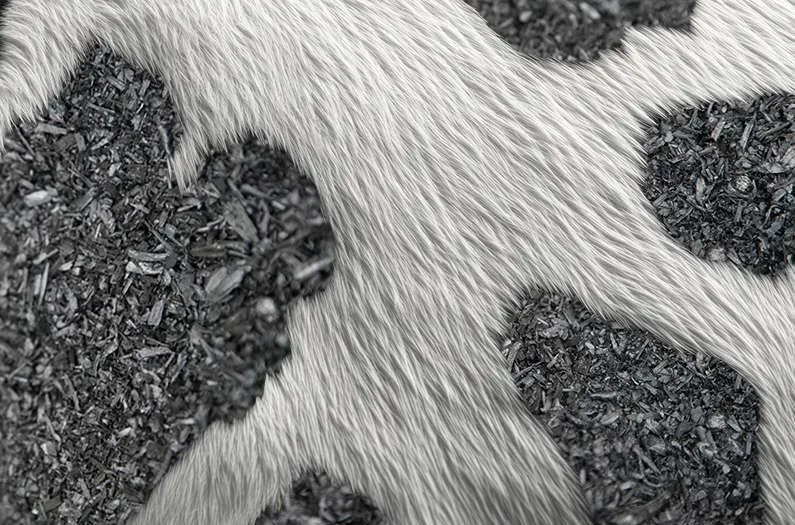
When Swiss researchers fed eight dairy cows a diet laced with biochar—a porous, carbon-rich material made from heated plant waste—something unexpected happened. The cows didn't break it down. Instead, they passed it through largely intact, effectively becoming mobile soil-improvement machines.
The finding opens a genuinely odd possibility: what if cattle could help offset their own climate impact while fertilizing the land they graze on, simply by eating an additive that survives their digestion almost unchanged.
How the Study Worked
The team added biochar to about 1% of each cow's daily feed over two 35-day periods. By switching which cows received the additive between periods, each animal served as its own control—a methodological detail that matters because it rules out individual variation. The researchers then collected and analyzed dung samples using three separate methods to see how much biochar made it through intact.
We're a new kind of news feed.
Regular news is designed to drain you. We're a non-profit built to restore you. Every story we publish is scored for impact, progress, and hope.
Start Your News DetoxThe numbers were striking. Between 70 and 90% of the biochar survived the cow's digestive system. Of that surviving material, roughly 98% remained structurally and chemically stable. This stability is the key: biochar's condensed carbon structure means it persists in soil without breaking down and releasing the carbon it's meant to lock away. The quality of the biochar itself mattered—oxygen-rich variants decomposed more easily in the gut—but the core finding held across variations.
Why This Matters
Biochar has long been known to improve soil carbon storage when applied directly to fields. It also enhances soil nutrients and water retention. But spreading it manually across pastureland is labor-intensive. If cows could do it passively, through grazing and excretion, the logistics shift entirely. A herd becomes a distributed application system.
There's another angle too. Previous research suggests biochar in cattle dung could reduce methane emissions from the manure itself—meaning the additive might help cows offset their own environmental footprint on multiple fronts. That's not nothing in an industry responsible for roughly 14% of global greenhouse gas emissions.
The question now is whether this scales. A small feeding trial with eight cows is proof of concept. Moving this into mainstream dairy and beef production would require cost-effective biochar production, regulatory approval, and evidence that the practice works across different breeds, climates, and grazing systems. None of that is guaranteed.
But the mechanism works. The biochar doesn't get destroyed. It gets distributed. And for an agricultural practice to have climate potential, it first has to be physically possible.