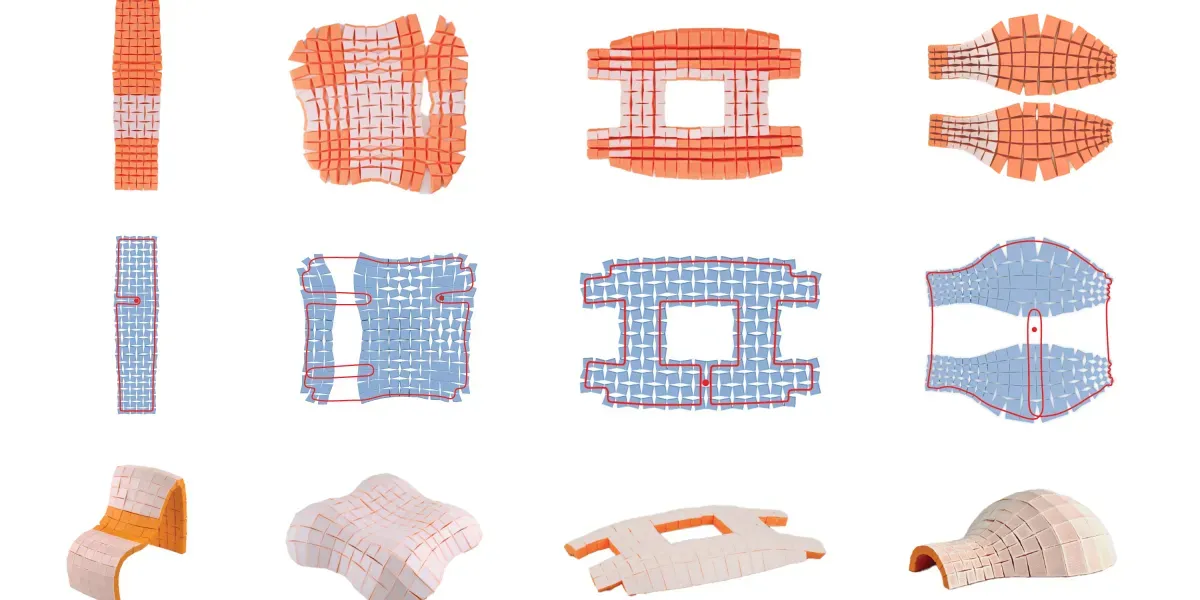
MIT researchers have figured out how to turn a completely flat sheet of connected tiles into a usable 3D object—just by pulling a string. The technique draws from kirigami, the Japanese art of paper cutting, and could reshape how we design everything from emergency shelters to medical devices to spacecraft components.
Here's what makes this different: most foldable designs require multiple actuations or complex mechanisms. This one needs a single pull. Mina Konaković Luković's team at MIT's Computer Science and Artificial Intelligence Laboratory developed an algorithm that takes any 3D structure you want to create and reverse-engineers it into a flat pattern of tiles connected by rotating hinges. Then it calculates the optimal path for a string to thread through that pattern—the shortest route that lifts exactly the right points to pop the flat sheet into its intended shape.
The Algorithm Does the Heavy Lifting
The real innovation is in the math. The algorithm figures out the minimum number of lift points needed and finds the path connecting them while keeping friction low enough that one person can actuate the whole structure smoothly. It's reversible too—pull the string one way and you get your 3D shape; pull it back and it flattens again.
We're a new kind of news feed.
Regular news is designed to drain you. We're a non-profit built to restore you. Every story we publish is scored for impact, progress, and hope.
Start Your News DetoxAkib Zaman, the graduate student who led the work, sees the simplicity as the whole point. "The user just needs to provide their intended design," he explains, "and then our method optimizes it in such a way that it holds the shape after just one pull on the string." No robots required. No specialized training. Just intent and a string.
The team tested the concept across wildly different scales. They designed a personalized medical splint, a posture corrector, and an igloo-like portable shelter. They also fabricated a human-scale chair—proof that this isn't just theoretical. The same method could theoretically work for tiny objects deployed inside the body or for building frames assembled on-site with cranes.
The practical implications are substantial. Flat structures take up almost no space in storage or transport. A foldable bike helmet that pops into shape when you need it. A field hospital that arrives rolled up and deploys in minutes. A modular habitat that robots could unfold on Mars. Medical devices that patients could carry in a pocket. These aren't distant possibilities—they're applications the researchers have already prototyped.
Next, the team wants to push the boundaries in both directions: making the smallest deployable structures even tinier, and scaling up to full architectural elements. They're also working on self-deploying mechanisms, so eventually these structures might unfold on their own without needing a human or robot to pull the string at all.