Scientists have figured out how to reverse a magnet's polarity using nothing but light. No heating required. No permanent rewiring. Just a laser pulse and a material that responds.
Researchers at the University of Basel and ETH Zurich achieved this in a lab, and the implications are quietly significant: it's a step toward electronic components that could be reconfigured on demand instead of locked into a single state.
How magnetism actually works
A ferromagnet isn't magic — it's choreography. Inside the material, electrons spin like tiny bar magnets. When billions of them align in the same direction, their individual magnetic fields add up into something strong enough to hold a photo to your fridge or point a compass needle north.
We're a new kind of news feed.
Regular news is designed to drain you. We're a non-profit built to restore you. Every story we publish is scored for impact, progress, and hope.
Start Your News DetoxBut alignment is fragile. Heat is constantly jostling the system, trying to scramble the order. Ferromagnetism only persists below a critical temperature — cross that threshold and the whole arrangement collapses into chaos.
Traditionally, the only way to flip a magnet's polarity is to heat it above that critical temperature, let the spins randomize, then cool it down and hope they freeze in the opposite direction. It works, but it's crude — like resetting a computer by turning it off and on again.
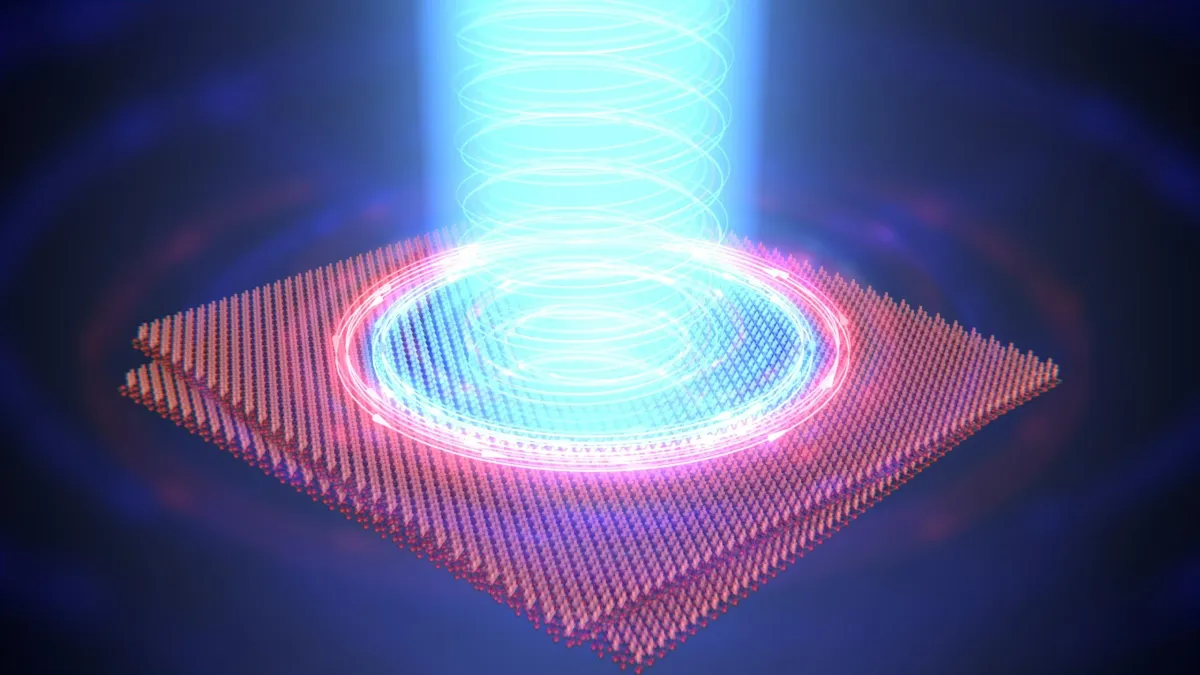
The Basel and Zurich team found a different path. They used a laser pulse to reverse the magnetic orientation without any heating at all.
The material that made it possible
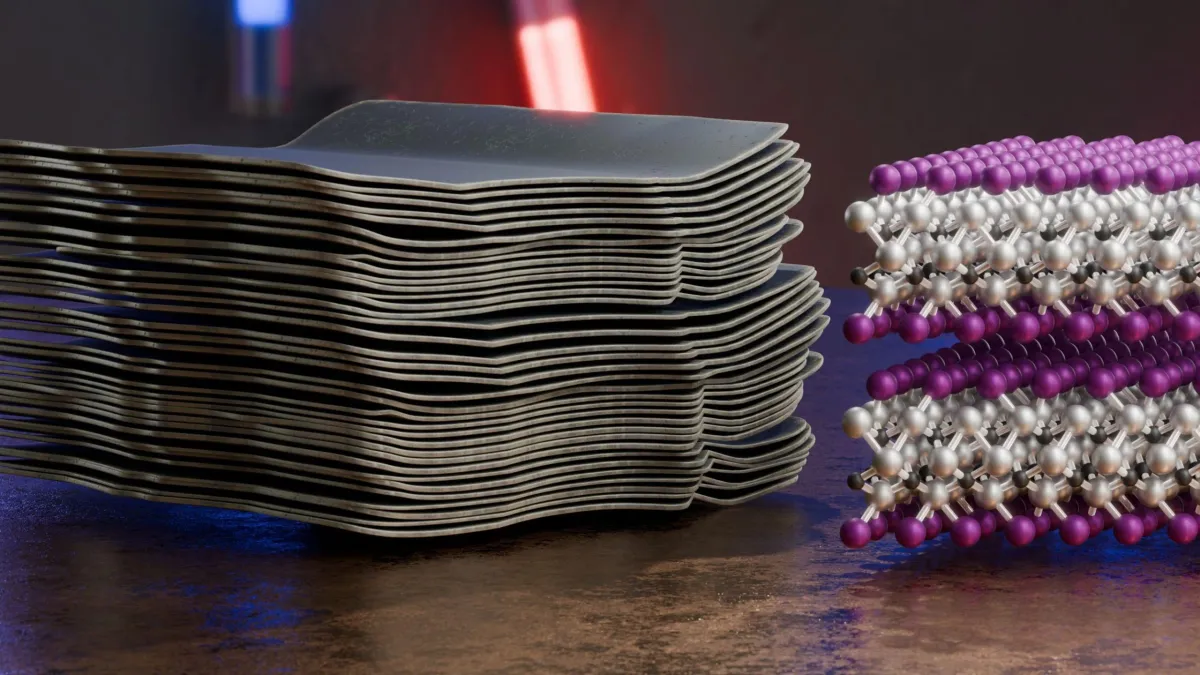
The trick lay in the material itself: two impossibly thin layers of molybdenum ditelluride, stacked with a deliberate twist between them. This "twisted" arrangement creates unusual electronic behavior — the slight misalignment between layers reshapes how electrons move and interact with each other.
The researchers could tune these electrons between different quantum states, each configuration pushing the spins to align in parallel and create ferromagnetism. What made this work was combining three separate frontiers of modern physics in one experiment: strong electron interactions, topology (the study of properties that survive deformation), and real-time optical control.
"What's exciting about our work is that we combine the three big topics in modern condensed matter physics in a single experiment," says Ataç Imamoğlu from ETH Zurich.
When the laser pulse hit the material, the entire ferromagnet flipped. The spins reoriented. And the flip was permanent — it stayed reversed without any additional energy input. More intriguingly, the way the flip unfolded was shaped by the material's topological state, linking magnetism and topology in a single controllable system.
What comes next
The team could even use the laser to draw new boundary lines within the material, creating regions where the topological ferromagnetic state existed. They could repeat this process, dynamically reshaping both the topological and magnetic properties.
To confirm the tiny ferromagnet (only a few micrometers across) had actually switched, they measured how a second, weaker laser beam reflected off it — the reflection revealed the new spin orientation.
For now, this is a proof of concept in a lab. But Smoleński sees a path forward: "In the future, we will be able to use our method to optically write arbitrary and adaptable topological circuits on a chip." That could enable tiny interferometers sensitive enough to detect extremely small electromagnetic fields, or reconfigurable logic circuits that adapt their function in real time rather than being hardwired at manufacture.
It's the kind of fundamental control — using light to reshape matter's behavior without destruction or permanent change — that quietly opens doors to technologies we haven't yet imagined.