Researchers at Leipzig University and TU Dresden have engineered molecules that act like on-off switches for ion channels — the tiny gates that control what moves in and out of cells. Shine violet light, and a channel opens. Switch to blue light, and it closes. This isn't science fiction; it's working in living tissue right now.
Ion channels are everywhere in your body. They regulate the flow of sodium, potassium, and calcium across cell membranes, which means they control everything from how your neurons fire to how your heart beats to how your digestive system contracts. Until now, scientists could study these channels, but controlling them with precision — in a specific location, at a specific moment — has been nearly impossible.
Light as a Molecular Switch
The breakthrough hinges on two new compounds: AzPico and AzHC. These molecules can reversibly bind to TRPC4 and TRPC5 ion channels, the kinds found in the brain, adrenal glands, and digestive tract. The elegance is in the light sensitivity. Violet light activates the channels; blue light deactivates them. The researchers call this "chromocontrol" — using color to control biology.
We're a new kind of news feed.
Regular news is designed to drain you. We're a non-profit built to restore you. Every story we publish is scored for impact, progress, and hope.
Start Your News DetoxTo understand why this matters, imagine trying to study how a specific group of neurons affects memory. Before, you'd have to activate all similar neurons at once, or use crude chemical methods. Now you can shine light on a precise spot in a mouse's brain and activate only the neurons you're targeting. The same precision applies to studying how the adrenal gland releases adrenaline or how the small intestine contracts.
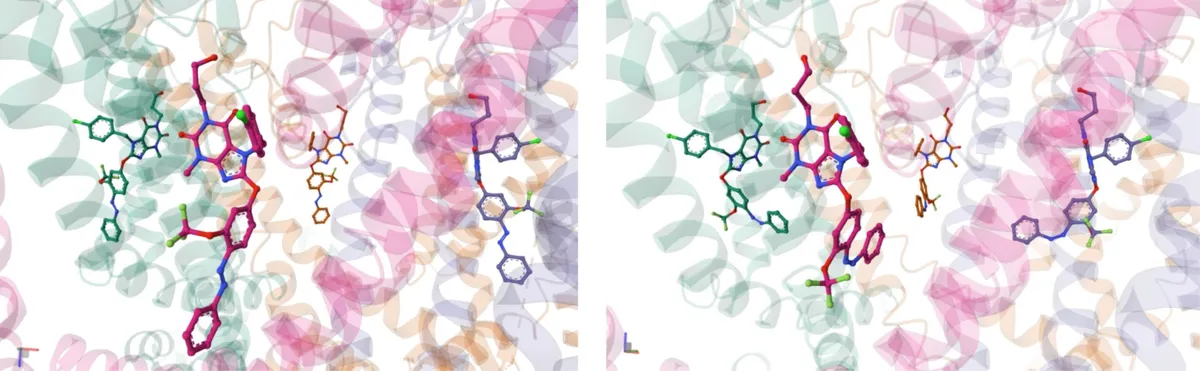
The team used cryo-electron microscopy to map exactly where these photoswitches bind to the ion channels, confirming the high selectivity. Experiments with genetically modified mice proved the molecules work with remarkable specificity in living organisms — not just in lab dishes.
The next phase is already underway. Researchers are developing successor compounds that respond to longer wavelengths of light, which can penetrate deeper into tissue. That means eventually controlling cells deep inside organs, not just at the surface. Other teams are exploring how to apply this technique to additional ion channel types and organ systems.
The practical implications are substantial. Understanding how ion channels work in the brain could illuminate neurological conditions. The same precision control might eventually enable new therapeutic approaches that activate or suppress specific cellular functions with unprecedented accuracy. For now, the science is still in the research phase — but the foundation is solid, and the momentum is building.