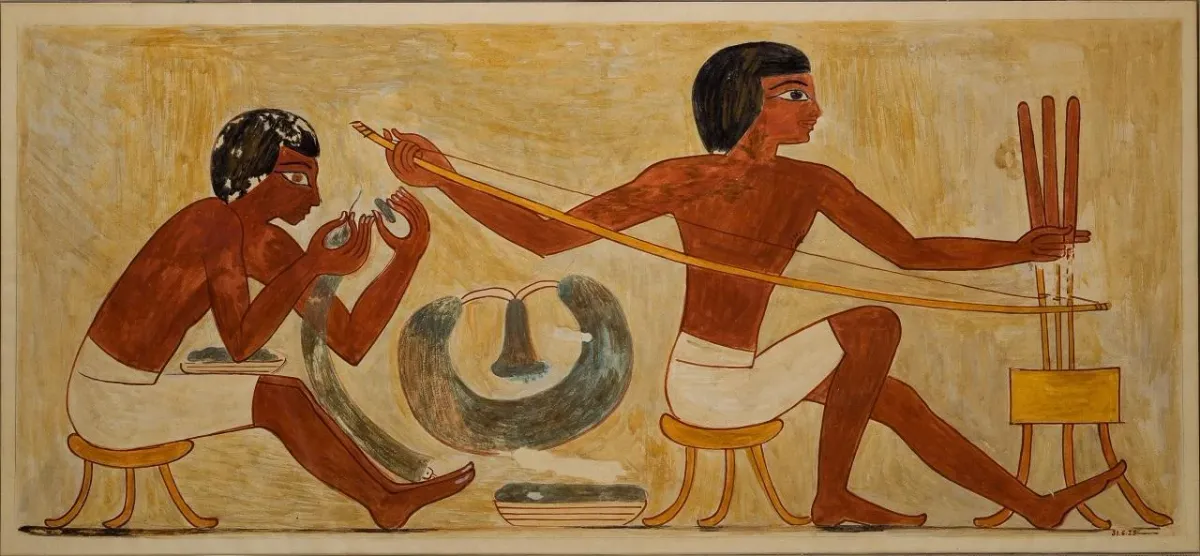
A small copper object sitting in Cambridge's museum collection for nearly a century has just revealed something unexpected: ancient Egyptians were drilling with sophisticated rotary tools far earlier than anyone thought.
The artifact—barely two and a half inches long—was excavated almost 100 years ago from a cemetery at Badari in Upper Egypt and dated to around 2500 BCE. It spent decades cataloged simply as "a little awl of copper," filed away among thousands of other grave goods. But when researchers from Newcastle University and the Academy of Fine Arts Vienna recently examined it with fresh eyes and modern analysis, they realized what they were actually looking at: the remains of a bow drill, a prehistoric power tool that would have let craftspeople spin a bit rapidly and precisely.
This matters because it pushes back the known history of Egyptian drilling technology by roughly 2,000 years. Until now, the best evidence for bow drills in Egypt came from the middle to late 2nd millennium BCE—well-preserved sets that showed the technology was already refined. This small copper piece suggests the innovation happened much earlier, during the late 4th millennium, when someone figured out that wrapping a cord around a shaft and using a bow to move it back and forth could create something far more efficient than twisting a tool by hand.
We're a new kind of news feed.
Regular news is designed to drain you. We're a non-profit built to restore you. Every story we publish is scored for impact, progress, and hope.
Start Your News DetoxMartin Odler, lead author of the study, noted that this would have been "invaluable to craftspeople of the time." The cemetery where the drill was found also contained beads and other drilled objects—evidence that rotary drilling wasn't just a one-off experiment but an actual technique being used to make things.
An Unexpected Trade Route
What intrigued the researchers equally was what the drill was made of. X-ray fluorescence analysis revealed an unusual mix of metals, including some that don't naturally occur in the region. That points to either extensive long-distance trading networks operating in the 4th millennium BCE or undiscovered ore sources somewhere in the Eastern Desert—either way, a hint that ancient Egypt's connections and resources were more complex than previously understood.
The rediscovery came through the EgypToolWear project, which systematically examines wear patterns on metal artifacts to understand how ancient tools were actually used. It's a reminder that museum collections—often overlooked in favor of new excavations—can still surprise us when approached with current technology and fresh questions. A misidentified object and a new analytical technique just rewrote a small but genuine piece of technological history.