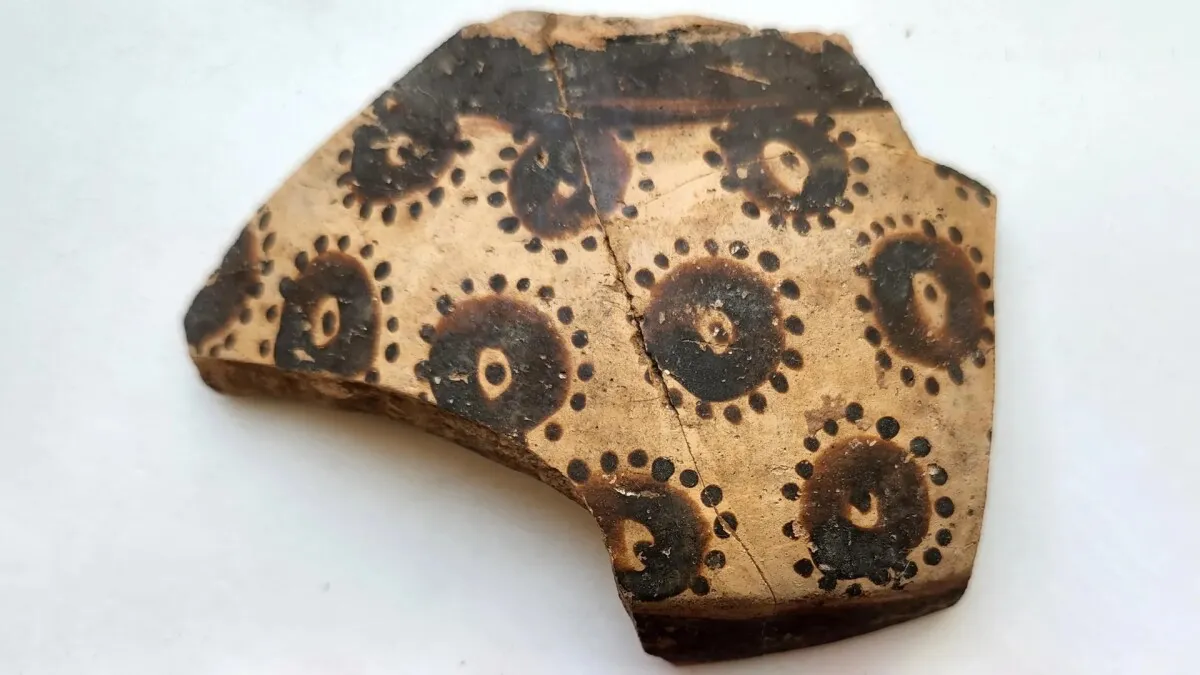
Eight thousand years ago, potters in northern Mesopotamia were painting flowers on ceramic bowls with such precision that they were encoding mathematical thinking into their designs—long before anyone invented writing.
A new study published in the Journal of World Prehistory examined thousands of painted pottery fragments from 29 Halafian sites (dating to around 6200-5500 BCE) and found something unexpected: the flower petals weren't random. They followed a strict geometric sequence—4, 8, 16, 32, 64 petals—a doubling pattern that reveals an understanding of mathematical progression.
"Mathematical cognition developed well before writing, embedded in craft traditions such as pottery painting and seal engraving," says Yosef Garfinkel, who led the research. The flowers weren't just decorative—they showed symmetry, controlled spatial subdivision, and systematic thinking. Among the 375 pottery sherds featuring floral designs, the precision was consistent across sites separated by distance and time.
We're a new kind of news feed.
Regular news is designed to drain you. We're a non-profit built to restore you. Every story we publish is scored for impact, progress, and hope.
Start Your News DetoxWhy would potters care about doubling sequences. The researchers suggest it came from a practical need: early villages had to divide crops and resources fairly among people. A system for equal partitioning—one that could scale from 4 to 64—would have been genuinely useful. Over time, this practical mathematics became embedded in how people made things, how they saw the world.
This reshapes what we thought we knew about when abstract thinking emerged. We've long assumed that mathematical reasoning arrived with writing, that you needed symbols and records to think in patterns. But these potters were thinking mathematically through their hands, through repetition and design. They were solving problems with geometry before they had a word for it.
The findings suggest that the Halafian culture underwent what archaeologist Laurent Davin calls "an important cognitive transformation: the integration of aesthetic appreciation, botanical awareness, and mathematical reasoning." It's a reminder that the human capacity for abstraction didn't suddenly appear. It grew quietly in craft, in the everyday work of making things.