For decades, astronomers have noticed something odd: nearby galaxies move in ways that don't quite match what we'd expect. The math didn't work. The gravitational pull of the Milky Way and Andromeda should have bent their paths more dramatically. Now, a team at the University of Groningen has figured out why.
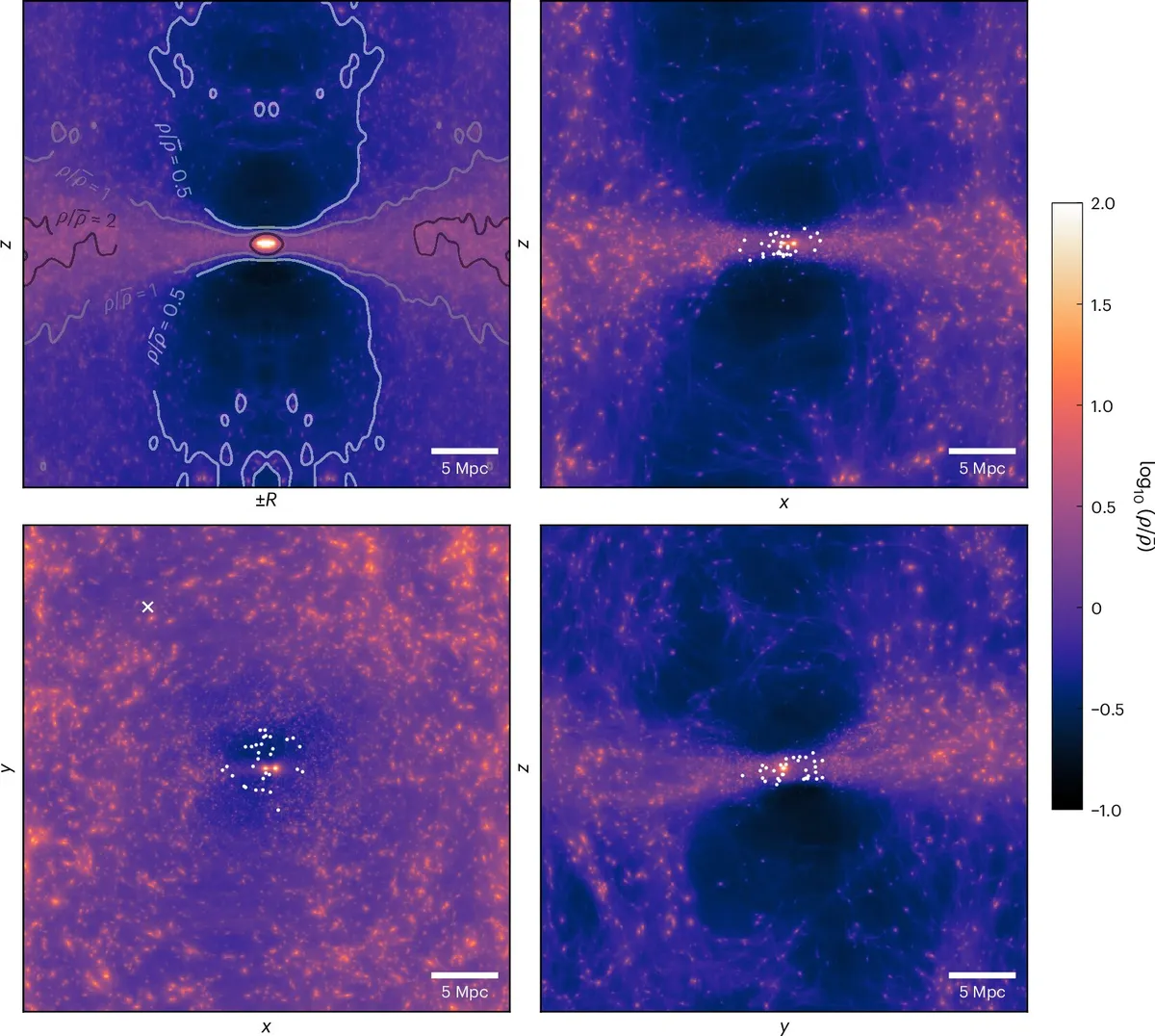
The answer is dark matter — but not scattered randomly through space. Instead, it's organized into a vast, flat sheet, like a cosmic pancake, with the Local Group (our Milky Way, Andromeda, and their satellite galaxies) embedded within it. Above and below this sheet are enormous voids, almost completely empty of matter.
How they found the invisible architecture
Ewoud Wempe and Amina Helmi ran computer simulations that started from the early universe's actual conditions — based on observations of the cosmic microwave background — and let them evolve forward to today. The goal was to recreate the Local Group's current state: the masses and positions of the Milky Way and Andromeda, plus the velocities of 31 nearby galaxies.
We're a new kind of news feed.
Regular news is designed to drain you. We're a non-profit built to restore you. Every story we publish is scored for impact, progress, and hope.
Start Your News DetoxWhat emerged was striking. The simulations only matched reality when they included this flat, sheet-like distribution of dark matter. When they ran the numbers with random dark matter distributions, the nearby galaxies' movements didn't match observations. But with the sheet model, everything aligned.
The sheet structure explains why nearby galaxies appear to follow the Hubble-Lemaître law — the rule that galaxies farther away move away faster — even though the Local Group's enormous mass should disrupt this pattern. For galaxies within the sheet, the Local Group's gravitational pull is balanced by the mass of the sheet itself extending outward. And the voids above and below? They're invisible to us because there are no galaxies there to observe.
"We are exploring all possible local configurations of the early universe that could lead to the Local Group," Wempe said in a statement. "It is great that we now have a model that is consistent with the current cosmological model and with the dynamics of our local environment."
Helmi, who has worked on this problem for years, called it a breakthrough. "Based purely on the motions of galaxies, we can now determine a mass distribution that corresponds to the positions of galaxies within and just outside the Local Group." The research was published in Nature Astronomy.
This discovery doesn't change how we understand dark matter fundamentally, but it does show that its large-scale architecture is far more structured than we'd assumed. The universe isn't a uniform soup of invisible matter — it's organized into sheets and voids, like the walls and empty spaces in a cosmic foam. And we're sitting right in one of those sheets.