Japanese researchers have grown miniature human brain models in the lab and discovered something fundamental: the thalamus doesn't just relay signals — it actively orchestrates how the cortex develops and organizes itself.
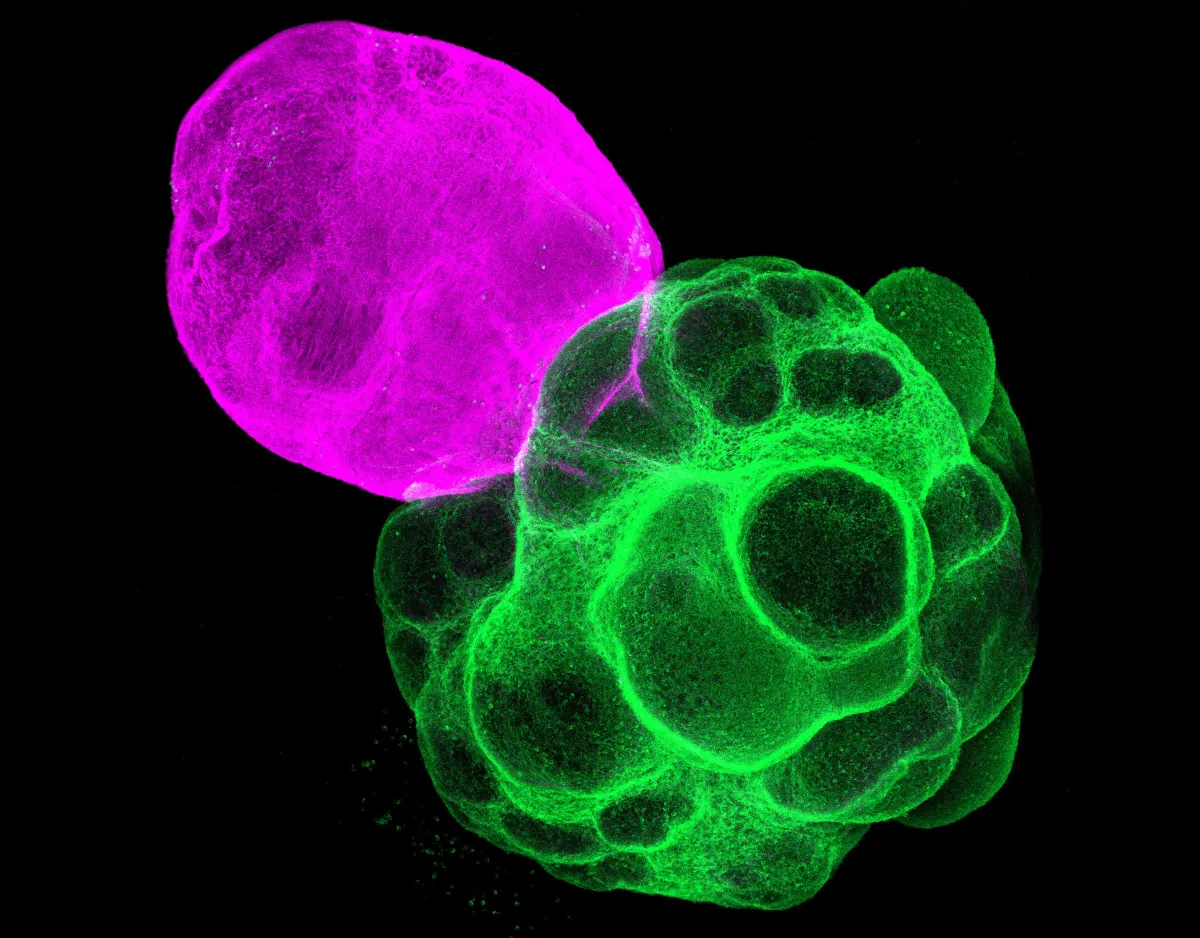
The team at Nagoya University built these tiny brain structures, called assembloids, by fusing together two types of lab-grown tissue: one that mimics the thalamus and one that mimics the cortex. The thalamus is a small, deep brain region that acts as a relay station, sending sensory information to the cortex. What wasn't clear until now was exactly how this relay process shapes the cortex's wiring during development — especially in human brains, where ethical constraints make direct study nearly impossible.
How They Built It
The researchers started with induced pluripotent stem cells — adult cells reprogrammed back to an embryonic state — and coaxed them to grow into brain-like tissue. They created separate thalamic and cortical organoids (tiny, three-dimensional models), then physically fused them together. This allowed the two regions to interact naturally, the way they do in a developing fetus.
We're a new kind of news feed.
Regular news is designed to drain you. We're a non-profit built to restore you. Every story we publish is scored for impact, progress, and hope.
Start Your News DetoxWhat happened next was striking. Nerve fibers from the thalamic tissue grew toward the cortex, while cortical fibers extended back toward the thalamus. The two regions formed connections that closely mirrored what you'd see in an actual human brain. More importantly, when the cortical tissue was connected to the thalamus, it showed signs of greater maturity than standalone cortical tissue. The thalamus wasn't just sending signals — it was actively promoting cortical development.
The Thalamus as a Conductor
When the researchers measured electrical activity flowing through these assembloids, they found something elegant: signals from the thalamus rippled into the cortex in wave-like patterns, creating synchronized activity across different cortical neurons. But here's the crucial detail — this synchronization wasn't random. It selectively strengthened specific neuron types: those that project back to the thalamus. Other neurons in the same tissue didn't show the same coordinated firing.
This suggests the thalamus doesn't just broadcast information. It shapes which neurons form networks and reach functional maturity, essentially conducting an orchestra where some instruments get amplified and others don't.
Why This Matters for Brain Disorders
In conditions like autism spectrum disorder, these cortical circuits develop differently or function improperly. Scientists have suspected for years that the thalamus plays a role — animal studies pointed that way — but the human brain is different enough that those findings don't always translate directly. Now researchers have a platform to watch human thalamic and cortical development unfold in real time, under controlled conditions.
This opens a path toward understanding what goes wrong in neurodevelopmental disorders and, eventually, testing potential treatments. Professor Fumitaka Osakada, who led the work, noted that these assembloids represent a significant step forward in what he calls the "constructivist approach" — essentially, understanding the brain by rebuilding it piece by piece.
The findings were published in the Proceedings of the National Academy of Sciences in 2025. What comes next is likely a flood of similar studies using these assembloids to probe other brain region interactions and the origins of various neurological conditions.