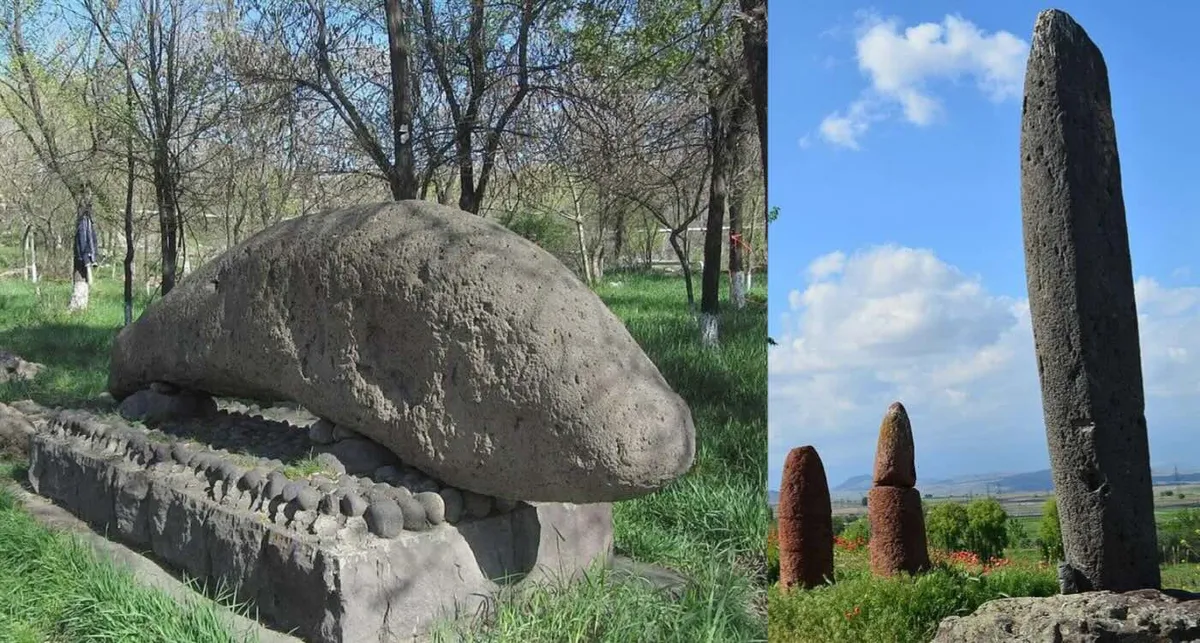
For thousands of years, Armenia's mysterious standing stones—carved with fish and stretched cowhides, weighing as much as small cars—have sat scattered across mountain slopes with no clear explanation for why ancient builders went to such extraordinary effort to place them there.
Now researchers have cracked the code. A new survey by Yerevan State University's Institute of Archaeology and Ethnography found that these vishaps (meaning "dragons" in Armenian) weren't randomly scattered at all. They cluster in three main regions: 43 in the Geghema Mountains, 36 on Mount Aragats, and 17 in the Vardenis Mountains. Built between 4200 and 4000 BCE—around the same time Stonehenge rose in Britain—the stones tell a story about how ancient Armenians organized their world around water and survival.
The altitude paradox
The real puzzle emerged when researchers looked at where the largest stones were placed. Logic suggests that bigger monuments require more labor and time to build. At high altitude, where snow covers the ground for eight months a year and resources are scarce, you'd expect smaller stones. Instead, the team found massive vishaps—some taller than nine feet, weighing over seven tons—positioned at elevations around 9,000 feet.
We're a new kind of news feed.
Regular news is designed to drain you. We're a non-profit built to restore you. Every story we publish is scored for impact, progress, and hope.
Start Your News DetoxBuilding monuments of that scale in such hostile terrain suggests something deeper than practical necessity was driving the effort. The stones weren't placed where they were easiest to build. They were placed where they mattered most.
Water, worship, and landscape claim
The researchers' working hypothesis points to a water cult. The fish-carved vishaps cluster near mountain springs—the lifeblood of a highland community. The cow-hide stones tell a different part of the same story: they mark lower-altitude valleys where ancient irrigation channels and grazing lands sustained herds. Later civilizations understood this significance too. When the Urartians arrived centuries later, they carved their cuneiform alphabet into the vishaps. Early Christian communities added crosses, layering their own spiritual marks onto stones that had already been sacred for millennia.
What likely motivated the builders was something more fundamental than worship alone: proof that a community could work together at scale. These stones were monuments to cooperation itself—markers that said "we were here, we organized, we transformed this landscape." They anchored a people's claim not just to the land, but to each other.
The vishaps remained standing through empires and religions, each generation recognizing what the first builders understood: that some effort is worth the cost because it speaks across time.