NASA's Artemis II mission is going so smoothly that flight controllers skipped a planned engine burn. This means the Orion spacecraft is perfectly on track for its journey to the Moon.
A Smooth Journey to the Moon
The Artemis II crew is heading to the Moon on a very precise path. This accuracy allowed mission control at NASA's Johnson Space Center to cancel the first planned trajectory correction burn. The Orion spacecraft is already in the correct position for its lunar flyby, which is set for Monday, April 6.
Originally, three trajectory adjustments were scheduled to fine-tune Orion's speed and direction. While this first one was skipped, any necessary corrections can still be made with later burns. For now, the spacecraft is exactly where it needs to be.
We're a new kind of news feed.
Regular news is designed to drain you. We're a non-profit built to restore you. Every story we publish is scored for impact, progress, and hope.
Start Your News DetoxHumans Return Beyond Earth Orbit
After a successful translunar injection burn on April 2, the Artemis II astronauts began their second full day in space. NASA astronauts Reid Wiseman, Victor Glover, and Christina Koch, along with CSA (Canadian Space Agency) astronaut Jeremy Hansen, are the first humans to travel beyond Earth orbit since 1972.
Mission control woke the crew with music at 1 p.m. EDT. Their schedule is packed with deep space operations, spacecraft system checks, and science preparations. At that time, Orion was about 99,900 miles from Earth and getting closer to the Moon, which was about 161,750 miles away.
The planned trajectory correction burn was not needed because the spacecraft's current path was accurate enough. These short engine firings usually make small adjustments after major maneuvers. This particular burn would have lasted about eight seconds and changed Orion's speed by 0.7 feet per second. Skipping it shows how precise the mission's navigation has been.
Preparing for the Moon's Hidden Side
As Orion nears the Moon, scientists are finalizing plans for a six-hour observation period during the flyby. During this time, the Sun, Moon, and spacecraft will align, allowing the crew to see about 20% of the Moon's far side illuminated.
This part of the Moon cannot be seen from Earth. It includes features like the Orientale basin, Pierazzo crater, and Ohm crater. The astronauts expect to see several of these formations without special instruments.
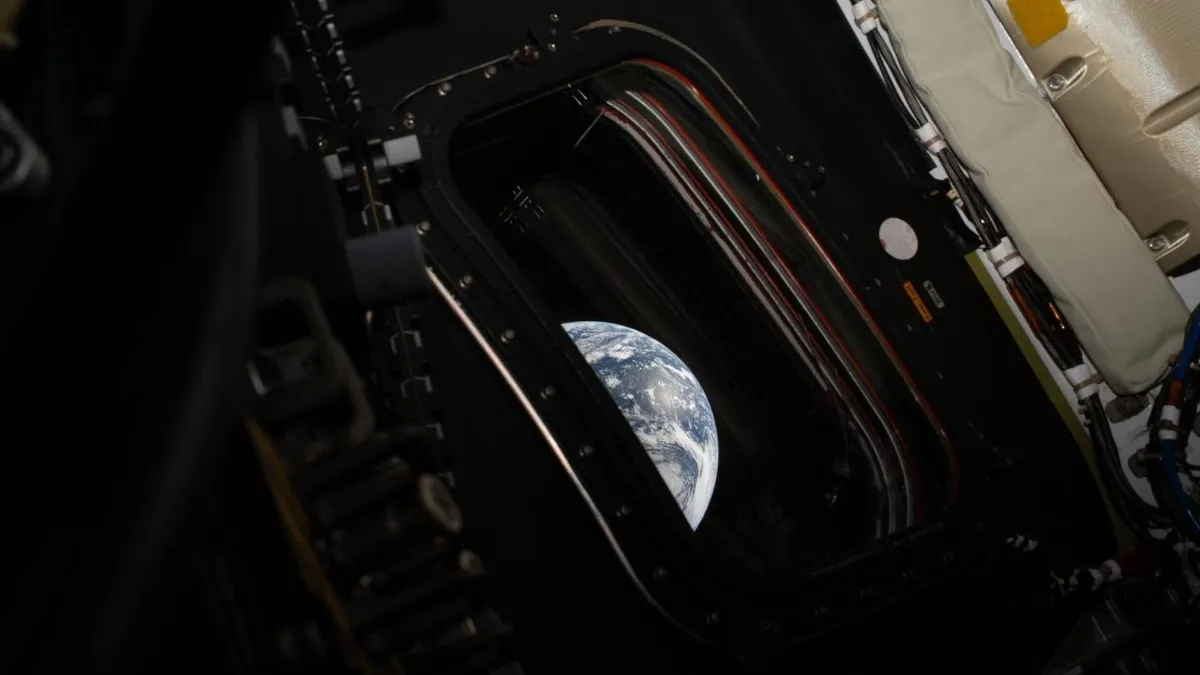
 A view of Earth taken by NASA astronaut and Artemis II commander Reid Wiseman from one of the Orion spacecraft’s four main windows after completing the translunar injection burn on April 2, 2026. Credit: NASA
Inside the spacecraft, the crew has been getting ready for these observations. They are organizing equipment, setting up cameras, and practicing moving in microgravity within the cabin, which is about the size of two minivans. They are also preparing handheld cameras with special lenses to capture images during the flyby.
Health and Communication in Deep Space
The astronauts also practiced medical procedures, including CPR and choking response, to see how emergency care would work in space. Staying healthy is important, so all four crew members continue to exercise using Orion’s flywheel system to keep their hearts strong.
Later, Christina Koch tested Orion’s emergency communication system using NASA’s Deep Space Network. The system worked well as the spacecraft moved further from Earth.
Additionally, the Orion Artemis II Optical Communications System connected with two ground stations in the United States. It sent high-definition video and other mission data back to Earth. This information quickly reached mission control, confirming that communication systems are working as expected in deep space.