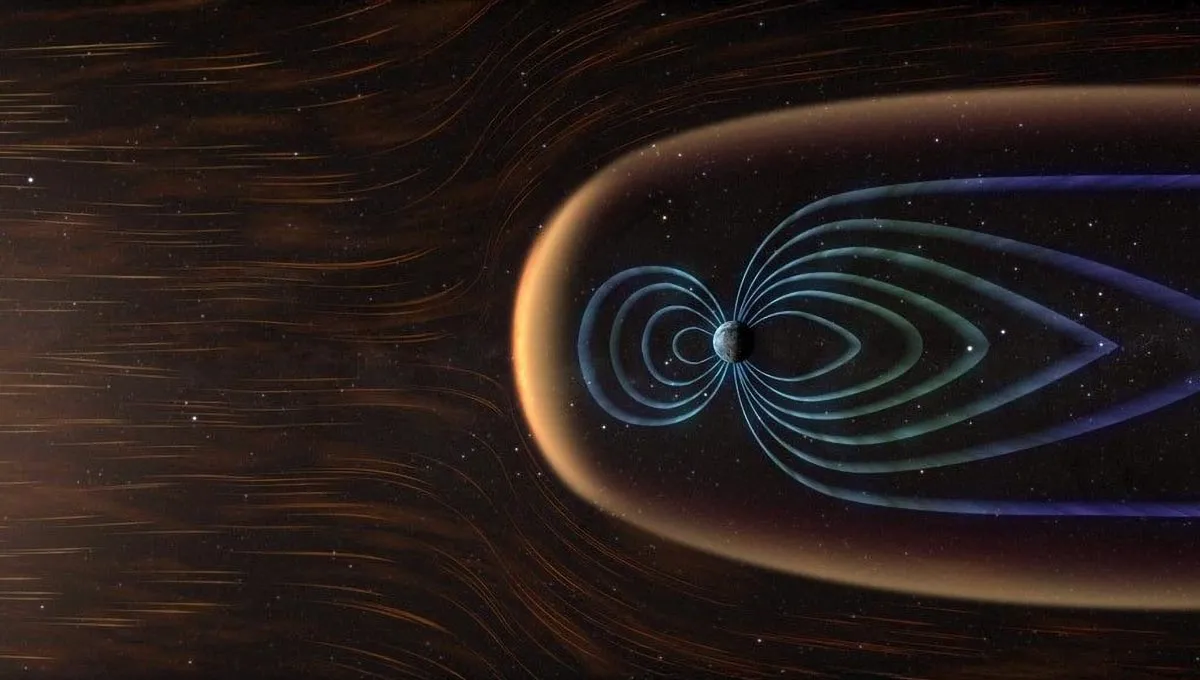
For half a billion years, two things that seem completely unrelated have moved in lockstep: the strength of Earth's magnetic field and the amount of oxygen in our atmosphere. NASA scientists just mapped this hidden rhythm, and it's forcing us to think differently about what actually keeps a planet habitable.
The discovery came from comparing two sets of ancient data that had never been closely examined together before. Geophysicists have long studied Earth's magnetic history by reading the mineral record locked inside old rocks — when molten material cools at the boundaries where tectonic plates spread, it captures a snapshot of the surrounding magnetic field like a photograph. Meanwhile, geochemists have been piecing together atmospheric oxygen levels by analyzing the chemical composition of ancient rocks and minerals, which tells them how much oxygen was present when those rocks formed.
When researchers from NASA's Goddard Space Flight Center and the University of Leeds lined these two records up, the correlation was unmistakable. Both the magnetic field strength and oxygen levels rose and fell together, following comparable patterns all the way back to the Cambrian explosion — roughly 540 million years ago, when complex life first became widespread on Earth.
We're a new kind of news feed.
Regular news is designed to drain you. We're a non-profit built to restore you. Every story we publish is scored for impact, progress, and hope.
Start Your News Detox"These two datasets are very similar," said Weijia Kuang, the geophysicist who led the analysis. "Earth is the only known planet that supports complex life. The correlations we've found could help us understand how life evolves and how it's connected to the interior processes of the planet."
What makes this finding so striking is what it suggests about planetary habitability. We tend to think about what keeps Earth alive in surface terms — atmospheric chemistry, ocean currents, solar radiation. But this research hints that the planet's deep interior plays a role we're only beginning to understand. Earth's magnetic field is generated by the movement of molten material far below our feet, and it acts as a shield protecting our atmosphere from erosion by high-energy particles from the Sun. The new data suggests that changes in this deep magnetic activity may somehow influence the conditions that allow oxygen to accumulate in our air.
The researchers aren't claiming they've solved the puzzle yet. Benjamin Mills, a biogeochemist at Leeds, notes that the correlation could point to a single underlying driver — perhaps the movement of Earth's continents, which affects both internal heat flow and surface chemistry. But the exact mechanism remains unclear. "There's more work to be done to figure that out," the team acknowledged.
What comes next is expansion. The researchers plan to push their analysis further back in Earth's history to see if the relationship holds even deeper in time. They're also looking at other elements essential for life — nitrogen, for instance — to see if similar patterns emerge. Each discovery narrows the gap between what happens in Earth's molten core and what happens in the air we breathe.