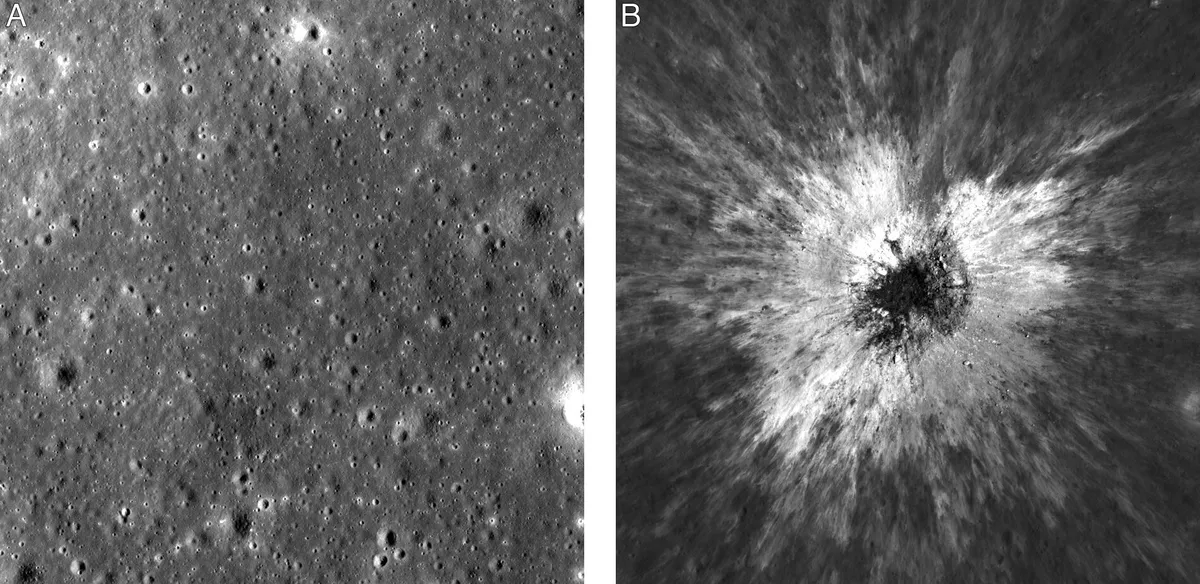
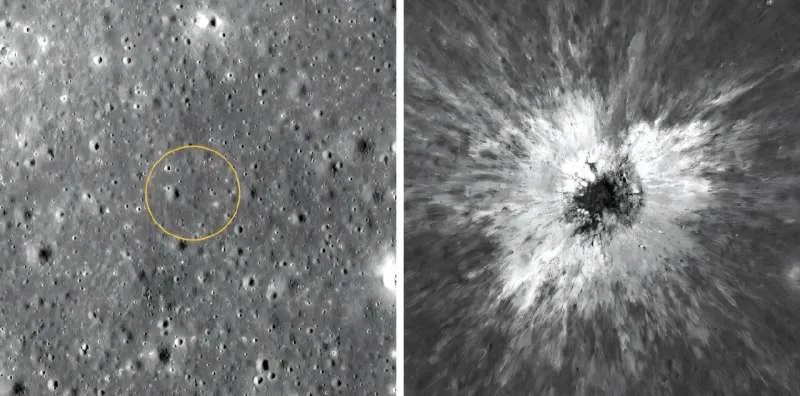
Scientists have found a new crater on the moon. It's larger than the Roman Colosseum and formed two years ago from a powerful impact that went unnoticed at first.
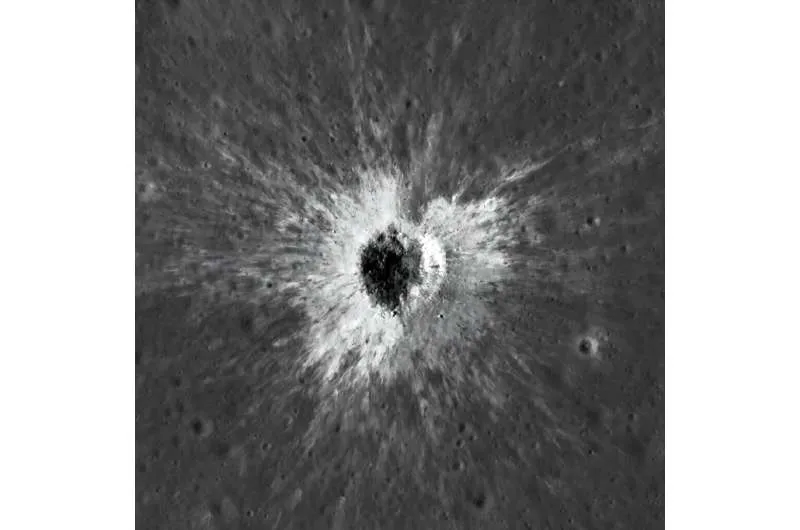
This steep-sided hole is about 728 feet across and up to 141 feet deep. It's the biggest known impact crater in our solar system to form recently.
A Rare Lunar Event
Such a large impact is expected only once every 132 years. This makes the new crater a valuable source of information as NASA plans to build a base for astronauts on the moon. Researchers called it a "statistically rare, effectively once-in-a-lifetime observation."
We're a new kind of news feed.
Regular news is designed to drain you. We're a non-profit built to restore you. Every story we publish is scored for impact, progress, and hope.
Start Your News DetoxNASA's Lunar Reconnaissance Orbiter (LRO) first saw the crater in May 2024. It was formed by a piece of an asteroid or comet hitting the moon's near side. Telescopes on Earth and in space didn't detect the strike in real time.
LRO's wide-angle images were not identified until August 2025 due to the large amount of data. The spacecraft then took more detailed pictures last fall, confirming the discovery early this year.
The crater is named after Thomas McGetchin, a former director of Houston's Lunar and Planetary Institute. It is three times bigger than the previous record-holder found by the LRO ten years ago. The moon has some of the solar system's largest impact craters, including one over 1,500 miles wide.
This latest impact stirred the lunar surface for more than 66 miles. Dust and rocky soil were thrown out at a higher angle than expected, according to Mark Robinson. He is the chief scientist for the LRO's cameras at Intuitive Machines and lead author of one of the studies.
Understanding Lunar Soil
Another study found a 4-mile-wide cold spot around the new crater. This suggests the moon's top soil has loosened. Co-author David Paige of the University of California, Los Angeles, compared it to gardening.
Paige noted that scientists are now seeing impacts as a way to "garden" the regolith. This means they churn the sediments and bring material from below to the surface.
Since its launch in 2009, LRO's many crater discoveries show that the moon's top inch of soil is overturned by ejected material every 80,000 years. This is faster than previously thought, Robinson said.
Contrary to popular belief, the dusty footprints left by Apollo moonwalkers will "definitely be long gone in that time frame," Robinson explained.
The next step is to figure out the risk of ejected material from craters hitting NASA's planned moon base. This information will help engineers make structures stronger so they can withstand damage.
Deep Dive & References
A new 222-m diameter lunar crater - Science Advances, 2026 New lunar crater reveals extensive distal regolith modification - Science Advances, 2026