DNA, bless its double-helix heart, is a bit of a paradox. On one hand, every strand carries a negative charge, which, if you remember basic magnets, means it should actively push away from other DNA strands. Like tiny, grumpy repelling noodles.
But inside our cells, DNA needs to get cozy. It pairs up for all sorts of vital functions, from fixing itself to silencing genes, and even, sometimes, getting involved in the messy business of cancer development. So, how do these negatively charged molecules overcome their natural aversion and perform a precise molecular tango?
Turns out, the secret is a handful of tiny metal ions acting as molecular matchmakers.
We're a new kind of news feed.
Regular news is designed to drain you. We're a non-profit built to restore you. Every story we publish is scored for impact, progress, and hope.
Start Your News DetoxThe Atomic Zipper
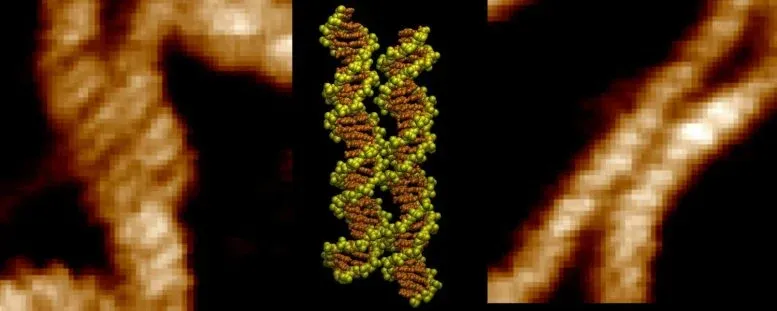
Scientists, armed with atomic force microscopes that let them peek at molecules in stunning detail, watched short DNA segments align perfectly, groove-for-groove. Then, computer simulations swooped in to reveal the microscopic mechanics: positively charged metal ions, like little bridges, nestle into these grooves, effectively holding the two DNA molecules together.
Professor Agnes Noy from the University of York, who co-led the research, noted that this discovery could help pinpoint specific parts of the genome where this pairing is crucial. These areas might be hotbeds for trouble when mutations mess with normal cell functions, potentially leading to cancer.
This isn't entirely new territory. The finding actually backs up a theory from two decades ago — the rather wonderfully named "DNA zipper" model. Professor Alexey Kornyshev and his team at Imperial College London first suggested that salt ions around DNA could create alternating charge patterns, allowing DNA molecules to line up like interlocking spiral staircases. Which, if you think about it, is both impressive and slightly terrifying.
The Molecular Handshake
To actually see this in action, the team used atomic force microscopy to map DNA surfaces, while advanced computer simulations tracked individual atoms and ions. The simulations showed that double-charged metal ions act almost like tiny, charged arms, reaching out to both DNA molecules at once, bridging the gap, and stabilizing their alignment.
Dr. Thomas Catley from the University of Sheffield, a co-lead author, called it "incredible" to directly observe this long-hypothesized mechanism. Because apparently that's where we are now: watching atoms play matchmaker. Dr. Victor Velasco-Berrelleza, who performed the simulations, added that while microscopy shows what happens, simulations reveal the molecular why.
Some DNA sequences, it turns out, are better at this molecular handshake than others. They form stronger connections, creating "hotspots" where two helices are more likely to line up. Understanding these sequence-dependent interactions could be key to figuring out how mutations derail normal cell behavior and contribute to cancer.
Beyond medicine, these findings could open doors for engineers. Imagine designing custom DNA structures for biotechnology, precisely programming them to zip together just so. Because if DNA can overcome its natural repulsion with a little help from its ion friends, what can't it do?