Scientists have finally found an answer to a long-standing puzzle in nuclear physics. For decades, some atomic nuclei have released more low-energy gamma rays than expected. This mystery has now been linked to hidden magnetic changes inside these nuclei.
This new understanding comes from a study led by the Facility for Rare Isotope Beams (FRIB). Scientists from Lawrence Livermore National Laboratory (LLNL) also helped. The findings, published in Nature, could impact fields like astrophysics, nuclear energy, and national security.
Solving a Gamma-Ray Puzzle
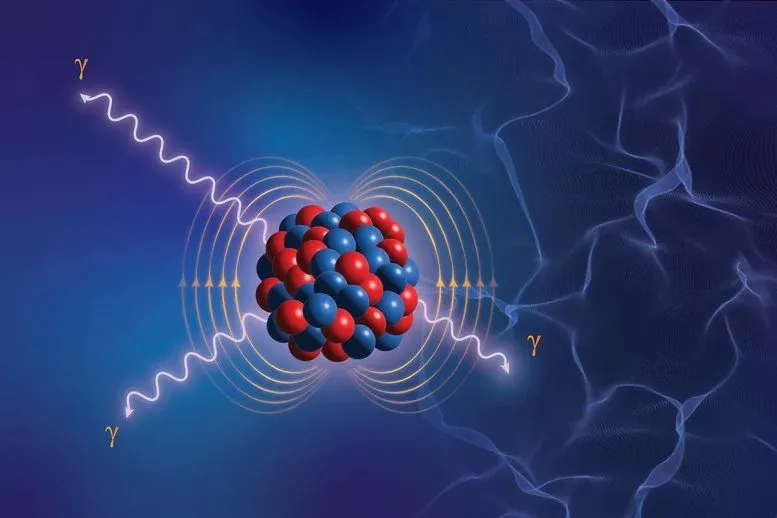
Gamma rays are a powerful type of electromagnetic radiation. They are like light or radio waves but carry much more energy. When an atomic nucleus is unstable, it releases gamma rays as it settles into a more stable state.
We're a new kind of news feed.
Regular news is designed to drain you. We're a non-profit built to restore you. Every story we publish is scored for impact, progress, and hope.
Start Your News DetoxFor years, scientists noticed that some nuclei produced an unusually high number of low-energy gamma rays. This "low-energy enhancement" was a mystery. It didn't happen in all nuclei, and there was no way to predict where it would occur.
Eleanor Ronning, the study's lead author, noted that this enhancement was a "shock to the community" because theory didn't predict it.
The new research strongly suggests that this effect comes from magnetic changes within the nucleus. Andrea Richard, a co-lead of the study, called this a "key step forward." She said they now have a clear explanation that connects experiments with theory.
Uncovering Magnetic Transitions
To solve the mystery, researchers studied gamma rays released when a radioactive copper isotope changed into zinc. Using special equipment at FRIB, the team could separate two different types of nuclear decay.
One type of decay involved an electric transition. Here, the protons in the copper nucleus shifted their positions.
The other type was a magnetic transition. In this process, neutrons and protons inside the nucleus essentially flipped their internal magnetic directions.
Only the magnetic transition caused the unexpected increase in low-energy gamma rays. This showed that the enhancement is magnetic.
Ronning and Richard proposed this experiment. LLNL scientists provided technical help and monitored the experiment for a full week.
Wider Impact of the Discovery
Even though the experiment focused on just one nucleus, the results could greatly improve our understanding of how nuclei behave.
Darren Bleuel, an LLNL scientist and author, said the findings could help improve how they understand nuclear stockpile performance and past test results. He added that it could also boost nuclear forensics, helping to identify if a nuclear event happened and its source.
The discovery could also make models of nuclear reactions in stars, supernovae, and neutron star mergers more accurate. These reactions are responsible for creating heavy elements. It could also improve our understanding of reactions important for nuclear energy.
Deep Dive & References
Magnetic character of the low-energy enhancement in 70Zn - Nature, 2026