Imagine trying to take a crystal-clear photo of something impossibly small and delicate — like a single, wobbly protein. Now imagine that every time you blast it with enough light to see it, you accidentally incinerate it. That's the electron microscope dilemma, in a nutshell.
But a team of Austrian researchers just proposed a solution that sounds like something out of a sci-fi novel: sticking a tiny quantum computer inside the microscope. Because apparently that's where we are now.
Traditional electron microscopes need a lot of electrons to get a good picture. More electrons, clearer image. Simple, right? Except when those electrons are basically tiny wrecking balls for your fragile biological samples. Philipp Haslinger from TU Wien points out that trying to image tiny details often means irreparable damage to the very thing you're trying to study.
We're a new kind of news feed.
Regular news is designed to drain you. We're a non-profit built to restore you. Every story we publish is scored for impact, progress, and hope.
Start Your News DetoxThe Quantum Leap: Entangled Ions to the Rescue
The new idea isn't about using fewer electrons, per se. It's about getting more information out of each electron. Instead of just counting them as they pass through, what if you could tap into their quantum secrets?
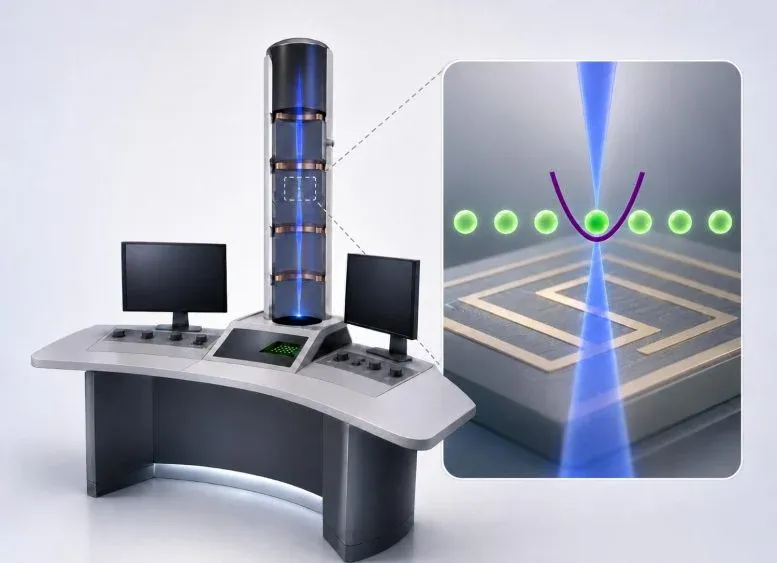
The proposed system works like this: Electrons from the microscope beam would interact with ions, which are basically charged atoms, held in place by the quantum computer. These ions become "entangled" with the electrons. Elias Pescoller, a doctoral student at TU Wien, explains that this entanglement creates a shared quantum state between the electron and the ion. Think of it as a secret handshake that transfers information.
This quantum handshake means the ion can hang onto an electron's quantum information even after the electron itself has moved on. When the next electron comes along, it does the same. Instead of treating each electron's measurement as a separate event, the quantum computer can combine information from many electrons, building a stronger, clearer signal from what would otherwise be statistical noise. Dennis Rätzel from TU Wien notes that specific quantum operations can essentially merge these bits of information, creating a robust signal with fewer electrons.
Turning Noise into Gold
Iva Březinová from TU Wien puts it plainly: processing this quantum information can extract much more from the process. What used to look like random static on a fuzzy TV screen could suddenly become a clear, detailed image. It's like finding a hidden message in a scrambled code.
This matters because standard electron counting hits a wall when you can only use a few electrons. Weak features in an image just get lost in the background hum. By leveraging quantum effects like entanglement, the researchers believe they can pull out details that traditional methods simply miss. Quantum physics, it turns out, is pretty good at overcoming what used to be considered fundamental limits.
Right now, this super-powered quantum microscope is still a mathematical marvel. The next step is to actually build it. Teams from quantum information, quantum computing, and electron microscopy are converging at TU Wien's USTEM center to combine an ion-based quantum computer with an electron microscope. If it works, fragile samples like individual proteins might finally get their close-up, damage-free. Which, if you think about it, is both impressive and slightly terrifying for the proteins.