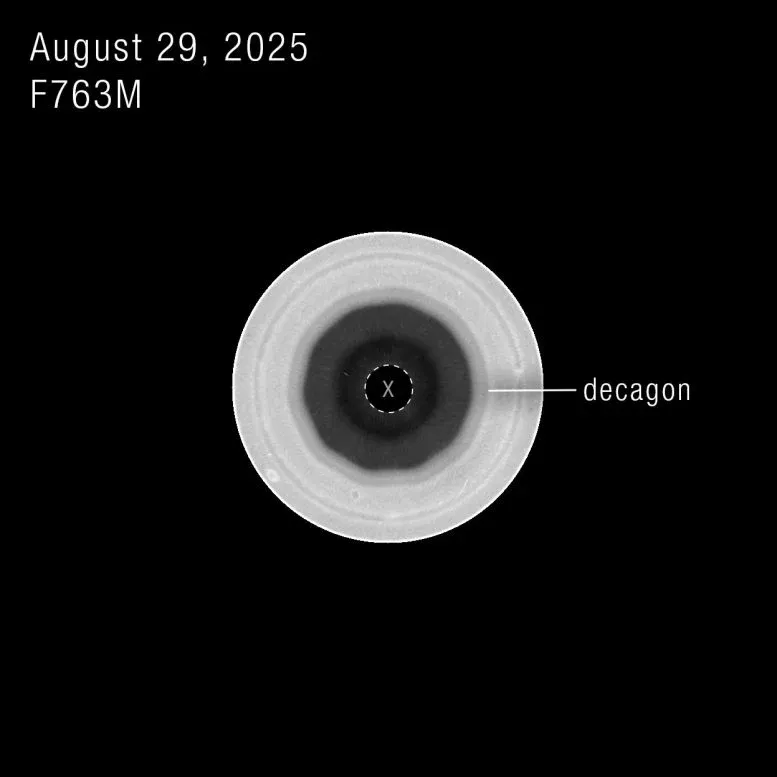
NASA's Hubble Space Telescope has spotted a huge, 10-sided atmospheric wave forming around Saturn's south pole. This is the first time scientists have seen such a regular, multi-sided jet pattern in the planet's southern half.
This new feature looks a lot like Saturn's famous hexagon at its north pole. However, they are not exactly the same. This difference suggests scientists might be watching a new kind of atmospheric event unfold on the gas giant.
The findings were published in the journal Science Advances.
How the Pattern Emerged
Researchers pieced together how the feature developed using several years of Hubble observations, going back to 2023. Earlier images showed faint hints of the structure before it became clearer.
We're a new kind of news feed.
Regular news is designed to drain you. We're a non-profit built to restore you. Every story we publish is scored for impact, progress, and hope.
Start Your News DetoxThese observations came from Hubble's Outer Planet Atmospheres Legacy (OPAL) program. This program has photographed the outer planets every year for over ten years.
Amy Simon, a study co-author and OPAL principal investigator at NASA’s Goddard Space Flight Center, noted that nothing like this has been seen in Saturn's southern hemisphere before. She explained that the northern hexagon has been present for over 40 years. This new feature is different because it seems to be getting stronger, offering a rare chance to watch a giant atmospheric pattern form.
Saturn's changing seasons helped make this discovery possible. As the planet moved through its yearly cycle, its south pole became easier to see from Earth.
Ground Observers Helped Spot the Decagon
The first strong clues came from astronomers looking at ground-based images of Saturn.
Agustín Sánchez-Lavega, the lead author of the new study and a researcher at the University of the Basque Country in Spain, runs a website that collects images of solar system planets from observers worldwide.
In 2024, Sánchez-Lavega and amateur astronomers Trevor Barry and Jean-Paul Oger noticed a faint, wavy band near Saturn’s south pole in these images. Ground-based observations from 2025 made the emerging decagon look even more convincing.
Hubble then provided a much clearer view. Because it observes from space, the telescope can capture Saturn with high detail over full planetary rotations without Earth's atmosphere blurring the view.
Sánchez-Lavega said that given Saturn's similar north-south jet stream system, they had been looking for a southern counterpart to Saturn’s northern hexagon in Hubble images since 1990. He added that images from NASA’s Cassini spacecraft, which orbited Saturn from 2004 to 2017, showed no sign of a long-lasting formation. The Hubble data confirmed the feature's presence back to 2023.
More Than Just Cloud Tops
The 10-sided wave is part of one of Saturn’s powerful jet streams. It also seems to stretch through several layers of the atmosphere, meaning it's not just a pattern on the cloud tops.
Its position appears to shift slightly depending on the wavelength Hubble uses. This happens because different wavelengths show different heights within Saturn’s atmosphere.
Simon finds it most interesting that this feature seems to have formed recently. The question is why it suddenly appeared now when it hasn't been seen before.
Scientists still don't know what caused the decagon to appear or how long it will last. The team believes future observations from Hubble and NASA’s James Webb Space Telescope, along with computer modeling, could help explain how the structure formed and how it compares to Saturn’s long-lasting northern hexagon.
Why Long-Term Hubble Observations Matter
Hubble’s long operational life has given astronomers a unique ability to watch gradual changes across the solar system and in other space objects.
Instead of relying on single snapshots, the OPAL program regularly observes the giant planets. This allows scientists to track seasonal changes, follow temporary storms, and detect atmospheric features that change slowly over many years.
Mike Wong, a study co-author from the University of California, Berkeley, said that when the OPAL program started, they expected exciting surprises but didn't know what specifically. He noted that many discoveries from OPAL are based on years of data, not just one observation. Regular observations over time are leading to many new findings.
Will Saturn’s Decagon Last?
Researchers plan to keep watching Saturn to see if the decagon becomes a stable, long-lasting structure like the northern hexagon, or if it continues to change.
Future observations could also reveal what drives the wave and what it can teach scientists about the atmospheric behavior of giant planets. They might also find out if similar processes happen in weather systems on Earth.
Deep Dive & References
- A decagon wave around Saturn’s south pole - Science Advances, 2026