Eighty years ago, a relatively small earthquake off the coast of Alaska spawned a massive tsunami that slammed into Hawaii, Alaska, Washington, and Oregon. How a modest shake-up created such a monster wave has been an enduring mystery for seismologists.
Now, a team from Michigan State University is diving deep into the Alaskan-Aleutian subduction zone, the precise underwater fault line where it all began. Their mission? To figure out if that same system is still quietly brewing trouble today.
Songqiao "Shawn" Wei, an associate professor at MSU, is leading the charge. His team is about to embark on a meticulously planned, incredibly complex expedition to measure the tectonic plate vibrations in a place that’s notoriously difficult to study.
We're a new kind of news feed.
Regular news is designed to drain you. We're a non-profit built to restore you. Every story we publish is scored for impact, progress, and hope.
Start Your News DetoxThe Deep Sea Listening Tour
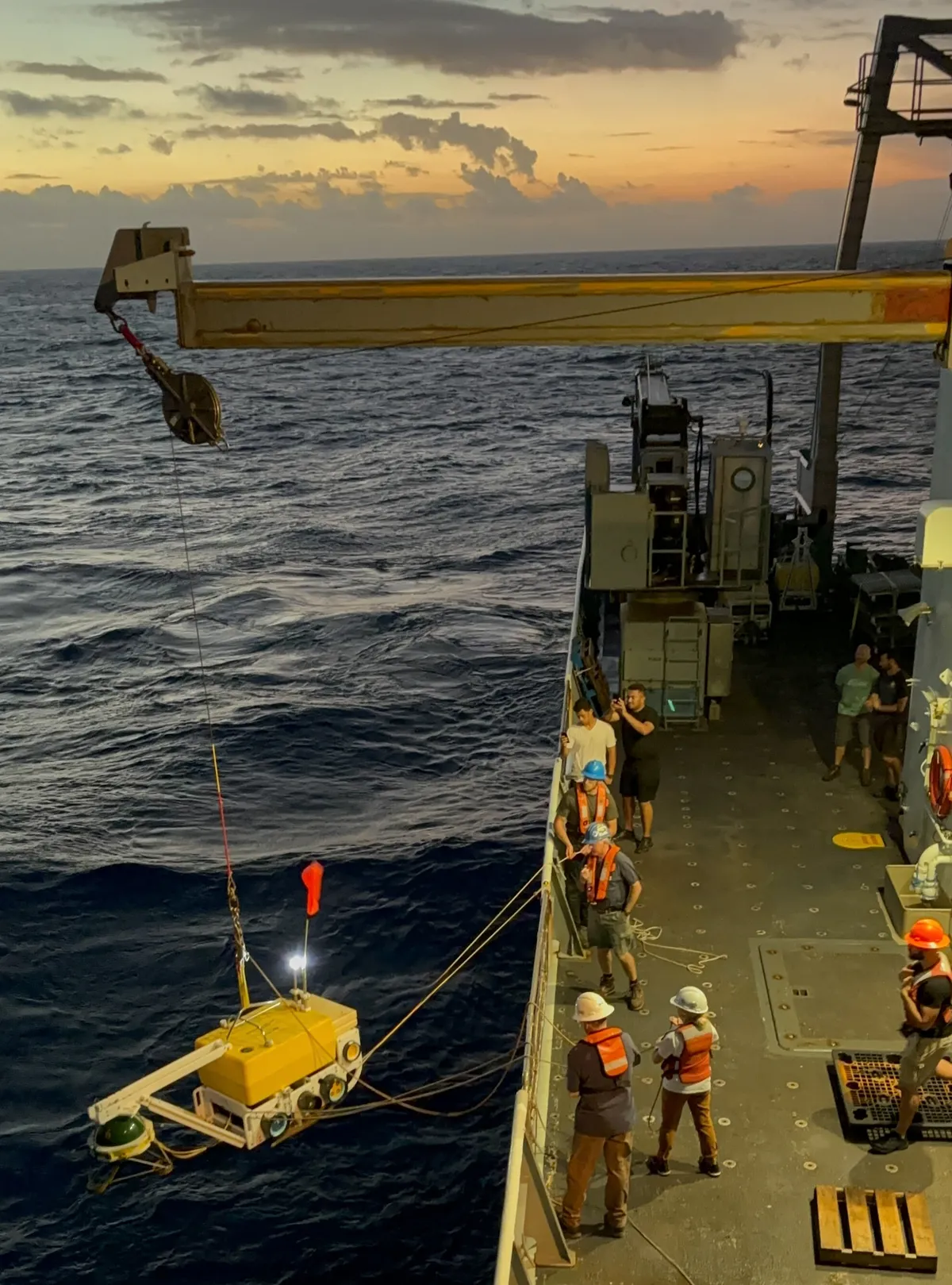
Imagine trying to listen to whispers at the bottom of the ocean. That's essentially what Wei's team will be doing. They're deploying a fleet of specialized, waterproof sensors called seismometers onto the Pacific Ocean floor near Alaska. These aren't your average gadgets; they’re equipped with atomic clocks to precisely timestamp every tiny vibration they pick up.
Each sensor will run on battery power for a solid 15 months before the team returns to collect them and analyze the data. Because apparently, that's how long it takes to get a good listen in the deep.
Studying these underwater tremors is a logistical nightmare compared to land-based research. It’s expensive, it’s challenging, and you can’t exactly plug in a solar panel down there. The National Science Foundation (NSF) is footing the bill, providing a grant that marks the first of its kind since January 2025 for this MSU-University of Hawaii collaboration. They're even getting ship time and access to instruments, which, for deep-sea science, is like winning the lottery.
Wei is particularly fixated on this area because of that perplexing 1946 event. A small earthquake, a colossal tsunami—it just doesn't add up in the usual seismic playbook. While the new sensors won't tell them exactly what happened eight decades ago, they will reveal how the fault is behaving now. This is crucial for understanding current risks.
Predicting earthquakes is still incredibly tough, Wei admits. But, as he notes, "We can improve our understanding of this local region." That understanding will then feed into the U.S. Geological Survey's risk maps and, eventually, even influence building codes. Because knowing is half the battle, especially when the other half is a wall of water.
Earthquakes occur when giant tectonic plates, grinding against each other, get stuck. Pressure builds, and then—whoosh—they slip, releasing energy that shakes the ground. Seismologists use this released energy to essentially X-ray the Earth's interior. Gathering this data is the key to unlocking the mysteries of why earthquakes happen, and why some turn into disasters.
Wei's work involves placing these seismometers in known earthquake hot zones like Samoa, Alaska, and the Marianas, leaving them to record for months or even years. On land, this is relatively straightforward; solar panels keep things powered, and GPS provides pinpoint accuracy. Deep underwater? Not so much.
Before a ship even leaves the harbor, the team meticulously maps the ocean floor, scouting for smooth, rock-free spots to gently deploy each sensor. And by gently, we mean using a special flotation system to ensure the sensor descends slowly enough not to get damaged. Dropping just one sensor can take hours. Talk about a delicate operation.
This painstaking effort is vital for understanding tsunami risks. When an undersea earthquake suddenly shoves the ocean floor up or down, it displaces a monumental amount of water. That disturbance then ripples across the ocean as a tsunami, growing taller and more menacing as it approaches shallow coastal areas.
Unearthing Slow Earthquakes and Hidden Water
Beyond the immediate tsunami threat, Wei is also intrigued by "slow earthquakes." These are the geological equivalent of a polite cough instead of a violent sneeze. Faults move over days or weeks, releasing energy gradually without the earth-shattering drama of a typical quake. Wei wants to know if these slow-motion events are connected to the bizarre 1946 earthquake and tsunami, and why they seem to be a local quirk of the Aleutian subduction zone.
The seismic data will also allow Wei to peer beneath the seafloor, much like a CAT scan. He's particularly interested in water trapped deep within the Earth's crust, wondering if it changes the friction between tectonic plates. This could be a crucial factor in determining whether a rupture fizzles out or escalates into a major earthquake.
Wei's team hopes to launch their next research trip in 2028, leaving their instruments on the ocean floor for about 15 months. What they record could help answer some of the biggest, most fundamental questions in earthquake science: Why do some ruptures stop while others keep going? Why do some faults slip slowly, while others unleash a sudden, violent fury?
These are questions you can't answer in a lab. "For us, nature is the lab," Wei says, with a hint of a smile. "And it turns out Earth is always way more complicated than our human labs. There are always surprising discoveries."
Which, if you think about it, is both impressive and slightly terrifying. Because nature, it seems, still has plenty of secrets to spill.