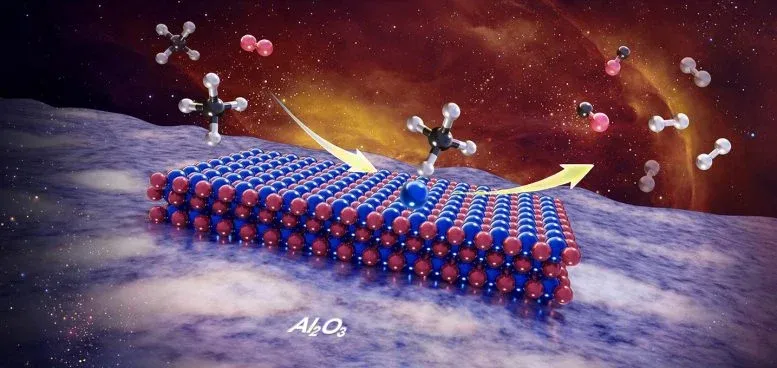
A hidden atomic structure on nickel oxide could lead to powerful methane catalysts. These new catalysts might use ten times less nickel.
Understanding how to efficiently produce syngas from methane is key. Syngas is a mix of gases used to make fuels and chemicals. Partial oxidation of methane (POM) is a promising way to create syngas.
For years, scientists thought metallic nickel (Ni) nanoparticles were the active parts of the catalyst. But there was a question: was the metallic nickel found after the reaction the actual catalyst? Or did it form later when nickel oxide was changed by syngas at high temperatures?
We're a new kind of news feed.
Regular news is designed to drain you. We're a non-profit built to restore you. Every story we publish is scored for impact, progress, and hope.
Start Your News DetoxNickel can change a lot during a reaction. Its oxidation state can shift, and its atomic structure can rearrange. These changes are hard to see directly. This made it difficult for researchers to know which nickel structure was truly responsible for POM.
A Catalyst That Changes During Work
A new study in Nature Catalysis found that active atomic structures can form directly on the surface of nickel oxide (NiO) as a reaction happens. This discovery shows what truly drives the catalytic activity. It also highlights why it's important to study catalysts under real working conditions, as their structures can constantly change.
The research team included Professors Tao Zhang, Aiqin Wang, and Xiaoyan Liu from the Dalian Institute of Chemical Physics (DICP) of the Chinese Academy of Sciences (CAS). Professor Wei Liu from DICP, Professor Tao Yang from Xi’an Jiaotong University, and Professor Graham J. Hutchings from Cardiff University also contributed.
The team made a catalyst with a small amount of nickel (0.8 wt% Ni/Al2O3). Even with so little nickel, it performed very well in POM. It converted 92% of the methane. The CO and H2 selectivities reached 87.0%, and the H2/CO ratio stayed stable at about 2.0.
Ten Times Less Nickel, Similar Performance
One surprising finding was that almost no metallic nickel was found in the catalyst after the reaction. Yet, this low-nickel catalyst worked as well as a catalyst with much more nickel (8.0 wt% Ni/Al2O3).
Its performance was also much better than another low-nickel catalyst made differently. Under the same conditions, that catalyst only caused methane combustion, not the desired partial oxidation.
The team then watched how nickel changed during POM. Metallic nickel nanoparticles present at the start of the reaction quickly turned into NiO. But NiO alone couldn't explain the high activity. When pure NiO was tested, it didn't show POM activity and instead caused complete methane oxidation.
A New Atomic Structure on Nickel Oxide
A closer look showed the difference. During the reaction, the surface of NiO rebuilt itself. This created a new active structure called [Ni1O4Ni4] on the NiO(100) surface.
Calculations showed that this new atomic structure makes it much easier to break a C–H bond in methane. The energy needed for this was only 12.5 kcal·mol-1.
This energy barrier was much lower than the 38.5 kcal·mol-1 needed for the original NiO(100) surface. It was also lower than the 15.7 kcal·mol-1 needed for the metallic Ni(111) surface.
These comparisons show that the rebuilt structure is much better at activating methane. Both experiments and calculations point to this dynamically formed structure as the true active center for POM.
Designing Better Catalysts with Less Metal
These findings suggest that catalyst performance can't always be understood by just looking at a material before or after a reaction. Sometimes, the most important active structures only appear while the catalyst is working.
Professor Liu noted that their study shows how important it is to observe catalysts under reaction conditions to find these dynamic active structures. He added that this dynamic rebuilding allows low-nickel catalysts to perform well. This opens new ways to design efficient catalysts and reduce the need for large amounts of metal.
Deep Dive & References
In situ generation of active motifs on Ni/Al2O3 during partial oxidation of methane to syngas - Nature Catalysis, 2026