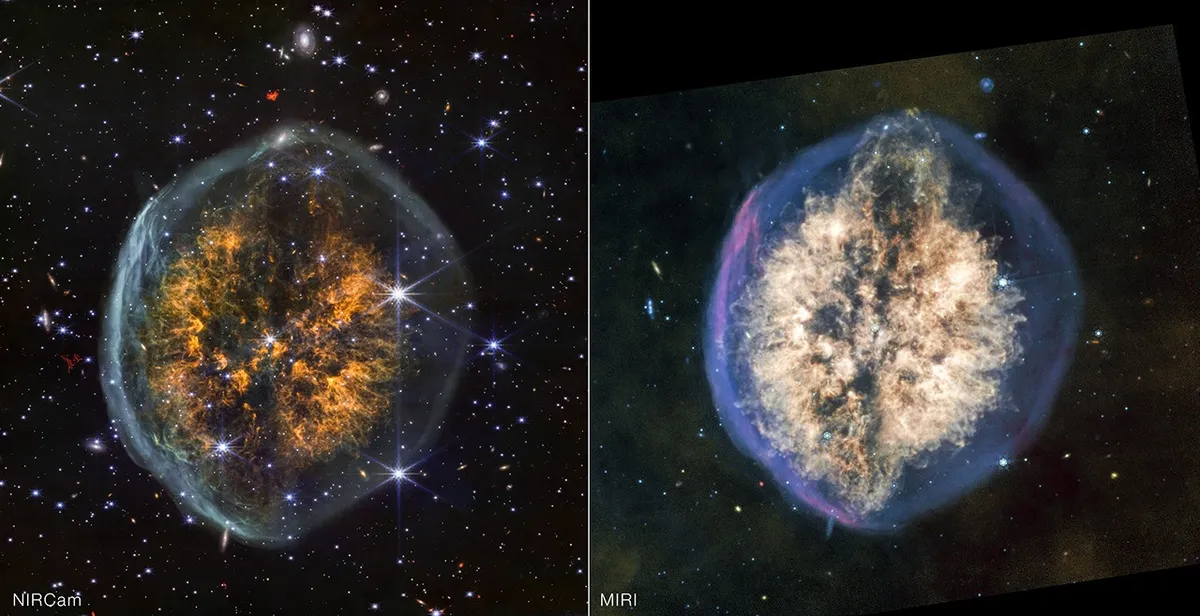
NASA's James Webb Space Telescope has captured something that looks less like astronomy and more like a medical scan: a nebula so perfectly brain-shaped that astronomers nicknamed it the "Exposed Cranium." But this isn't a cosmic accident of naming. What Webb is actually showing us is one of the most violent, beautiful processes in the universe — a star in its final act.
Nebula PMR 1 has been visible to infrared telescopes for over a decade, but Webb's sharper eyes reveal something the older Spitzer Space Telescope couldn't quite see: the fine detail of what happens when a star dies. The nebula has two distinct regions. An outer shell of hydrogen gas surrounds an inner cloud of more complex gases — like layers of an onion being peeled away. Running straight down the middle is a dark lane that splits the whole structure into left and right halves, which is exactly why it earned that unsettling nickname.
The Moment a Star Explodes Inward
That dark vertical line isn't just a visual quirk. It's evidence of something dramatic happening at the star's core. As stars approach the end of their lives, they don't go quietly. Instead, they expel their outer layers in violent outbursts — twin jets of gas that shoot outward in opposite directions, like a cosmic sneeze. Webb's mid-infrared instrument caught this in action, showing gas being ejected from the center of the nebula, expanding outward in real time (in cosmic terms, anyway).
We're a new kind of news feed.
Regular news is designed to drain you. We're a non-profit built to restore you. Every story we publish is scored for impact, progress, and hope.
Start Your News DetoxWhat happens next depends on the star's mass, which astronomers haven't pinned down yet. If it's massive enough, the star will eventually collapse and detonate as a supernova — one of the brightest events in the universe. If it's smaller, more like our Sun, it will keep shedding layers until only its dense, Earth-sized core remains: a white dwarf that will cool over trillions of years.
Webbs's image captures a single frame in this process — a snapshot of a transformation that takes thousands of years to unfold. It's the kind of detail that reminds us why we built a telescope that costs as much as a small country and sent it a million miles away. Some moments in the universe are worth preserving.