Chemists at ETH Zurich have cracked a problem that's haunted industrial chemistry for years: how to turn carbon dioxide into something useful without burning through energy and money. Their solution involves individual metal atoms acting as tiny factories, and it's working with unprecedented efficiency.
The core insight is almost elegant in its simplicity. In traditional catalysts—the substances that speed up chemical reactions—metals sit in clumps containing hundreds or thousands of atoms. Only the atoms on the surface actually do anything useful. The rest are just dead weight. It's like paying for a stadium full of workers but only putting a handful on the job site.
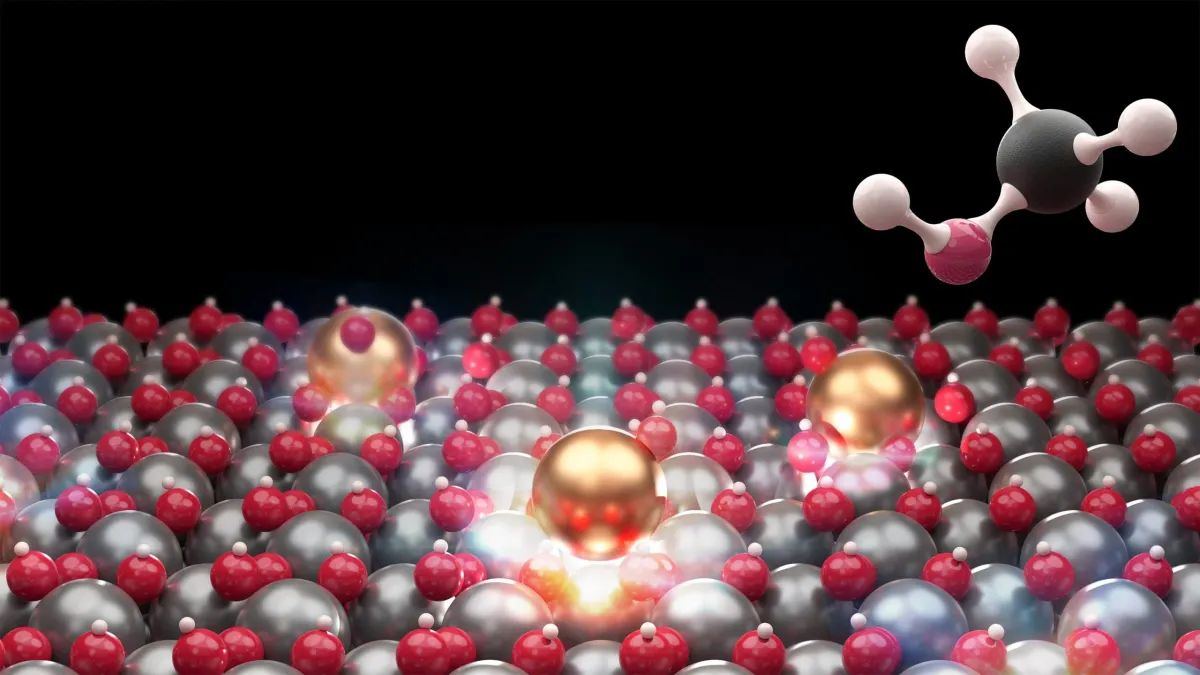
The ETH team dispensed with that waste entirely. They took indium, a rare metal, and scattered individual atoms across a hafnium oxide surface. Each atom became its own reaction site. The result: the same amount of metal does far more work. "Isolated indium atoms on hafnium oxide allow more efficient CO2-based methanol synthesis than indium in the form of nanoparticles containing large numbers of atoms," explains Javier Pérez-Ramírez, the catalysis engineer who led the research.
We're a new kind of news feed.
Regular news is designed to drain you. We're a non-profit built to restore you. Every story we publish is scored for impact, progress, and hope.
Start Your News DetoxWhy does this matter beyond the lab? Methanol is a chemical building block for plastics, fuels, and dozens of other products we use daily. Right now, making it requires fossil fuels. But if you pair this new catalyst with renewable hydrogen and renewable energy, you've just created a way to turn atmospheric CO2 into raw material instead of letting it drift into the sky. The chemistry doesn't care where the carbon came from.
Stability Under Pressure
Getting individual atoms to stay put on a surface is harder than it sounds. The ETH team used extreme conditions to anchor them: burning starting materials in flames reaching 2,000 to 3,000°C, then cooling rapidly. This locked the indium atoms in place firmly enough to survive industrial conditions—temperatures up to 300°C and pressures 50 times normal atmospheric pressure.
There's a second advantage hiding in this architecture. Single-atom catalysts are far easier to study. With traditional catalysts, most of the measurement signals come from atoms buried inside particles, even though only surface atoms do the actual work. It's like trying to understand a conversation by listening to everyone in a building instead of just the people talking. With isolated atoms, the noise disappears. Researchers can finally see clearly what's happening during the reaction, which means they can design better catalysts systematically instead of guessing.
Pérez-Ramírez has been chasing improved methanol catalysts since 2010, working closely with industry partners and holding several patents in the field. He credits Switzerland's strong catalysis research network for making this breakthrough possible—a reminder that scientific progress often depends less on individual genius than on communities of researchers building on each other's work.
The question now is speed: how quickly can this move from the research lab to actual industrial use. That's typically where promising chemistry gets stuck. But with a clearer understanding of how the reaction works, and a design that uses precious metals far more efficiently, the path forward looks less like a dead end.