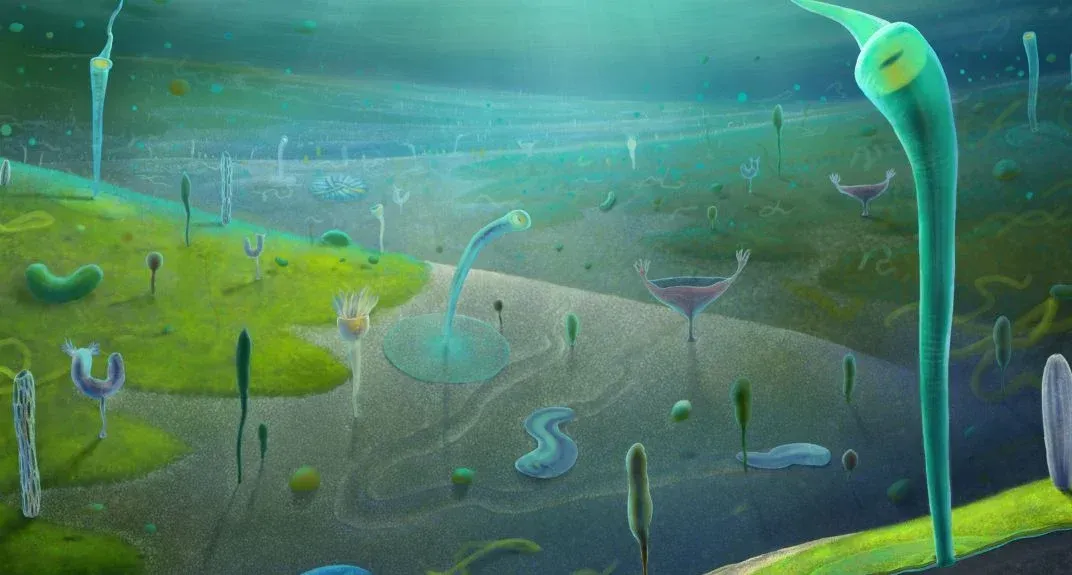
An illustration shows what the fossils' environment might have looked like between 539 million and 554 million years ago.
Life on Earth began over 3.5 billion years ago. However, it took a long time for diverse creatures to appear. Scientists used to think that complex life really took off about 535 million years ago. This period, called the Cambrian explosion, saw many new animal groups emerge. Many of these groups still exist today.
Now, new fossils found in China suggest this timeline might be wrong. Researchers have discovered primitive, complex creatures that lived millions of years before the Cambrian period. This discovery was published on April 2 in the journal Science.
We're a new kind of news feed.
Regular news is designed to drain you. We're a non-profit built to restore you. Every story we publish is scored for impact, progress, and hope.
Start Your News DetoxPushing Back the Clock on Complex Life
Ross Anderson, a paleobiologist at the University of Oxford and co-author of the study, explained that these findings show a more complex start to animal diversity. He noted that the "explosion" of animal life might have begun earlier than thought.
The time between the Ediacaran period (about 635 million to 538 million years ago) and the Cambrian period (about 538 million to 485.4 million years ago) has been a mystery. Scientists wondered if the Cambrian explosion was truly a sudden burst of evolution. Or, if the complex animals of that time had older ancestors. Earlier Ediacaran fossils showed animals with strange body shapes that didn't look like Cambrian creatures or modern animals.
The new fossils, found in southwest China, could be the missing link. There are over 700 fossils, dating back 539 million to 554 million years ago. They include organisms that look like creatures from both the Cambrian and Ediacaran periods. Some were only known from the Cambrian explosion before, and some have never been seen.
Gaorong Li, a paleobiologist at Yunnan University and co-author, stated that this discovery fills a big gap in understanding early animal diversification. He added that many complex animals, usually found in the Cambrian, were present in the Ediacaran period. This means they evolved much earlier than previous fossil evidence showed.
Bilaterians and Deuterostomes
The most common fossil found was a worm-like animal. It was about the size of an adult's index finger and had a disk to anchor itself to the ocean floor. Many of these creatures were bilaterians, meaning they had two mirrored sides. This was a key adaptation for early animals. It helped them move in sediment and water, develop nervous systems, and eventually dominate the animal kingdom. Frankie Dunn, a paleontologist at the Oxford University Museum of Natural History and co-author, shared this information.
Most modern animals, including humans, are bilaterians. Scientists previously thought they mostly appeared during the Cambrian period.

Researchers also found fossils that seem to be the earliest known deuterostomes. This large group of animals includes all vertebrates today. One fossil was a U-shaped creature attached to the seafloor. It resembles an extinct Cambrian creature related to modern sea stars and acorn worms.
Emily Mitchell, a paleontologist at the University of Cambridge not involved in the study, said this discovery "makes a huge amount of sense." She noted that since the Ediacaran period had animals, there must have been a transition to Cambrian fauna. Until now, there was no real evidence of this transition.
Deep Dive & References
- Surprise fossil discoveries push back the evolution of complex animals - New Scientist
- Jaw-dropping fossils reset the clock on when complex animals evolved - Scientific American
- Spectacular fossil treasure trove pushes back origins of complex animals - University of Oxford
- Fossil animals from China push back the clock on complex life - Associated Press
- A Ediacaran animal assemblage with bilaterian affinity - Science, 2026