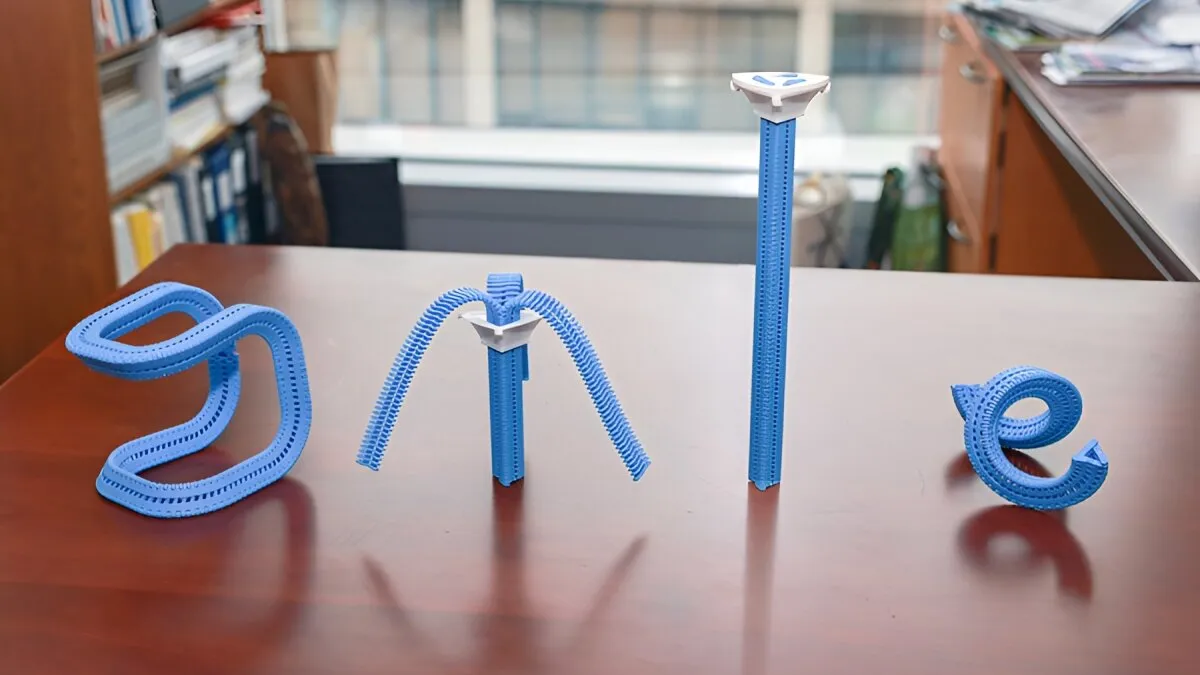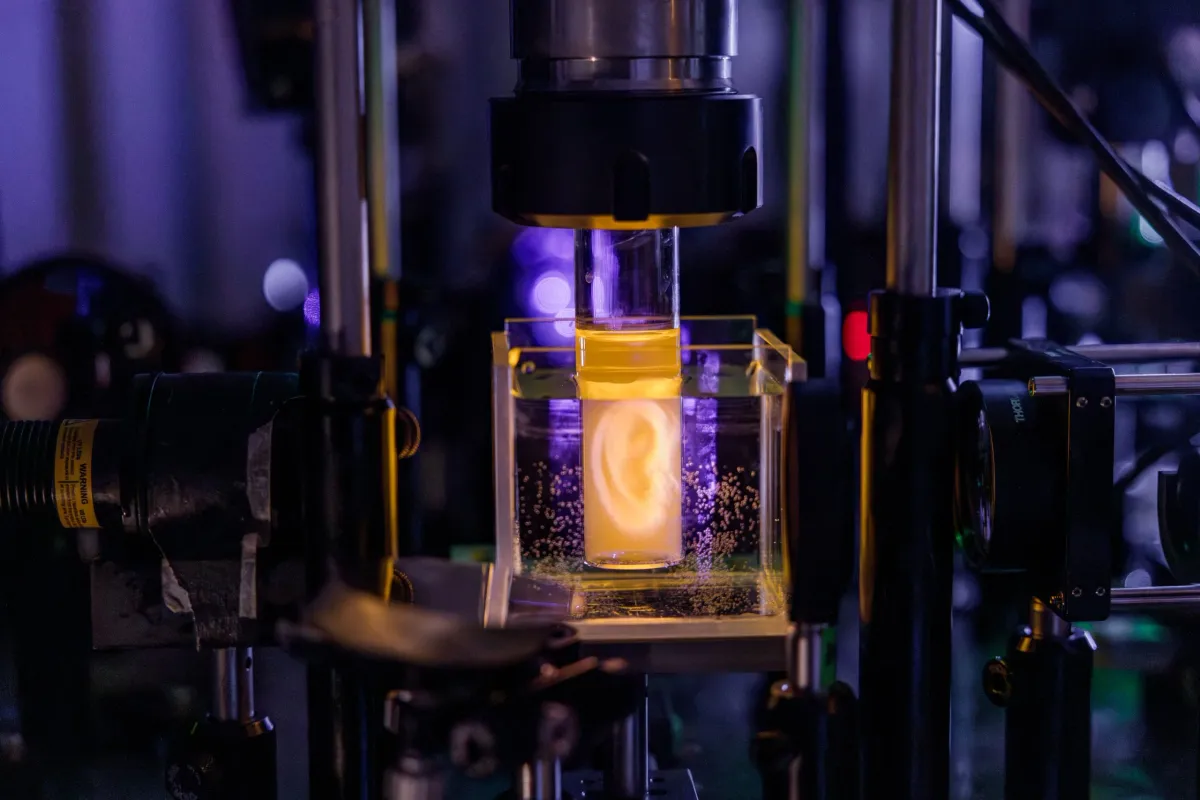
Imagine a 3D printer that doesn’t slowly stack layers like some digital bricklayer, but instead conjures entire objects out of goo in mere seconds. Now imagine that goo can be living tissue. Because apparently that's where we are now.
Researchers at EPFL have unveiled a holographic 3D printing method that’s not just faster, but also ridiculously more efficient. We're talking 70 times more efficient than its predecessors. This isn't just an upgrade; it’s a whole new dimension of printing.
How to Print a Human Ear in Minutes
The magic happens with something called tomographic volumetric additive manufacturing (TVAM). Instead of the usual layer-by-layer grind, this system blasts patterns of light into a spinning container of special liquid resin. Wherever enough light converges, poof, a solid 3D shape appears. It’s like a tiny, high-tech magic show.
We're a new kind of news feed.
Regular news is designed to drain you. We're a non-profit built to restore you. Every story we publish is scored for impact, progress, and hope.
Start Your News DetoxWhat makes this version so much better? Holograms. Back in 2025, the EPFL team figured out how to control the phase of light waves, not just their brightness. Think of it as sculpting with light itself. Now, the Laboratory of Applied Photonic Devices (LAPD) has refined it further by integrating a new device that manages the laser beam’s phase directly inside the printer. The result? A system that can print millimeter-scale objects in seconds, and centimeter-scale objects in minutes.
And it gets better: the system uses “self-healing” beams. This means it can print incredibly accurate structures, even in tricky materials that scatter light, like those containing living cells. Head of LAPD, Christophe Moser, noted they've printed structures far larger than before, even with those light-scattering cells inside. Which, if you think about it, is both impressive and slightly terrifying in the best possible way.
To prove it, they printed a life-sized human ear using a low-power 150 mW laser. This is a significant leap towards creating bioprinted implants for reconstructive surgery. In another test, living cells in a smaller print not only survived for six days but actually formed networks. Maria Alvarez-Castaño, the lead author, highlighted how this brings volumetric printing much closer to creating real-scale implants with biologically friendly, low-power lasers.
Future plans include printing directly onto existing objects and gaining even finer control over tiny features. They’re even working on a version that projects a hologram directly into the resin, eliminating the need for the container to spin. Because why spin when you can just… project?
So, while your home 3D printer is still whirring away for hours on a plastic trinket, scientists are over here creating entire body parts in a blink. Let that sink in.