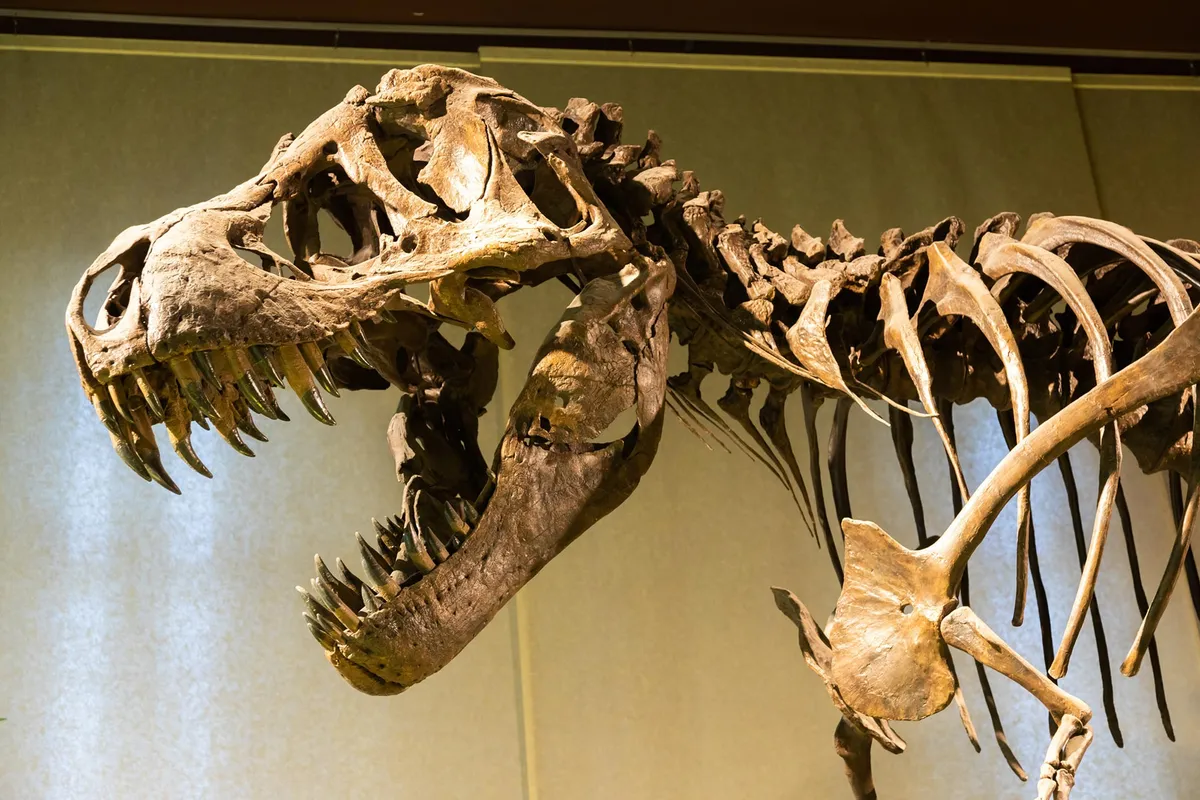
Scientists have spent a century studying Tyrannosaurus rex, and they just realized they've been getting the dinosaur's childhood wrong.
A sweeping analysis of 17 tyrannosaur fossils — the largest dataset assembled for the species — shows that T. rex took roughly 40 years to reach its eight-ton adult size. That's about 15 years longer than previous estimates suggested. The finding, published in PeerJ, rewrites what we thought we knew about how the world's most famous predator actually lived.
How scientists read a dinosaur's bones
The breakthrough came from a combination of detective work and new technology. Holly Woodward at Oklahoma State University led a team that examined cross-sections of fossilized bone under specialized lighting — both circularly polarized and cross-polarized light — to reveal growth rings that earlier studies had missed. Think of it like tree rings, except a slice of T. rex bone only records the last 10 to 20 years of the animal's life. To see the full picture, the researchers needed to stitch together growth records from multiple specimens.
We're a new kind of news feed.
Regular news is designed to drain you. We're a non-profit built to restore you. Every story we publish is scored for impact, progress, and hope.
Start Your News Detox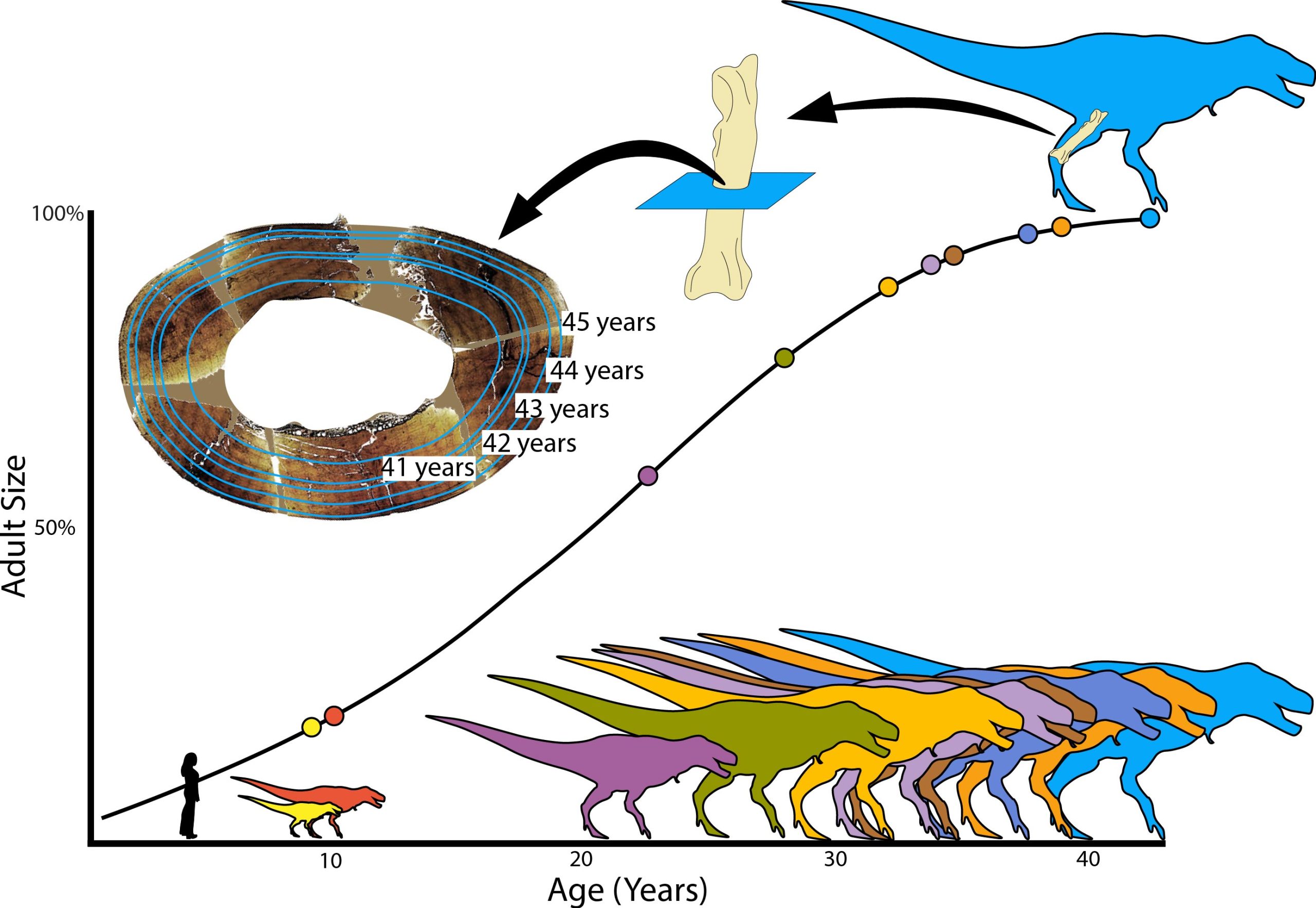
That's where mathematician Nathan Myhrvold came in. He developed a new statistical approach to combine data from different fossils into a single growth trajectory — essentially reconstructing the year-by-year life history of a T. rex from infancy to old age. "The composite growth curve provides a much more realistic view of how Tyrannosaurus grew and how much they varied in size," Myhrvold explains.
What emerges is a portrait of a dinosaur that grew steadily but unhurried. Instead of racing to adulthood, young T. rex spent decades in a slower developmental phase. Jack Horner of Chapman University suggests this mattered ecologically: "A four-decade growth phase may have allowed younger tyrannosaurs to fill a variety of ecological roles within their environments. That could be one factor that allowed them to dominate the end of the Cretaceous Period as apex carnivores."
In other words, teenage T. rex weren't just smaller versions of adults — they may have hunted differently, lived in different habitats, or competed for different prey. That flexibility could have given the species a competitive edge.
A fossil mystery gets more complicated
The study also illuminates a decades-old debate about tyrannosaur diversity. Paleontologists have long argued about whether certain fossils labeled as T. rex actually belong to separate species. Smaller specimens have been proposed as members of a different species called Nanotyrannus rather than juveniles of T. rex. Growth patterns alone can't settle the question, but they add crucial evidence.
Two particularly famous specimens — nicknamed "Jane" and "Petey" — show growth curves statistically incompatible with other T. rex in the study. That doesn't prove they're different species, but it's suggestive. A recent independent analysis classified both as distinct Nanotyrannus species, though the debate remains unresolved.
What matters here is that the new tools and methods are reshaping how paleontologists read dinosaur biology. The discovery that specialized lighting reveals previously invisible growth rings could apply far beyond T. rex, potentially requiring scientists to re-examine growth studies across multiple dinosaur species.
After more than a century of study, Tyrannosaurus rex continues to yield new secrets. By combining larger datasets, sharper statistical methods, and careful microscopy, paleontologists are getting closer to understanding T. rex not as a fossil, but as a living animal — growing, changing, and adapting across four decades of its life.