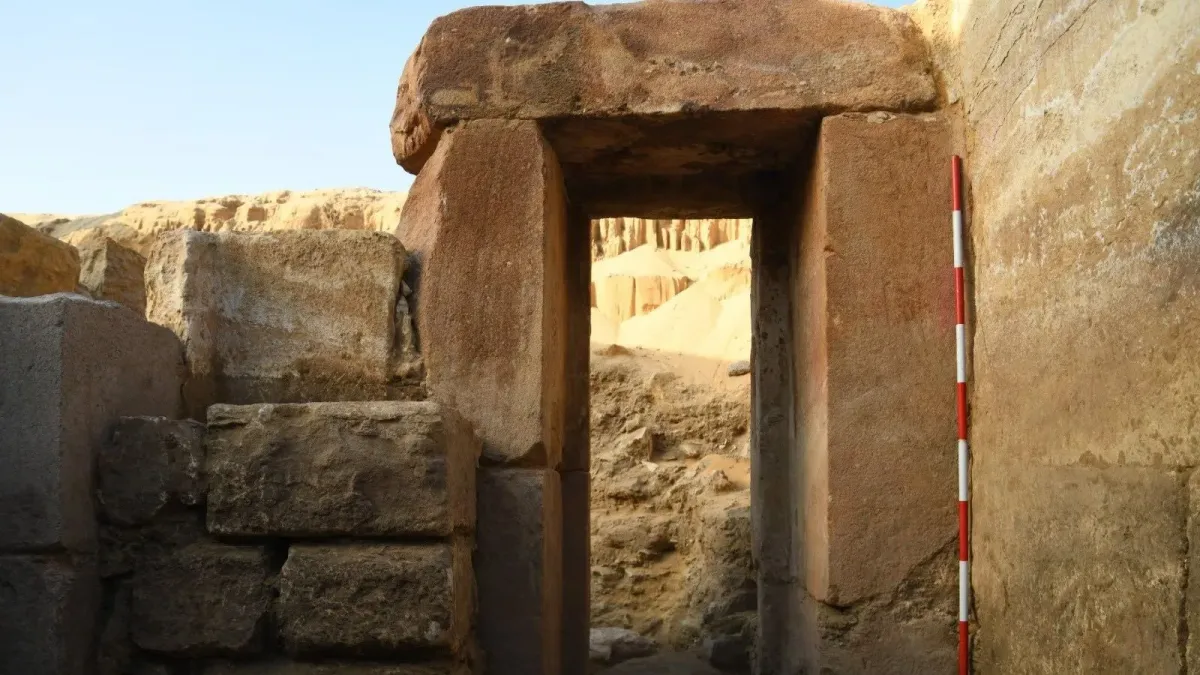
Archaeologists digging near Cairo have uncovered a 4,500-year-old temple that once displayed a religious calendar on its front wall—possibly the earliest known instance of a public schedule carved in stone.
The valley temple belonged to Pharaoh Nyuserra, a 5th Dynasty ruler who presided over Egypt's golden age of sun worship. It sat hidden beneath the Nile's floodplain for over a century, only becoming accessible after the Aswan Dam lowered groundwater levels and the river's course shifted. Teams from the University of Turin and University of Naples began systematic excavation in 2024.
A Calendar Written in Stone
The structure itself is monumental: a granite and limestone building spanning more than 10,800 square feet and standing over 18 feet tall. But what makes it remarkable isn't the scale—it's what was written on it. Carved blocks near the entrance list festivals dedicated to various gods: Sokar (a falcon-headed deity linked to Memphis), Min (god of fertility), and Ra himself. These weren't hidden in a priest's chamber or locked behind temple walls. They were displayed on the facade, visible to anyone approaching the sanctuary.
We're a new kind of news feed.
Regular news is designed to drain you. We're a non-profit built to restore you. Every story we publish is scored for impact, progress, and hope.
Start Your News DetoxThis placement suggests something genuinely novel: a public religious calendar. For a society that predates written calendars as we know them, the idea of posting your ritual schedule where ordinary people could see it speaks to a shift in how authority and religion were communicated. The temple was used actively for about a century, then abandoned—only to be reoccupied by local communities for over 300 years, suggesting it remained a meaningful place even after its original function faded.
"The crucial importance of this discovery," said Massimiliano Nuzzolo of the University of Turin, "lies in the fact that this temple is one of only two examples of valley temples of solar complexes known to exist in ancient Egypt." The rarity matters. Most of what we know about Old Kingdom temples comes from the upper sanctuaries, positioned on high ground and used by priests for core rituals. Valley temples—the public-facing structures that connected the sacred precinct to the river—are far less common in the archaeological record, making this find a genuine window into how ordinary Egyptians experienced their religious life.
The temple's longevity and later reuse also challenge a common assumption: that sacred spaces remained sacred or were abandoned entirely. This one became something else—a settlement, a landmark, a repurposed building—yet retained enough cultural weight that people kept returning to it.