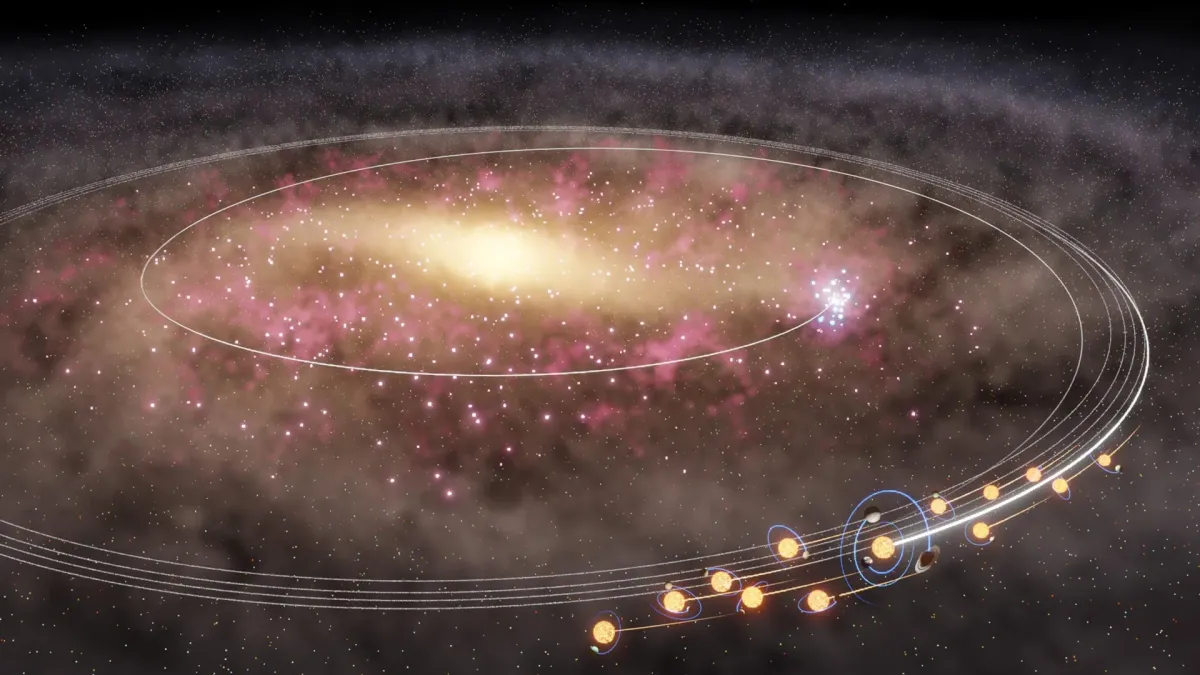
Our Sun might have moved away from the Milky Way's center with thousands of similar stars. This happened about four to six billion years ago. Scientists used data from the European Space Agency's Gaia satellite to study this.
Their findings help us understand how the Milky Way changed over time. It also sheds light on how the bar-shaped structure at the galaxy's center formed.
The Sun's Journey from the Galactic Center
Archaeology on Earth studies old objects to understand the past. In space, "galactic archaeology" helps scientists piece together the history of stars and galaxies.
We're a new kind of news feed.
Regular news is designed to drain you. We're a non-profit built to restore you. Every story we publish is scored for impact, progress, and hope.
Start Your News DetoxAstronomers know the Sun formed about 4.6 billion years ago. It was more than 10,000 light-years closer to the Milky Way's center than it is now. Evidence from star chemistry supports this idea. However, how the Sun moved so far out has been a puzzle.
Our galaxy has a huge bar-like structure in its middle. This creates a "corotation barrier." This barrier makes it hard for stars to travel far from the galactic center.
Studying Solar Twins
To figure out how the Sun reached its current orbit, researchers studied "solar twins." These stars are very similar to our Sun in temperature, surface gravity, and chemical makeup. Assistant Professors Daisuke Taniguchi and Takuji Tsujimoto led this study.
They used data from the Gaia satellite. Gaia has collected detailed measurements for about two billion stars. From this huge dataset, the team found 6,594 solar twins. This is about 30 times more stars than previous studies used.
A Shared Migration
With more data, the team could find the ages of these stars very accurately. They also adjusted for a bias that makes brighter stars easier to spot.
They found that many solar twins were between four and six billion years old. Our Sun is also in this age range. Many of these stars are also about the same distance from the galactic center.
These clues suggest the Sun's current spot isn't just luck. It likely moved here as part of a much larger group of stars traveling outward.
Clues to the Milky Way's Central Bar
These findings give new information about the Milky Way's structure and history. Normally, the corotation barrier would stop so many stars from leaving the inner region. But this might have been different if the bar structure was still forming back then.
The ages of the solar twins suggest when this big migration happened. They also hint at how long it took for the galactic bar to develop.
Why the Sun's Journey Matters for Life
The inner parts of the Milky Way are much harsher than the outer regions. Near the galactic center, there is stronger radiation and more frequent star interactions. The Sun's move away from this busy area may have put our solar system in a calmer part of the galaxy.
This quieter region provided the right conditions for life on Earth to appear and grow.
Deep Dive & References
EXPLORE project - European Union's Horizon 2020 Research and Innovation Program