Solar cells have always needed a trick: a carefully engineered boundary between two different materials that forces light to turn into electricity. But physicists have just discovered a shortcut that sidesteps this requirement entirely.
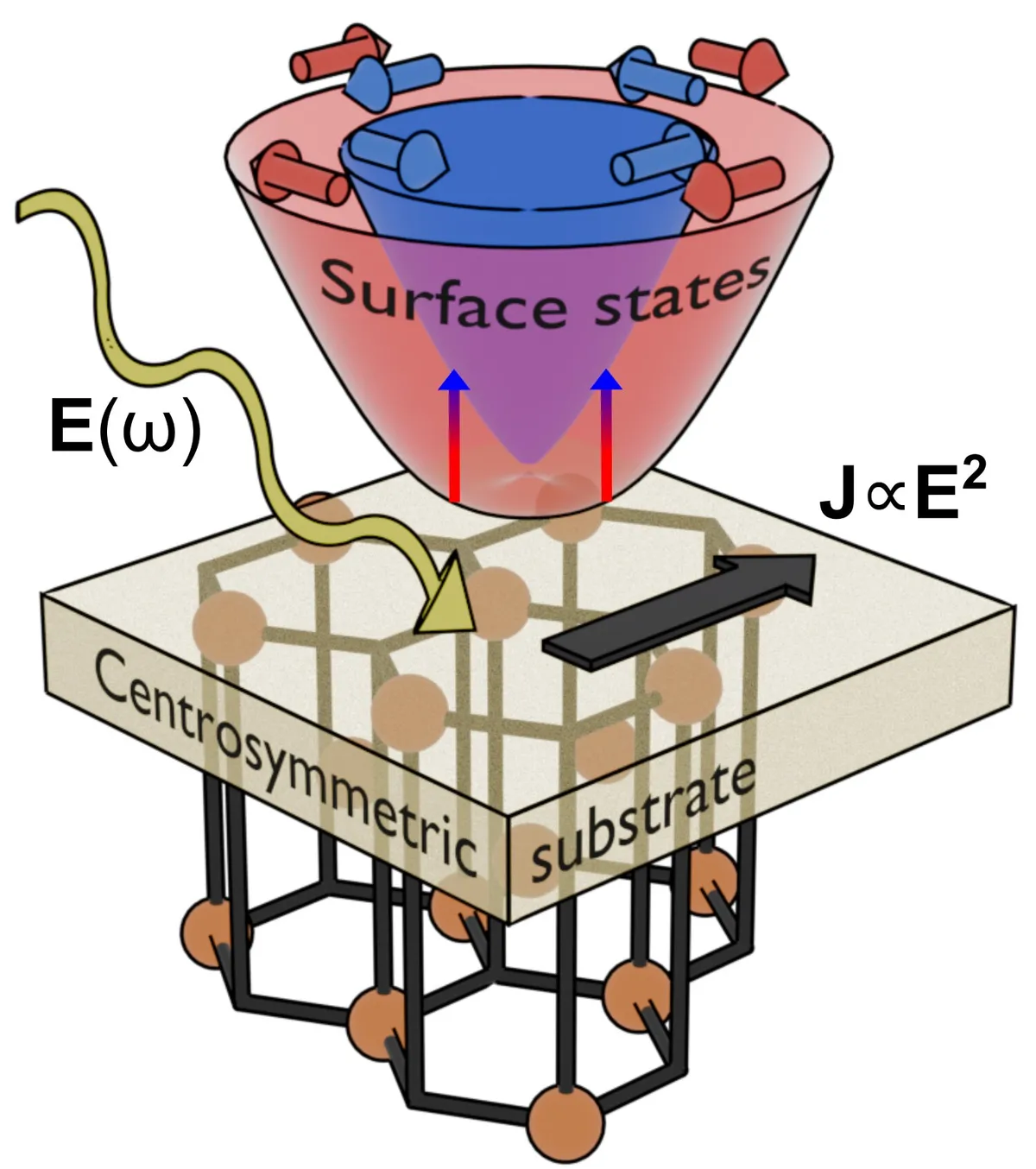
Researchers from Spain's University of the Basque Country, working with colleagues at nanoGUNE and the Donostia International Physics Center, found that even materials with perfectly balanced, symmetrical crystal structures can generate significant electrical currents from light—if you engineer their surfaces the right way.
The breakthrough tackles a problem that's frustrated materials scientists for decades. A phenomenon called the bulk photovoltaic effect can theoretically convert light to electricity without needing those complex junctions. But it only works in materials with lopsided, asymmetrical crystal structures—a severe limitation that's kept the effect mostly academic.
We're a new kind of news feed.
Regular news is designed to drain you. We're a non-profit built to restore you. Every story we publish is scored for impact, progress, and hope.
Start Your News Detox"What we've shown is that you don't need the crystal to be asymmetrical at all," the research essentially says. Instead, something remarkable happens at the surface of symmetric materials. Electrons there behave in ways completely different from electrons deeper inside. These surface electrons break symmetry on their own, responding to light in nonlinear ways that generate both regular electrical currents and something even more exotic: pure spin currents—flows of electron spin without any charge moving.
The team used computer simulations to map out how this works, starting with gold's well-studied surface before identifying thallium on silicon as an ideal test case. The predictions suggest this material could produce photocurrents as strong as ferroelectric materials—some of the best performers in the field today—but with clearer fingerprints that experimentalists can actually detect and measure.
Why does this matter beyond the lab. For solar energy, it opens a new design playbook. Instead of hunting for rare non-symmetric crystals, engineers can now take ordinary symmetric materials and deliberately craft their surfaces to harvest light. The spin currents add another layer: the ability to generate and control electron spin using only light, with no magnets and no applied voltage. That's the foundation for ultrafast spintronic devices—the next generation of computing hardware that could be faster and far more energy-efficient than what we have now.
The work appears in Physical Review Letters and suggests we're still finding new ways to squeeze electricity from sunlight.