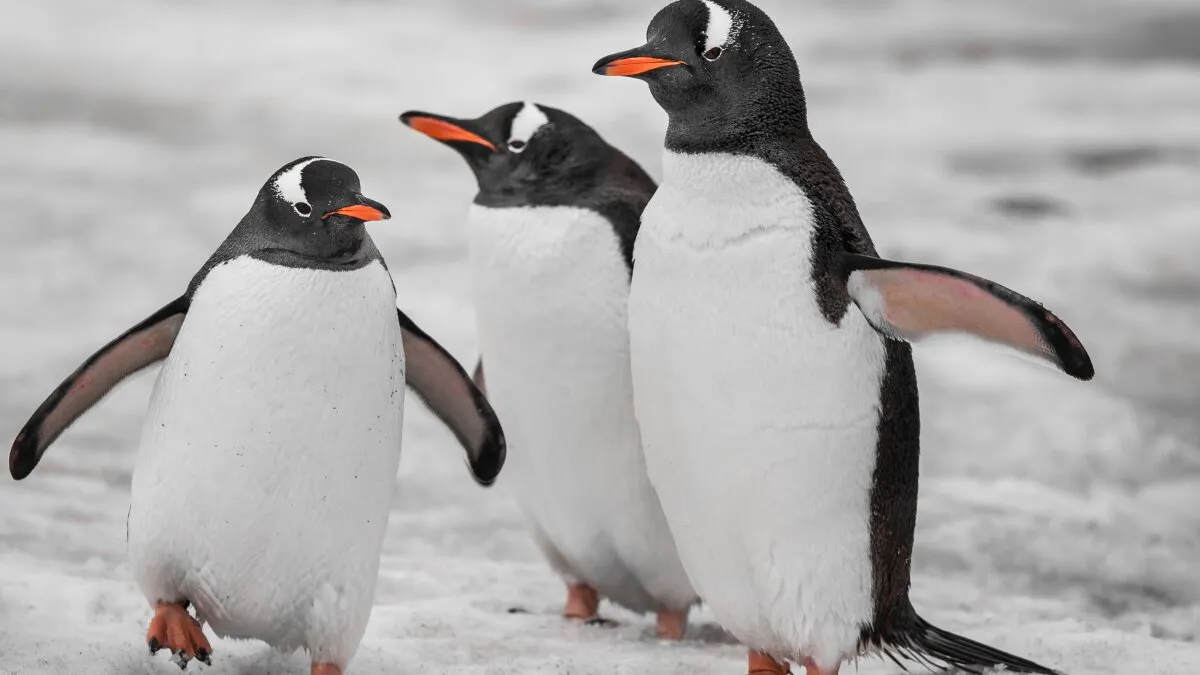
Penguins are masters of staying comfortable, whether it's scorching hot or freezing cold. Now, scientists have created a new material inspired by these birds. This material can automatically switch between heating and cooling modes.
It can also block or let through microwaves, depending on the temperature. Plus, it repels ice and water.
A Material That Adapts
Researchers from Harbin Institute of Technology, Henan Normal University, and Suzhou Laboratory developed this new material. Our world has big temperature swings between seasons. Most materials are good at either heating or cooling, but not both. A surface that keeps a building cool in summer might waste heat in winter.
We're a new kind of news feed.
Regular news is designed to drain you. We're a non-profit built to restore you. Every story we publish is scored for impact, progress, and hope.
Start Your News DetoxModern technology adds another layer of complexity. We have many devices that use electromagnetic waves, like antennas and radar. Cooling materials often reflect sunlight and avoid absorbing energy. But microwave shielding materials usually need to be electrically conductive, which can make them absorb more heat.
Combining these features without losing effectiveness has been very hard. Until now, a material that could switch between heating and cooling while also changing how it handles microwaves seemed like science fiction.
How the "Janus" Film Works
The researchers created a "Janus" film, named after a two-faced Roman god. This film uses a special compound called vanadium dioxide (VO₂). VO₂ is unique because it changes dramatically with temperature.
At low temperatures, VO₂ acts like an insulator. But when it heats up to about 68 °C (154 °F), it suddenly becomes much more conductive, like a metal. This change is huge, making its electrical resistance drop by about 10,000 times. This allows the film to control microwaves.
The scientists put VO₂ into tiny fibers within a flexible polymer layer. One side of the film is designed for heating. It absorbs about 94.5% of sunlight, making it warm up quickly.
In lab tests, this side reached about 73 °C (163 °F), which was 52 °C hotter than the surrounding air. In outdoor tests, it got even hotter, reaching about 87 °C (188 °F). As the VO₂ heats up and becomes conductive, the tiny fibers create pathways that change how the film interacts with microwaves.
At room temperature, microwaves mostly pass through the film. But once heated, the material switches modes. It then strongly absorbs and reflects microwaves. The researchers showed this works across a wide range of frequencies, from 8.2 to 40 GHz, which covers many radar and communication bands.
For example, in the X-band, used for radar and satellites, microwave transmission dropped from 83.6% to just 0.06% after heating. This means it became very effective at blocking electromagnetic interference. To show this, they demonstrated a Bluetooth connection that worked at low temperatures but cut off when the material was heated.
The Cooling Side and Penguin Inspiration
The other side of the film is designed for cooling. This layer uses silica particles and a porous structure to reflect sunlight. It also releases heat very efficiently in the mid-infrared spectrum, allowing heat to escape into the sky.
This cooling side reflects over 90% of sunlight and emits heat very well. In outdoor tests, it kept temperatures about 4–12 °C below the surrounding air. So, the same sheet can act as a solar heater on one side and a cooling system on the other.
The idea for this material came from penguins. These birds manage heat using layers, special insulation, waterproofing, and adapting to their environment. They are natural experts in thermal management. The new film also has another penguin-like quality: it resists water.
Both sides of the material are superhydrophobic. This means water beads up and rolls off, keeping the surface clean. This also gives the film anti-icing and de-icing abilities.
During tests, freezing was delayed by up to 812 seconds. Even in weak sunlight and temperatures around -6 °C (21 °F), ice melted within about 17.4 minutes.
Future Possibilities
Many materials exist for thermal management, microwave shielding, cooling, and anti-icing. But this new project is exciting because it combines all these features into one adaptive material. It does this without needing motors, complex mechanics, or electronics.
This material could be used in many ways. Buildings could use one side of the film to absorb solar heat in winter and then switch to the other side in summer to reduce cooling needs. The researchers estimate this could save about 11 kWh of energy per square meter each year.
Vehicles and aircraft could have adaptive skins that control both temperature and electromagnetic signals. Outdoor electronics could allow wireless communication sometimes and block interference at other times.
While the researchers didn't say it's for stealth, a material that can change its microwave behavior has clear military and aerospace uses.
Currently, this project is still in the lab. The team plans to test its durability outdoors, improve how it's made on a large scale, and optimize it for real-world use.
The study was published in the journal Advanced Functional Materials.
Deep Dive & References: Vanadium Dioxide X-band Study in Advanced Functional Materials - Advanced Functional Materials, 2023