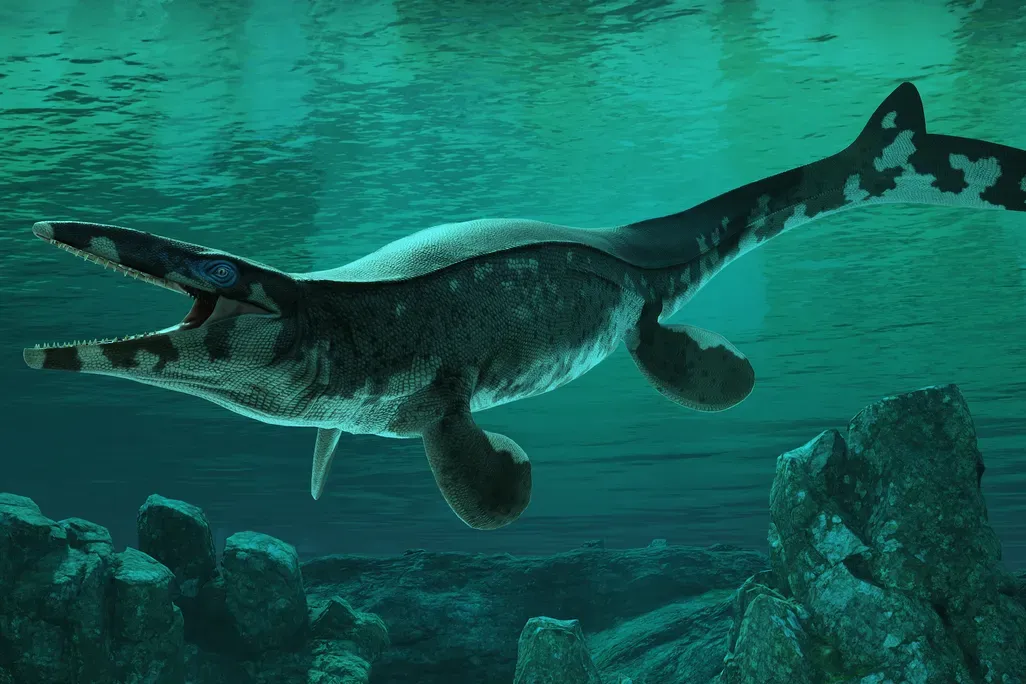
Imagine being 380 million years old, perfectly preserved, and holding the secret to one of life's greatest leaps: how animals crawled out of the water and onto land. That's the resume of Koharalepis jarviki, an ancient Antarctic fish whose skull just spilled its guts (metaphorically speaking, of course) thanks to some seriously high-tech scans.
Turns out, this ancient predator was basically an aquatic trailblazer, rocking features that hint at humanity's very first baby steps on terra firma.
The Devonian's Deepest Secrets, Revealed
Researchers at Flinders University peered inside the only known fossil of Koharalepis jarviki, a large, meter-long fish from the Devonian Period — a.k.a. the "Age of Fishes." Found in Antarctica's Lashly Mountains, this specimen is so rare, it's like finding a unicorn that also happens to be a living fossil. And it's been keeping its secrets locked away for millions of years.
We're a new kind of news feed.
Regular news is designed to drain you. We're a non-profit built to restore you. Every story we publish is scored for impact, progress, and hope.
Start Your News DetoxUsing advanced neutron imaging (which basically means they zapped it with neutrons instead of X-rays, because apparently that's where we are now), scientists could see the internal structures of its skull without so much as a scratch. What they found was a fish perfectly adapted for life near the water's surface.
Think skull openings for gulping air (because who needs gills when you can just breathe?), and a light-sensitive organ that helped it keep track of day and night. Which, if you think about it, is both impressive and slightly terrifying for a fish that old.
Dr. Alice Clement, a coauthor, noted that this "precious fossil" belongs to a group called the Canowindridae, highlighting the ancient geological links between Australia and Antarctica. Because, yes, these fish roamed across what was once East Gondwana, long before continents decided to go their separate ways.
Brains of a Land-Walker, Senses of a Hunter
Lead author Corinne Mensforth explained that Koharalepis is the only fossil in its entire family to preserve these internal skull bones, offering a VIP pass into its braincase and nerve structure. The scans showed a brain remarkably similar to those fish that made the water-to-land transition. It was like finding the instruction manual for walking, written in fish.
These surface-dwelling adaptations, like the air-gulping skull openings and the light-detecting brain organ, were crucial for surviving in shallow waters where oxygen could be scarce. Basically, Koharalepis was innovating long before Silicon Valley was even a geological twinkle.
And how did this meter-long ambush predator hunt with its relatively small eyes? Mensforth suggests it relied heavily on its other senses. So, not just a pioneer in evolution, but also a master of sensory perception. Let that satisfying number sink in: about 385 million years ago, fish started leaving the water. Koharalepis is a key part of that story.
Modern imaging, as Emeritus Professor John Long (who first described Koharalepis in 1992) pointed out, is what allowed them to unlock these ancient behavioral and adaptive secrets without harming the fossil. It's a testament to how far we've come, and a reminder of how much we still have to learn from the original inhabitants of Earth.
This fish isn't just a fossil; it's a missing link, a biological Rosetta Stone, and a testament to the sheer, stubborn audacity of life to just keep evolving. You might even say it's why you're reading this on land right now.